

Nepal Opens Restricted Areas to Solo Trekkers: The 2026 Breakthrough
For decades, Nepal’s most spectacular trekking destinations: the ancient kingdom of Upper Mustang, the sacred circuit of Manaslu, the wild frontier of Upper Dolpo, were locked behind a single bureaucratic rule: you needed a partner. The minimum two-person requirement for Restricted Area Permits (RAPs) effectively shut out solo adventurers who dreamed of these trails but couldn’t find a companion willing to match their schedule, their pace, or their ambition.
On March 22, 2026, Nepal’s Department of Immigration and the Trekking Agencies’ Association of Nepal (TAAN) jointly announced the abolition of that rule. Solo foreign trekkers may now apply for and receive Restricted Area Permits as individuals. This is the most significant shift in Nepal’s trekking policy in over two decades, and it opens the Himalayan frontier to a whole new category of traveller.
But freedom comes with structure. Alongside the solo permit breakthrough comes a firm reinforcement of Nepal’s mandatory licensed guide policy — and understanding how these two rules interact is essential before you book your flights. This guide walks you through everything, from permit fees to digital registration to the step-by-step process of getting legally onto the trail in 2026.
2026 KEY UPDATE — MARCH 22
As of March 22, 2026, the minimum two-person rule for Restricted Area Permits has been officially abolished. Solo foreign nationals may now apply for RAPs independently provided they are accompanied by a licensed guide hired through a TAAN-registered agency like Excellent Himalaya.

Table of Contents
- The 2026 New Rules: Complete Breakdown
- New Permit Fee Comparison
- Step-by-Step: How to Get Your 2026 Nepal Trekking Permit
- The Mandatory Guide Requirement: What You Need to Know
- Solo vs. Group Trekking in 2026: Which is Right for You?
- Restricted Area Deep Dive
- Frequently Asked Questions: 2026 Nepal Permit Rules
- Why Trust Excellent Himalaya with Your Permits?
- Ready to Plan Your Solo Himalayan Restricted Region Trek?
The 2026 New Rules: Complete Breakdown
Here is a precise summary of what has changed, what has been reinforced, and what remains the same as of the March 22, 2026 policy update.
What has changed since 2025
- Two-person minimum abolished — Solo foreigners can now obtain RAPs for Upper Mustang, Manaslu, Upper Dolpo, Nar Phu, Tsum Valley, and all other restricted areas without requiring a second trekker.
- Pre-Arrival ID processing — TAAN-registered agencies can now begin permit applications using your visa application number before you arrive in Nepal, dramatically reducing Kathmandu paperwork time.
- Guide licensing centralised — All guide licences must now be verified through the new Nepal Tourism Board (NTB) central database, accessible at checkpoints via the E-TIMS system.
- E-TIMS replaces paper TIMS cards — The new digital Tourism Information Management System integrates your trekking registration with real-time checkpoint data across all major trails.
What has not changed
- Independent trekking without a licensed guide remains strictly illegal in all National Parks and Restricted Areas.
- All foreign nationals still require ACAP for Annapurna and Mustang circuits.
- TIMS registration (now E-TIMS) is compulsory for all trekkers on all designated trekking routes.
- Children under 10 are exempt from most permit fees but still require registration.
COMMON MISCONCEPTION
The abolition of the two-person rule does NOT mean you can trek restricted areas without a guide. The mandatory licensed guide requirement has been enforced at checkpoints. Solo permit + no guide = permit confiscation and possible fines.
New Permit Fee Comparison
Fees below are current as of the March 2026 policy update. All USD figures are approximate based on Nepal Rastra Bank exchange rates. NPR amounts are official.
| Region | RAP Fee (Non-SAARC) | Basis | Peak Season | Key Notes |
| Upper Mustang | USD $50/day | Per Day | Mar–May, Sep–Nov | No minimum days |
| Manaslu Circuit | USD $100/week | Per week (peak) | Sep–Nov, Mar–May | $75/week off-peak. Also requires MCAP permit |
| Upper Dolpo | USD $500 | Per 10 days | May–Oct | Extension at $50/day. |
| Nar Phu Valley | USD 100/week | Per week (peak) | Mar–May, Oct–Nov | $75/week Off-peak. Often combined with Annapurna Circuit. |
| Tsum Valley | USD $40/week | Per week | Mar–May, Sep–Nov | $7/day after. $30/week Off-peak: |
| Kanchenjunga | USD $20/week | Per week | Mar–May, Oct–Nov | Nepal’s third-highest peak region. North & South circuits available. |
Step-by-Step: How to Get Your 2026 Nepal Trekking Permit
This is the exact process we walk every Excellent Himalaya client through, from initial booking to E-TIMS verification at the first checkpoint.
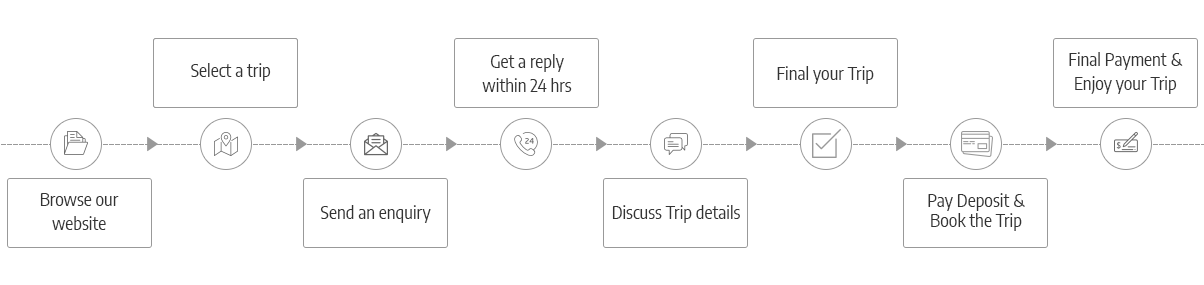
Step 1: Book through a TAAN-registered agency
This is the mandatory first step. Your guide must be licensed, and their licence must be attached to your permit application through an agency registered with TAAN. Hiring a guide from a hotel lobby or online freelance platform does not satisfy the 2026 requirement. Contact Excellent Himalaya at [email protected] to begin the process.
Step 2: Provide your visa application number (Pre-Arrival ID)
Under the new 2026 digital integration, your agency can initiate your E-TIMS registration and begin RAP applications using your Nepal visa application number — before you arrive in the country. Send passport details and your visa reference number at least 14 days before your flight. This eliminates the need for a Kathmandu permit day.
Step 3: E-TIMS digital registration confirmed
Once your application is submitted, you receive a digital confirmation with a unique trekker ID and QR code. This QR code is your primary identification at every checkpoint. We recommend saving it to your phone and printing a physical backup. Your guide’s licence number is embedded in the same QR, linking your identity to their authorisation in the national database.
Step 4: Permit wallet collection in Kathmandu
For trekkers who prefer physical documents — or whose permit type requires an original stamp (Upper Mustang and Upper Dolpo RAPs still require a physical permit booklet) — our Thamel office prepares a complete permit wallet. This includes all original permits, copies, a checkpoint log sheet, and an emergency contact card. Collection takes under 30 minutes.
Step 5: Checkpoint verification via E-TIMS
At every designated checkpoint, officials will scan your QR code against the E-TIMS database. Your guide’s licence, permit validity, declared itinerary, and entry date are all verified in real time. If there is any discrepancy — wrong dates, unregistered guide, missing permit — you will be stopped. Our clients’ records are always clean.
Step 6: Itinerary changes and permit extensions
Weather delays, acclimatisation needs, and irresistible side valleys are realities of Himalayan trekking. If your itinerary changes and you need to extend a permit, contact our office via WhatsApp or satellite communicator and we will process the extension remotely. Extension requests must be submitted at least 48 hours before the current permit expires.
The Mandatory Guide Requirement: What You Need to Know
The mandatory guide policy is not new — but 2026 marks a significant tightening in enforcement. The E-TIMS system has effectively ended the era of ‘hire a guide on paper, trek alone in practice.’ Checkpoints now verify your guide’s real-time location against your trekking registration.
- A licensed guide must be physically present with the trekking group at all times in National Parks and Restricted Areas.
- Guides must hold a current Nepal Government Tourism Ministry trekking guide licence, verified in the E-TIMS database.
- The guide must be hired through a TAAN-registered agency — not independently through social media or informal arrangements.
- The maximum guide-to-trekker ratio is 1:7. One licensed guide may accompany a maximum of seven trekkers. Groups larger than seven require an additional licensed guide.
STRICT ENFORCEMENT — 2026
In 2026, unguided trekking in restricted areas and national parks carries a fine of NPR 10,000–50,000 (approx. USD 75–375) and permit confiscation. Repeat violations result in a Nepal entry ban. This is not a fee you can pay and continue. Do not risk your trek — and someone else’s job — by trying to circumvent the guide requirement.
What your guide actually provides
Beyond the legal requirement, a genuinely qualified guide transforms what you experience on the trail. Our Excellent Himalaya guides are trained emergency responders, cultural interpreters, logistics coordinators, and in many cases, lifelong residents of the regions they lead you through. When you trek Upper Mustang with our guide Karma Gurung, you are walking with someone whose family has lived in Lo Manthang for generations. That context cannot be downloaded.
Solo vs. Group Trekking in 2026: Which is Right for You?
The March 2026 policy change creates a genuine choice where previously only one option existed. Here is how to think through the decision:
Solo trekking with a private guide is now the premium option for restricted areas. You set your own pace. You spend nights in villages the group itinerary skips. Your guide’s full attention is on your safety and your experience. The trade-off is cost — private guide fees (USD 30–50/day for a licensed restricted-area guide) add up quickly. But for experienced trekkers who want something different, this is transformative.
Group trekking remains the most economical and socially rich option. Shared guide costs, communal energy on hard days, and the camaraderie of a summit camp are real benefits. Groups can still access all restricted areas — the change simply means they no longer need to drag a second reluctant trekker into the mountains to hit the minimum.
Restricted Area Deep Dive
- Manaslu Circuit — Nepal’s Finest Off-Track Classic
Permit: $100/week peak season · Solo trekking in Manaslu now accessible
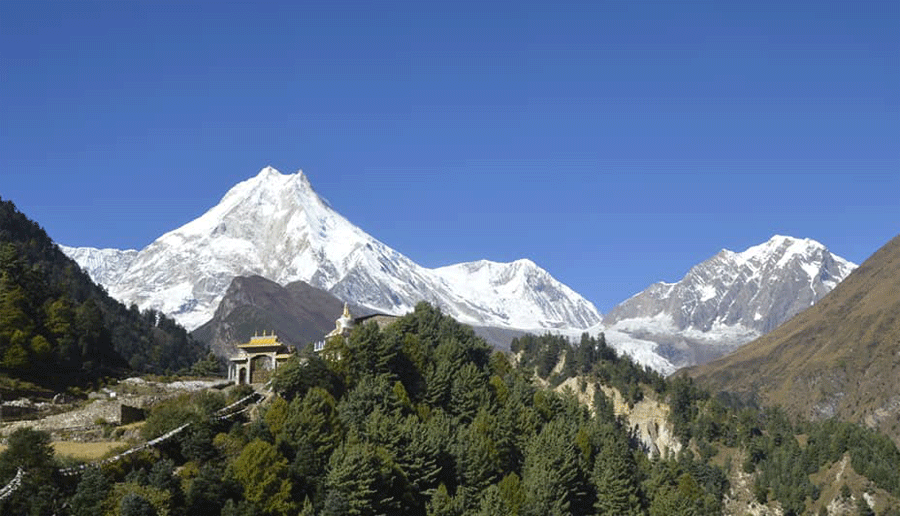
Manaslu is Nepal’s most compelling alternative to the Annapurna Circuit. Circumnavigating the world’s eighth-highest peak, this 14–17 day route crosses the 5,160m Larkya La pass and winds through Gurung and Tibetan-influenced villages where teahouse hospitality has not yet been smoothed into tourist infrastructure. The mandatory guide requirement and RAP fee structure under Nepal trekking rules 2026 have maintained a trekker quality-to-crowd ratio that makes the Manaslu valley feel like a genuine mountain encounter. Solo trekking in Manaslu, now accessible under the 2026 solo permit reform, is one of the great new openings in Himalayan adventure travel.
- Upper Mustang — The Last Forbidden Kingdom
Permit: $50/day · Min. 10 days · Solo trekkers now welcome with licensed guide
A rain-shadow desert kingdom north of the Annapurnas, Upper Mustang remained closed to foreigners until 1992 and retains a Tibetan cultural identity found nowhere else in Nepal. Walled cave cities, 15th-century monasteries with original frescoes, and plateau landscapes that evoke the high Tibetan borderlands define every stage of this route. The $50/day restricted area permit fee actively limits visitor numbers — walk two days from Lo Manthang and you may not encounter another trekker. Solo trekking in Mustang is now possible under 2026 rules for the first time, provided you are accompanied by a mandatory trekking guide Nepal-licensed and listed on your E-TIMS permit.
- Upper Dolpo — Crystal Mountain Country
Permit: $50/day · Remote · Serious altitude experience required
Immortalised by Peter Matthiessen’s The Snow Leopard, Upper Dolpo sits at over 4,000 metres and shares a cultural and geographic DNA with Tibet. Shey Gompa, the ancient crystal mountain circumambulation, and Phoksundo Lake — Nepal’s deepest, at a staggering 145 metres — define a trek that demands serious altitude experience, genuine wilderness tolerance, and the logistical expertise that restricted area permit rules were specifically designed to ensure trekkers bring with them. Lower Dolpo shares the same ancient Bon Buddhist communities but with a less demanding altitude profile — an excellent stepping stone.

Frequently Asked Questions: 2026 Nepal Permit Rules
Q. Can I trek Manaslu alone in 2026?
A. Yes and this is new for 2026. The abolition of the two-person minimum means a solo foreign trekker can now obtain a Manaslu Restricted Area Permit as an individual. However, ‘alone’ means without a second trekker, not without a guide. You will still be required to trek with a licensed guide hired through a TAAN-registered agency. The permit cost remains USD 100 per week during peak season (September–November) and USD 75 per week off-season.
Q. What is the 1:6 guide-to-trekker ratio, and how does it affect my group?
A. Nepal’s 2026 regulations specify that a single licensed guide may accompany a maximum of six trekkers simultaneously. For groups of seven or more, a second licensed guide must be engaged. For solo trekkers, the ratio effectively means a dedicated 1:1 guide arrangement. Note that porters — who may accompany any group size — do not count toward the guide ratio. Porters carry your gear; guides hold the legal authorisation.
Q. What is E-TIMS and do I need to set it up myself?
A. E-TIMS (Electronic Tourism Information Management System) is Nepal’s new digital trekker registration platform, replacing the old paper TIMS card system. It links your permit data, guide licence, itinerary, and checkpoint log into a single QR-code-based record. As a trekker, you do not need to navigate the E-TIMS portal yourself — your TAAN-registered agency handles the registration on your behalf.
Q. Can I get my permits on arrival in Kathmandu, or must I apply in advance?
A. For non-restricted-area treks (Everest Base Camp, Annapurna Circuit, Langtang, etc.), same-day or next-day permit processing in Kathmandu is possible. For Restricted Area Permits — Upper Mustang, Manaslu, Upper Dolpo, Nar Phu — allow a minimum of 3–5 business days in Kathmandu, or use our Pre-Arrival ID service to initiate processing before you land.
Q. Are permits refundable if I have to cancel or cut my trek short?
A. ACAP and TIMS permits are non-refundable once issued. Restricted Area Permits are partially refundable under specific circumstances — unused days on a RAP (minimum of 5 unused days) can be refunded at the issuing authority, minus a processing fee, provided the request is made within 30 days of the permit’s issue date.
Q. What is the difference between ACAP, TIMS, and a Restricted Area Permit?
A. These are three distinct permit types that often overlap on the same trek. ACAP is required for any trek within the Annapurna and Mustang conservation zones. TIMS (now E-TIMS) is a universal trekker registration that applies to virtually all designated routes. A Restricted Area Permit is an additional authorisation required for designated sensitive border zones such as Upper Mustang, Upper Dolpo, and Manaslu. Most restricted area treks require all three simultaneously.
Q. Do I need a permit for the Everest Base Camp trek in 2026?
A. Yes. The Everest Base Camp trek requires a Sagarmatha National Park entry permit (NPR 3,000) and an E-TIMS registration (NPR 2,000). Khumbu Pasang Lhamu Rural Municipality also charges a local fee (NPR 2,000). A licensed guide is mandatory under the 2026 regulations. The EBC route is not a Restricted Area, so you do not need an RAP — but the mandatory guide requirement applies because the entire route falls within a National Park.
Q. Can I really trek solo in Upper Mustang under 2026 rules?
Yes, but “solo” means trekking without a group, not without a guide. The March 2026 reform allows individual trekkers to obtain Restricted Area Permits, provided they are accompanied by a licensed guide and the booking is made through a registered agency. You cannot obtain a RAP independently and trek alone.
Q. Can I apply for a restricted area permit from my home country?
A. Yes. Using the new Pre-Arrival ID system via E-TIMS, Excellent Himalaya can initiate your permit application using your visa Application Submission ID before you depart for Nepal. The permit fee is paid online and your permit ID is generated electronically. This means you can arrive in Kathmandu with your paperwork already processed which save 2–4 working days that you’d otherwise spend in the capital waiting.
Q. What insurance is required?
A. Helicopter medical evacuation insurance valid above 4,000m is legally mandatory for all restricted area trekkers under 2026 regulations. Your policy must explicitly state evacuation coverage — generic travel insurance that does not mention helicopter rescue is rejected at the DoI permit desk. Purchase this before you submit your application, not after. Excellent Himalaya can advise on accepted policies and verify your coverage before submission.
Q. What happens if I trek without a permit or beyond my permitted zone?
A. Trekking in a restricted area without a valid permit results in immediate fines and deportation. Trekking beyond the specific geographic zone stated in your permit triggers permit cancellation and potential entry blacklisting from Nepal. Checkpoint officers cross-reference your permit zone against the E-TIMS database at multiple points along every restricted route — there are no practical workarounds under the new digital system.
Q. Do these rules apply to Everest Base Camp and Annapurna Circuit?
A. These routes are not restricted areas, so RAP fees do not apply. However, the mandatory guide policy and E-TIMS registration apply to all National Park treks. You will still need a TIMS card, the relevant Conservation Area or National Park entry permit, and a licensed guide for all treks within park boundaries.
Why Trust Excellent Himalaya with Your Permits?
Excellent Himalaya Trek and Expedition, the Kathmandu based local trekking company, has navigated every policy evolution Nepal’s permit system has seen in the past two decades. We are a government-registered, TAAN-affiliated agency with deep institutional relationships at the Department of Immigration. When rules change overnight, we don’t scramble to catch up — we already know what’s happening, because we’re at the table. Our licensed guides are not gig workers assigned from a pool: they are our long-term team members with years of high-altitude experience and first-aid certification. When you entrust your Restricted Area Permit to us, you’re placing it with a team that treats your itinerary as seriously as we treat our own.
These new regulations exist for three reasons we deeply believe in: the safety of every trekker in the high Himalayas, the protection of UNESCO-listed cultural heritage in regions like Upper Mustang, and the long-term preservation of fragile mountain ecosystems. After 20 years guiding in these mountains, we have seen firsthand how the right regulations save lives and protect irreplaceable landscapes. Our guides are all Nepal Tourism Board government-licensed and TAAN (Trekking Agencies’ Association of Nepal)-registered. When you trek with us, you are fully compliant, fully insured, and in the most experienced hands available.
Ready to Plan Your Solo Himalayan Restricted Region Trek?
The rules have changed. The paperwork hasn’t gotten simpler. Let Excellent Himalaya handle every permit, every document, and every checkpoint briefing — so you can focus entirely on the mountains.
Free 2026 permit consultation · No obligation · Response within 24 hours
✉ Contact us: [email protected]
Excellent Himalaya Trek & Expedition · Thamel, Kathmandu · Government-registered Trekking Agency· TAAN member
About the Author

Suman Shrestha
I am Suman Shrestha. I have dedicated my life to mastering the rhythms of the Nepal Himalayas and its culture. I am also a fully government-licensed trekking and tour guide. I've personally led hundreds of adventure groups across our country's most diverse and demanding landscapes and guided countless tour groups across every special interest imaginable. I know the ground reality of every ridge, every sacred monument, and every remote teahouse along the way, because I've earned that knowledge step by step, not from a brochure. My deep technical knowledge of Nepal’s diverse geography is matched only by my uncompromising commitment to safety. Beyond the physical path, I take a pride in being a bridge for all people by sharing the knowledge of the Himalayas, rich traditions and spiritual heritage of Nepal ensuring every journey is an authentic Experience. Let’s explore the heart of the Himalayas together. You can connect with me via WhatsApp at +9779851203181.