


Everest Mountain Flight from Kathmandu: Cost, Airlines & Booking Guide (2026)
Updated [July 23rd, 2026]. Written and reviewed by Suman Shrestha.
Nepal is home to eight of the world’s fourteen 8,000-meter peaks, and Mount Everest (8,848.86 m), the highest point on Earth, sits at the heart of the Mahalangur Himal range northeast of Kathmandu. Most travelers reach it on foot over 8-14 days of trekking. The Everest Mountain Flight is the alternative: a single early-morning turboprop flight that takes off from Kathmandu, tracks the Himalayan wall past Everest, and lands back in Kathmandu before breakfast.
This guide breaks down exactly what the flight costs in 2026, who operates it, what you actually see (and don’t), how to avoid overpaying an agent, and what to do if the weather doesn’t cooperate. It’s written and maintained by a Kathmandu-based, government-registered trekking company that has coordinated this flight for clients across two decades of Himalayan operations, so the pricing and logistics reflect current on-the-ground practice rather than recycled brochure copy.
| QUICK ANSWER
Excellent Himalaya Trek’s Everest Mountain Flight from Kathmandu costs USD 280 per person (standard fare) for foreign nationals, discounted to USD 240 per person for advance or group bookings. Nepali and Indian citizens pay NPR 18,600 per person (standard fare), discounted to NPR 17,500 per person. It is a 50-60 minute scenic flight departing early morning (6:00-7:30 AM) from Tribhuvan International Airport, flying past Mount Everest and 15+ other Himalayan peaks with a guaranteed window seat, before landing back in Kathmandu the same morning. Fares verified July 21, 2026. |

What Is the Everest Mountain Flight?
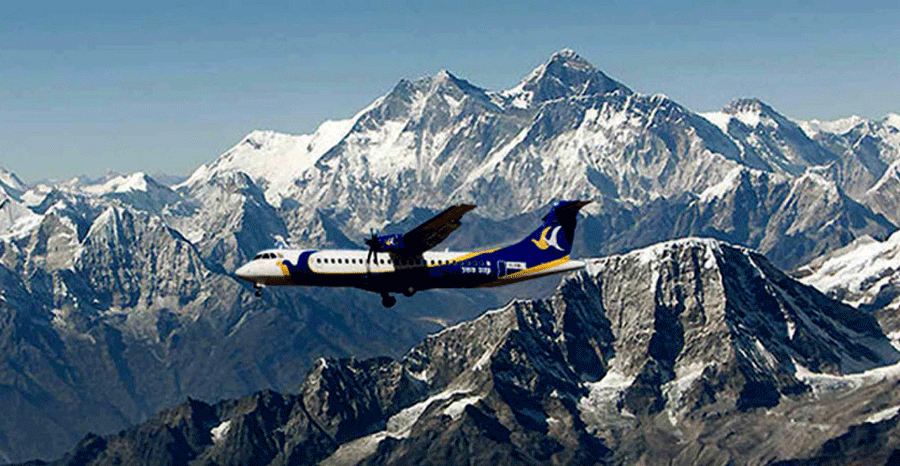
The Everest Mountain Flight — also called the Mountain Flight or the Everest Experience Flight — is a fixed-wing scenic sightseeing flight operated on small twin-engine turboprop aircraft (ATR 42, ATR 72, and similar) by Nepal’s domestic airlines. It departs from the domestic terminal of Tribhuvan International Airport (TIA) in Kathmandu, flies east parallel to the Himalayan range for roughly 50-60 minutes, and returns to the same runway. No overnight stay, no permit, and no physical exertion is required.
Locally, Nepalis simply call it the ‘Mountain Flight.’ It is distinct from the Everest Base Camp Helicopter Tour, which lands at Everest Base Camp or Kala Patthar and costs substantially more — see the comparison later in this guide if you’re deciding between the two.
Everest Mountain Flight Cost in 2026 (Verified July 23rd, 2026)
Fares are quoted in three currencies depending on nationality and change modestly by airline, season, and whether you book direct or through an agent. The table below reflects Excellent Himalaya Trek’s current published fare, verified in July 2026.
Excellent Himalaya Trek & Expedition — Everest Mountain Flight Fare (as of July 23, 2026)
| Nationality | Standard Fare | Discounted Fare |
| Foreign nationals | USD 280 per person | USD 240 per person |
| Nepali citizens | NPR 18,600 per person | NPR 17,500 per person |
| Indian citizens | NPR 18,600 per person | NPR 17,500 per person |
- Rates include airport tax. Discounted fares apply to bookings made 30+ days in advance or groups of 4 or more; contact us to confirm current group pricing.
- Indian citizens must present a valid Indian passport (a voter ID card is not accepted for this fare) at check-in.
- Fares are reviewed monthly. This table was last checked against airline counters on July 23, 2026 — if you’re reading this later, WhatsApp +977 9851203181 to confirm today’s rate before booking.
A note on ‘cheap fare’ claims: no operator in Kathmandu can guarantee a fixed ‘today only’ discount, because seat inventory and fuel surcharges shift week to week. Treat any price under roughly USD 195 for a foreign national with caution — it usually means a shared/standby seat, a different (longer) route, or a bait price that gets revised at check-in.

Airlines Operating the Everest Mountain Flight
Three Nepali carriers currently operate the Everest Mountain Flight from Kathmandu. Here’s a short overview of each.
Buddha Air
Nepal’s largest domestic airline, established in 1997. Operates the Everest Mountain Flight on ATR 72-500 and ATR 42-320 turboprop aircraft with the most frequent daily morning departures of the three operators, and an established process for rebooking passengers if a flight is weathered out.
Yeti Airlines
A long-established Nepali carrier operating ATR 72 and ATR 42 family aircraft on this route, with multiple daily morning slots. Offers an in-flight experience to Buddha Air with guaranteed window seats, peak commentary, and a completion certificate.
Shree Airlines
A Nepali operator running fewer daily departures on this route with a turboprop fleet. Known for flexible, personalized service and last-minute date changes, though rebooking can take longer during multi-day weather disruptions in peak season.
Everest Mountain Flight: Minute-by-Minute Itinerary
5:00-5:30 AM — Arrive at Tribhuvan International Airport, Domestic Terminal — by your own taxi/hotel transport, or via a private airport transfer arranged with us in advance for an extra cost. Drive time is roughly 20-30 minutes from most central Kathmandu/Thamel hotels.
5:30-6:00 AM — Check-in at the airline counter; you’ll receive a boarding pass and a printed peak-identification map.
6:00-6:30 AM — Security screening and boarding gate wait. Airline staff confirm real-time weather clearance from the tower before boarding is called — this is the step where delays or cancellations are decided.
6:15-7:30 AM (typical departure) — Takeoff from Kathmandu. The aircraft climbs northeast toward the Himalayan wall. Because flights are booked at roughly half capacity, every seat is a window seat, and passengers may swap sides mid-flight to see both the near ridgeline and the distant peaks.
In flight (~50-60 min) — The aircraft tracks the Himalayan range, passing Langtang Lirung, Gauri Shankar, and on to Everest, Lhotse, Makalu and the eastern peaks before turning back. Cabin crew announces each peak by name; the cockpit door is opened for one passenger at a time on many flights so you can see forward through the flight deck.
~7:15-8:30 AM (typical landing) — Landing back at Kathmandu’s domestic terminal. You’ll receive a printed flight-completion certificate at the gate or counter.
After landing — Make your own way back to your hotel, usually in time for breakfast, or use your pre-arranged return transfer if you booked one. Total door-to-door time runs about 2-2.5 hours excluding transfers, or 2.5-3 hours if you’ve added transfers on both ends.

Mountains You Will See on the Everest Mountain Flight
On a clear morning, the flight passes 15-16 named 7,000m+ and 8,000m+ peaks along the Nepal-Tibet border. Visible order (roughly west to east) is approximately:
| Peak | Height | Note |
| Langtang Lirung | 7,234 m | First major peak after takeoff, closest to Kathmandu |
| Gauri Shankar | 7,134 m | Considered sacred in both Hindu and Buddhist tradition |
| Mt. Ganesh | 7,429 m | Named for the elephant-headed deity |
| Shishapangma | 8,013 m | The only 8,000m peak located entirely within Tibet |
| Gyachung Kang | 7,952 m | Highest peak below 8,000 m in the world |
| Cho Oyu | 8,201 m | Sixth-highest mountain on Earth |
| Pumori | 7,161 m | Sits just west of Everest Base Camp |
| Nuptse | 7,855 m | Immediate neighbor of Everest, often blocks ground-level EBC views |
| Mount Everest / Sagarmatha | 8,848.86 m | The world’s highest point, main highlight of the flight |
| Lhotse | 8,516 m | Fourth-highest mountain on Earth, connected to Everest by the South Col |
| Ama Dablam | 6,812 m | One of the most photographed peaks in the Khumbu for its dramatic shape |
| Chamlang | 7,319 m | Marks roughly the turnaround point of the flight |
| Makalu | 8,463 m | Fifth-highest mountain on Earth |
| Kanchenjunga | 8,586 m | Third-highest mountain on Earth, on the Nepal-Sikkim border |
Reality Check
Reality check: you’re viewing Everest from roughly 15-25 km away and around 6,000-7,000 m of altitude in the aircraft, not standing next to it. It reads as a large, clearly identifiable summit above the surrounding ridgeline — genuinely striking — but it is not the close-up, fill-the-frame photo some marketing images suggest. If you want to be physically at the mountain’s foot, that requires the Everest Base Camp trek or an Everest Base Camp helicopter landing tour, both of which cost considerably more.
Best Time of Year to Fly
| Period | Visibility | Notes |
| September – November (autumn) | Best | Post-monsoon clear skies, the most reliable window all year; also the busiest, so book 3-5 days ahead |
| December – February (winter) | Very good, cold mornings | Sharp visibility, snow-covered peaks, occasional early-morning fog delays takeoff by 30-60 minutes |
| March – April (spring) | Good | Some haze/dust builds up by late spring; still generally reliable |
| May – early June (pre-monsoon) | Variable | Afternoon cloud buildup starts earlier in the day; morning flights still usually go |
| Mid-June – August (monsoon) | Poor | Frequent cancellations and reschedules; if you must fly in this window, hold flexible dates |
The rule that matters most: only morning flights are worth booking. Cloud builds over the Himalaya through the day, so there is effectively no reliable afternoon departure for this route regardless of season.
How to Book the Cheapest Fare Without Overpaying
- Compare same-day quotes from at least two sources — a direct airline counter/website quote and one local agency quote — before paying. Fares for this specific flight are not centrally published as international tickets are, so quoted prices genuinely vary depending on who you ask.
- Book 3-7 days ahead in October-November; this is peak demand, and seats do sell out on the earliest, most reliable morning slots.
- Airport transfer is not included in the flight fare by default — it’s available on request as a paid add-on. If a quote you’re comparing includes free transfer, check whether that cost has been folded into a higher flight price rather than genuinely waived.
- If a quote is dramatically below the USD 200-280 range for a foreign national, ask what airline and aircraft it’s on before paying; it may be a shared seat on a lower-capacity aircraft with a materially shorter route.
- Confirm the cancellation/rebooking policy in writing (WhatsApp or email) before paying in full, particularly if you’re flying in the monsoon window.

What to Bring, Accessibility & Practical Notes
- Documents: passport (or Indian passport for the Indian-citizen fare) for airport check-in; a printed or mobile copy of your booking confirmation.
- Camera/phone: a small mirrorless or phone camera works better than a large DSLR with lens hood in the tight cabin; window glare is common, so a lens cloth helps more than a polarizing filter.
- Clothing: light layers — the aircraft cabin is heated, but early-morning airport waits before sunrise can be cold, especially October-February.
- Children and elderly travelers: the flight is widely used by families and older travelers since there is no walking, altitude exposure, or physical exertion involved; the main consideration is the early 5:00-5:30 AM airport arrival time.
- Baggage: this is a same-day round trip with no overnight stay, so airlines typically only require a small day bag; check with your airline if you’re combining it with an onward domestic flight the same day.
- Motion sensitivity: light turbulence is possible over ridgelines; if you’re prone to motion sickness, request a seat over the wing (more stable) rather than the front or rear of the cabin.
Weather, Cancellation & Refund Policy
All three operators apply the same basic rule: the flight only departs if the tower confirms usable visibility toward the Himalayan range that morning. This decision is made shortly before boarding, not the night before, which is why departure windows are given as a range (e.g., 6:15-7:30 AM) rather than a fixed time.
If your flight is delayed: you wait at the airport or are asked to return for a later same-day slot.
If your flight is cancelled for weather: standard practice across Buddha Air, Yeti Airlines, and Shree Airlines is to rebook you on the next available morning departure at no extra cost, or issue a full refund if rebooking isn’t possible within your travel dates. Get this commitment in writing from whoever you book with — airline counter policy and a third-party agent’s cancellation policy are not always identical, and you want your agent’s promise to match the airline’s.
What’s Included
Included
- Airport tax
- Guaranteed window seat
- In-flight peak commentary from cabin crew
- Flight-completion certificate
- Cockpit visit, one passenger at a time, on most (not guaranteed on all) flights
Not Included
- Airport transfer — available on request at an extra cost; not bundled into the flight fare by default
- Personal travel insurance
- Meals (this is a ~1-hour flight; no meal service is provided)
- Tips for driver/ground staff
Everest Mountain Flight vs. Everest Base Camp Helicopter Tour
| Mountain Flight | EBC Helicopter Tour | |
| Aircraft | Fixed-wing turboprop (ATR 42/72) | Helicopter (small group or private) |
| Duration | 50-60 minutes, no landing | 3-5 hours, includes a ground landing near Everest Base Camp / Kala Patthar |
| Typical cost (foreign national) | USD 200-280 | USD 1,000-1,600+ per person (shared), more for private charter |
| Closest approach to Everest | ~15-25 km, viewed from cruising altitude | Landing within the Khumbu, direct ground-level views of Everest and Ama Dablam |
| Best for | Short-stay visitors, families, budget-conscious travelers, anyone who wants Everest views without a large spend | Travelers who want to physically stand near Everest without trekking, and have a larger budget |

Frequently Asked Questions: Everest Mountain Flight
What is the Everest Mountain Flight?
It is a 50-60 minute scenic sightseeing flight departing early morning from Kathmandu that flies past Mount Everest and 15+ other Himalayan peaks without landing, before returning to Kathmandu the same morning.
How much does the Everest Mountain Flight cost in 2026?
With Excellent Himalaya Trek, the standard fare is USD 280 per person for foreign nationals and NPR 18,600 per person for Nepali and Indian citizens; a discounted fare of USD 240 (foreign nationals) or NPR 17,500 (Nepali and Indian citizens) applies to advance or group bookings. Market-wide, foreign-national fares across all three airlines range roughly USD 200-280. Prices are verified as of July 21, 2026 and vary by airline and season.
How long does the Everest Mountain Flight take?
The in-air flight time is 50-60 minutes. Including airport check-in and security, plan for roughly 2-2.5 hours at the airport; add more if you’re arranging your own transport to and from the airport.
What time does the Everest Mountain Flight depart?
Departures run in the early morning, typically between 6:00 AM and 7:30 AM, for the clearest visibility before daytime clouds build over the Himalaya.
Which airlines operate the Everest Mountain Flight?
Buddha Air, Yeti Airlines, and Shree Airlines currently operate this route from Kathmandu, using ATR 42, ATR 72, and comparable twin-engine turboprop aircraft.
Do I really see Mount Everest up close?
You see Mount Everest clearly as the tallest identifiable summit on the horizon from roughly 15-25 km away at cruising altitude — a genuine, striking view, but not a close-up the way a ground landing at Everest Base Camp would be.
Is every passenger guaranteed a window seat?
Yes. Aircraft are booked at roughly half capacity specifically so every passenger gets a window seat, and passengers can often swap sides mid-flight to see both directions.
Can passengers visit the cockpit during the flight?
On most flights, passengers are invited one at a time to view the flight deck, though this isn’t formally guaranteed on every departure and depends on the crew and aircraft.
Is commentary provided during the flight?
Yes, cabin crew announce and explain each major peak as it comes into view.
Which mountains are visible on the flight?
Typically Langtang Lirung, Gauri Shankar, Mt. Ganesh, Shishapangma, Gyachung Kang, Cho Oyu, Pumori, Nuptse, Everest, Lhotse, Ama Dablam, Chamlang, Makalu, and Kanchenjunga, weather permitting.
What is the best time of year to fly?
September through November offers the most reliable clear-sky mornings, followed by December through April. Mid-June through August (monsoon) has frequent weather cancellations.
What happens if the weather is bad?
If visibility doesn’t clear, the flight is delayed to a later same-day slot or cancelled outright; airlines reschedule you to the next available morning at no extra charge.
Is there a refund if the flight is cancelled?
Yes — standard practice is a full refund or free rebooking if the flight can’t depart due to weather and no suitable alternative date works for your trip.
Do I get a certificate?
Yes, all three operators provide a printed flight-completion certificate after landing.
Is the Everest Mountain Flight suitable for children or elderly travelers?
Yes. Since there’s no walking or altitude exposure involved, it’s a popular option for families and older travelers who want Everest views without trekking.
Is the Everest Mountain Flight safe?
It is operated by licensed Nepali carriers under Civil Aviation Authority of Nepal (CAAN) oversight using standard twin-engine turboprop aircraft, with experienced pilots trained for Himalayan terrain; flights are grounded rather than flown in unsafe weather.
Do I need a passport for the flight?
Yes, a passport or valid photo ID is required for airport check-in and security. Indian citizens must specifically present an Indian passport (not a voter ID) to qualify for the Indian-citizen fare.
What’s the difference between the Everest Mountain Flight and the Everest Helicopter Tour?
The Mountain Flight is a fixed-wing flight past Everest with no landing, costing roughly USD 200-280. The Helicopter Tour lands near Everest Base Camp or Kala Patthar for ground-level views and typically costs USD 1,000 or more per person.
Which side of the plane has the better view, left or right?
Accounts vary: some travelers report the left side (facing north) gives a longer, wider view of the Himalayan range on the outbound leg, while the right side offers a closer view of Everest itself as the aircraft turns back. Since seats are half-empty, crew generally allow you to swap sides mid-flight rather than commit to one.
Can I book directly with the airline, or should I use an agent?
Both work. Booking through a local agency like ours includes same-day rebooking support if weather disrupts your flight; airport transfer is not bundled into either option by default but can be added on request for an extra cost.
Is airport transfer included in the Everest Mountain Flight price?
No. Airport transfer is not included in the standard flight fare. It’s available on request as a paid add-on — let us know when booking if you’d like a private pickup and drop-off arranged, and we’ll quote the extra cost separately.
What is the baggage allowance on the Everest Mountain Flight?
As a same-day round trip with no overnight stay, only a small day bag is expected; there’s no need for checked luggage unless you’re connecting to another domestic flight.
Is Everest visible year-round, including during monsoon?
Technically, flights operate year-round, but June-August visibility is unreliable due to monsoon cloud cover, and cancellations are common in that window.
How far in advance should I book?
3-7 days ahead is generally enough, except during the October-November peak season, when booking 5-7+ days ahead is safer.
What should I wear or bring for the flight?
Light layers for a cold pre-dawn airport wait, your passport/ID, a phone or compact camera, and a lens cloth for window glare.
Other Popular Activities in Nepal
If you’re weighing the Everest Mountain Flight against other short activities in Nepal, here’s current same-day pricing for comparison.
| Activity | For Nepali | For Indian | For Foreigner |
| Paragliding in Pokhara | NPR 8,500 | NPR 8,500 | NPR 8,500 |
| Bungee in Pokhara | NPR 7,500 | NPR 7,500 | NPR 7,500 |
| Ultralight Flight | NPR 17,600 | NPR 17,600 | USD 150 |
| Rafting in Pokhara | From NPR 6,000 | From NPR 6,000 | From USD 50 |
| Trishuli River Rafting | NPR 3,500 | NPR 4,000 | USD 35 |
| Hot Air Balloon in Pokhara | NPR 11,000 | USD 120 | USD 150 |
About the Author & This Guide
This guide is written and maintained by Suman Shrestha, founder and lead trekking guide of Excellent Himalaya Trek & Expedition, a government-registered trekking company (Reg. No. 175840/074/075, Tourism License No. 2432) based in Thamel, Kathmandu, and affiliated with TAAN, NMA, NTB, and HRA. Suman holds a Master’s degree in Tourism Management and has coordinated treks, tours, and mountain flights across the Everest, Annapurna, Manaslu, and Langtang regions since 2004/2005.
Pricing in this guide reflects fares checked directly with airline counters and agency contacts in Kathmandu as of July 23, 2026, cross-referenced against publicly available airline and travel-agency pricing. Where market data (competitor fares, aircraft specs) could not be independently verified with the airlines, it is presented as a range rather than a fixed claim, and testimonials or reviews are not fabricated or attributed to unnamed travelers on this page.
Ask our experts (Inquiry)
Why Travel with us?
- Run by local experts, guide & Sherpa.
- Focus on your needs.
- Good value for money.
- Real cared services.
- Government recognized company.
- Best reasonable rate.