


Khopra Danda vs. Ghorepani Poon Hill: Which Annapurna Trek is Better?
The Annapurna Conservation Area is the most visited trekking region in Nepal, drawing over 130,000 international trekkers annually. Within it, Ghorepani Poon Hill occupies legendary status — a name as recognizable in trekking circles as Everest Base Camp or the Inca Trail. But in 2026, that reputation comes with a cost: crowds that can shatter the mountain silence you came to find.
Enter Khopra Danda (also called Khopra Ridge) — a community-managed trail that runs parallel to the Poon Hill circuit but feels like a completely different planet. Higher in elevation, quieter by a factor of ten, and anchored by a lodge system that sends profits directly to local schools: Khopra is the Annapurna trek the guidebooks have been slow to document.
This guide is written by guides who have led over 50 combined expeditions on both circuits. We will not dress up either trek to sell you a package. We will give you the honest, ground-level comparison you need to choose the trail that matches your trekker personality.
QUICK VERDICT 2026/2027
Choose Poon Hill if you want comfort, iconic sunrise photos, and a well-trodden trail with reliable infrastructure.
Choose Khopra Danda if you want solitude, raw mountain proximity, and a trek where your money directly funds local communities and schools.
Both treks require a mandatory licensed guide in 2026. Neither should be attempted solo.

Table of Contents
- At a Glance: Side-by-Side Comparison
- The Deep Dive: Ghorepani Poon Hill — The Classic Experience
- The Deep Dive: Khopra Danda — The Secret Route
- Logistics & Permits: 2026 ACAP Requirements for Both Treks
- The View Factor: A Photographer's Analysis
- Our Guide's Take: Which Trek is Right for You?
- Frequently Asked Questions
- Final Verdict: Our Honest Assessment
- Still Undecided?
At a Glance: Side-by-Side Comparison
The table below covers every category that materially affects your trekking experience, from altitude to accommodation model to crowd density.
| Category | Ghorepani Poon Hill | Khopra Danda |
| Maximum Altitude | 3,210 m (Poon Hill viewpoint) | 3,660 m (Khopra Ridge); 4,660 m (Khayer Lake optional) |
| Typical Duration | 4–5 days (classic circuit) | 6–8 days (full Swanta route) |
| Difficulty Level | Easy to Moderate | Moderate to Challenging |
| Crowd Level (1–10) | 9/10 — extremely busy in peak season | 2/10 — rare to meet other trekkers |
| Accommodation | Mix of teahouses + luxury lodges | Community-run lodges (ACAP-registered) |
| Revenue Model | Primarily private operators | Profits fund local schools & healthcare |
| Best Views Of | Annapurna South, Machhapuchhre, Dhaulagiri (distant) | Dhaulagiri (close), Annapurna South, Nilgiri, Tukuche Peak |
| Sunrise Viewpoint | Poon Hill — iconic, crowded | Khopra Ridge — private, panoramic |
| ACAP Permit (2026) | NPR 3,000 (~$22) | NPR 3,000 (~$22) |
| Licensed Guide | Mandatory (2026 law) | Mandatory (2026 law) |
| Mobile Signal | Good up to Ghorepani | Patchy; offline after Swanta |
| Best Season | Oct–Nov, Mar–Apr | Oct–Nov, Apr–May |
| Trekker Personality | Comfort-seeker, first-timer, families | Adventurer, photographer, solo traveler |
One figure deserves emphasis: the crowd score. On a busy October morning at Poon Hill, you may share the 3,210 m viewpoint with 400–600 other trekkers. At Khopra Ridge — 450 m higher and with arguably superior sightlines to Dhaulagiri — you may share that dawn with fewer than ten.
The Deep Dive: Ghorepani Poon Hill — The Classic Experience
There is a reason Poon Hill has been the most-trekked short route in Nepal for three consecutive decades. The combination of accessibility, infrastructure, and panoramic payoff is almost impossible to beat for a 4–5 day mountain experience. Understanding what makes it exceptional — and where it falls short in 2026 — is essential context for any comparison.
The Route: Nayapul to Ghorepani via Ulleri
The classic circuit begins at Nayapul (1,070 m), a 90-minute drive from Pokhara. From there, the trail follows the Modi Khola river valley through rhododendron forest before ascending to Ulleri (2,050 m) — a relentless climb of over 3,000 stone steps that has become something of a rite of passage for first-time Himalayan trekkers. Do not underestimate it. Those steps are steep, uneven, and humbling even for fit trekkers carrying a light pack.
From Ulleri, the trail eases through Banthanti and Nangethanti before reaching Ghorepani (2,860 m) — the overnight hub for the Poon Hill sunrise. Ghorepani in 2026 is a substantial village with dozens of teahouses ranging from $5-per-night basic rooms to purpose-built lodges with attached bathrooms, Wi-Fi, and restaurant menus that span pasta, pizza, and dal bhat. The infrastructure is, by Himalayan standards, genuinely impressive.
The Poon Hill Sunrise: Iconic for Good Reason
The 4:30 AM alarm. The headlamp procession up the final ridge. The moment the first light catches Annapurna South (7,219 m) and turns the snowfields from grey to flaming pink while Machhapuchhre (6,993 m) — the sacred, unclimbed fishtail peak — glows like a lit candle above the valley: this is one of the genuinely spectacular mountain moments Nepal offers, and it has earned its reputation.
The panorama from Poon Hill at 3,210 m sweeps across the entire Annapurna massif — Annapurna I (8,091 m), Annapurna South, Hiunchuli, Machhapuchhre, Lamjung Himal, and a distant Dhaulagiri (8,167 m) to the west. It is a wide, sweeping panorama — more theatrical than intimate.
The honest caveat for 2026: you will share this moment with hundreds of other trekkers. The viewing platform at Poon Hill now has designated standing sections. The silence of the mountains is replaced by the sound of camera shutters and smartphone notifications. For many trekkers, the shared energy is part of the experience. For others, it is precisely what they came to escape.
The Crowd Reality at Poon Hill
We have led groups on this trail every season for fifteen years. The change in crowd density over the last five years has been dramatic. In October 2024, our guides counted over 500 trekkers at the Poon Hill summit during a single morning. The Ghorepani trail — particularly the Tikhedhunga to Ulleri section — sees consistent traffic jams during peak season. Teahouse rooms book out weeks in advance in October and November.
None of this makes Poon Hill a bad trek. It makes it a specific kind of trek — one that delivers a world-class mountain panorama within a comfortable, well-resourced corridor. If that matches your expectation, it will not disappoint. But if you came to Nepal for solitude and the feeling of genuine discovery, the Poon Hill circuit in 2026 will feel more like a mountain theme park than a wilderness experience.
Day-by-Day Itinerary: Classic Ghorepani Poon Hill (4 Days)
- Day 1: Pokhara to Nayapul (drive). Trek to Tikhedhunga (1,540 m) | 3–4 hrs
- Day 2: Tikhedhunga to Ulleri (stone steps) to Ghorepani (2,860 m) | 5–6 hrs
- Day 3: Pre-dawn hike to Poon Hill (3,210 m) to Descent to Tadapani (2,630 m) | 6 hrs
- Day 4: Tadapani to Ghandruk (1,940 m) to Nayapul (drive to Pokhara) | 5–6 hrs
The Deep Dive: Khopra Danda — The Secret Route
Khopra Danda — the ridge at 3,660 m — is one of those trekking destinations that feels disproportionately unknown for how extraordinary it is. Part of the reason is intentional: the Annapurna Rural Municipality and local community organizations have deliberately kept the route off mainstream booking platforms, preferring slower, more sustainable visitor growth that benefits the communities of Swanta and Khopra directly.
The result, in 2026, is a trek that feels like Nepal must have felt twenty years ago: quiet trails, villages where you are a guest rather than a tourist commodity, and mountain views that stop you mid-step because nobody warned you how close Dhaulagiri would look.
The Route: The Swanta Approach
Unlike Poon Hill, which funnels trekkers through Ghorepani, the Khopra circuit approaches via Kimche and the village of Swanta (2,200 m). The trail to Swanta is initially gentle — following a high ridge line above the Kali Gandaki valley, through terraced fields and oak forest. It is quieter within the first hour than the Ulleri stone steps ever get at any hour.
From Swanta, the trail climbs steadily through rhododendron and bamboo forest — spectacular in March and April when the rhododendrons bloom at altitude — reaching Bayeli Kharka (3,050 m) and then Dobato (3,500 m), where the first community lodges sit against a backdrop so cinematic that many trekkers simply stop and stare before remembering to check in.
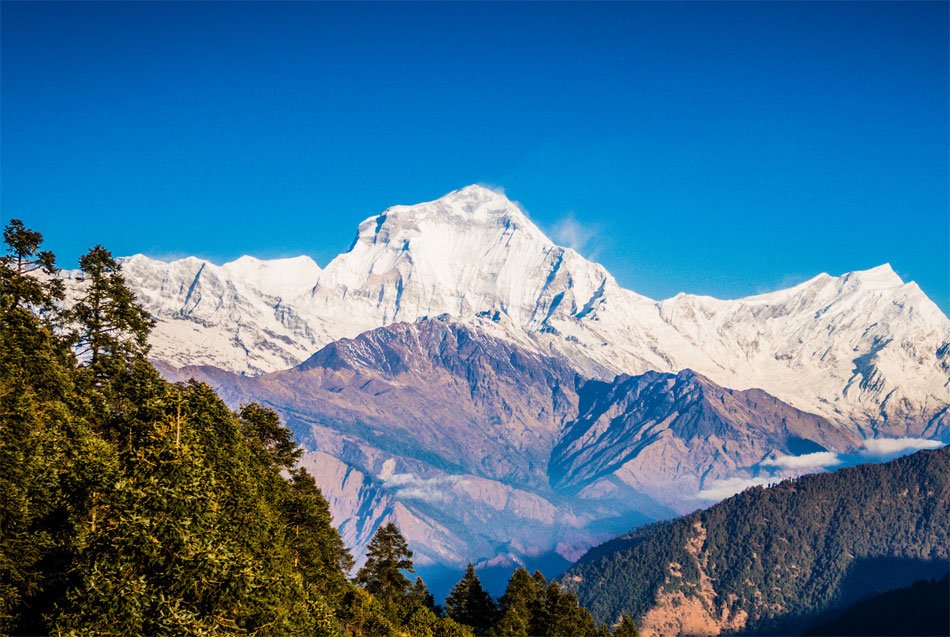
The final ascent to Khopra Ridge (3,660 m) is a 45-minute climb from Dobato. The reward is a viewpoint that offers arguably the most intimate proximity to Dhaulagiri of any accessible trekking viewpoint in Nepal. While Poon Hill gives you a wide theatrical panorama, Khopra Ridge puts you inside the mountain architecture — the sheer southwest wall of Dhaulagiri fills your field of vision in a way that standard wide-angle mountain photography simply cannot capture.
The Optional Extension: Khayer Lake (4,660 m)
For trekkers with the fitness and acclimatization, the most extraordinary extension on this circuit is the two-day high-altitude journey to Khayer Lake (4,660 m) — a sacred glacial lake considered holy by local Hindu and Buddhist communities. The lake sits in a cirque below Annapurna South and Nilgiri North, with a dramatic ridge approach that involves genuine high-altitude hiking above 4,000 m.
This is not a casual add-on. The Khayer Lake extension requires proper acclimatization, cold-weather gear rated to -15°C, and ideally at least three prior days above 3,000 m. Our guides recommend this extension only to trekkers with previous high-altitude experience. That said, for those who qualify: it is one of the most spiritually and visually arresting places in the Annapurna region.
The Community Lodge Model: Where Your Money Goes
This is where Khopra Danda diverges most sharply from any other short trek in Nepal. The lodges at Swanta, Bayeli Kharka, Dobato, and Khopra Ridge are not privately owned teahouses. They are community assets, registered under the Annapurna Conservation Area Project (ACAP) community infrastructure program, managed by local cooperatives, and structured so that a fixed percentage of all revenues funds the local school, a community health post, and trail maintenance.
When you pay for a room and a meal at a Khopra community lodge, you are not generating profit for a Kathmandu-based operator. You are directly funding children’s education in one of Nepal’s most remote mountain communities. The lodges are simple — expect clean rooms, shared bathrooms, and a menu that leans heavily on local produce — but the quality of welcome and the sense of authentic hospitality is unlike anything the commercialized Poon Hill circuit can offer.
Excellent Himalaya has been a supporting partner of the Khopra Community Lodge network since 2019. We require our guides to explain the revenue model to every group — not as a marketing point, but because we believe trekkers who understand where their money goes make better decisions about how they trek.
Day-by-Day Itinerary: Classic Khopra Danda Circuit (7 Days)
- Day 1: Pokhara to Nayapul (drive). Trek from Kimche to Swanta (2,200 m) | 5–6 hrs
- Day 2: Swanta to Bayeli Kharka (3,050 m) through rhododendron forest | 4–5 hrs
- Day 3: Bayeli Kharka to Dobato (3,500 m) to Afternoon exploration of Khopra Ridge viewpoint | 3–4 hrs
- Day 4: Dobato to Khopra Ridge (3,660 m) sunrise Optional: begin Khayer Lake extension | 3 hrs to ridge
- Day 5 (optional): Khayer Lake (4,660 m) high-altitude circuit to Return to Dobato | 7–8 hrs
- Day 6: Dobato to Swanta to Ghorepani (2,860 m) — joining the Poon Hill trail for descent flexibility | 5 hrs
- Day 7: Ghorepani to Nayapul to Pokhara (drive) | 4–5 hrs trek + 1.5 hrs drive

Logistics & Permits: 2026 ACAP Requirements for Both Treks
The Mandatory Guide Rule — 2026
Effective 2025 and fully enforced in 2026, solo unguided trekking in the Annapurna Conservation Area is prohibited for all foreign nationals. This regulation applies equally to both the Ghorepani Poon Hill circuit and the Khopra Danda trail. ACAP checkpoints at Birethanti (Poon Hill entry) and Kimche (Khopra entry) now verify that every trekking group is accompanied by a TAAN-licensed Nepali guide before issuing the trail registration stamp.
Trekkers found beyond checkpoints without a licensed guide risk permit confiscation, a monetary fine, and mandatory escort back to the trailhead. The regulation is not bureaucratic inconvenience — it was introduced following a significant increase in solo trekker incidents, including several fatalities from acute altitude sickness on unmanned sections of the Khopra route where no other trekkers were present for days.
2026 Permit Fees: Both Circuits
| Permit / Document | Applies To | 2026 Fee (NPR) | 2026 Fee (USD approx.) |
| ACAP (Annapurna Conservation Area Permit) | Both treks | NPR 3,000 | ~$22 |
| E-TIMS (Electronic Trekkers Info System) | Both treks | NPR 2,000 | ~$15 |
| Licensed Guide (mandatory) | Both treks | Included via operator | ~$30–40/day |
| TAAN Guide Admin Fee | Both treks | NPR 500–1,000 | ~$4–7 |
| Total Permit Cost (approx.) | — | NPR 5,500–6,000 | ~$40–45 |
Both permits are non-negotiable and non-refundable. The E-TIMS card has fully replaced the paper TIMS system. It is processed digitally through your licensed operator or at the Nepal Tourism Board office (Bhrikutimandap, Kathmandu). Operators like Excellent Himalaya handle all permit procurement as part of a package booking, saving you the queue time in Kathmandu.
Getting There: Pokhara as Your Base
Both treks begin from Pokhara and end at Pokhara, making the Lakeside tourism hub your logistics base. The trailhead for Poon Hill is at Nayapul (1.5 hrs by private jeep or 2.5 hrs by local bus from Pokhara). The trailhead for Khopra Danda is at Kimche, a 30-minute additional drive from Nayapul. In 2026, private jeep transport from Pokhara to either trailhead costs approximately NPR 4,000–6,000 (roughly $30–$45) per vehicle.
Best Season: When to Trek Each Route
Ghorepani Poon Hill: The trail is accessible year-round but peaks in October–November and March–April. Winter (December–February) brings snow to Ghorepani and cold but often crystal-clear skies. Monsoon (June–August) is not recommended due to leeches on the Ulleri section and frequent cloud cover blocking the Poon Hill panorama.
Khopra Danda: The community lodges at Dobato and Khopra Ridge are closed from December through February due to extreme cold and heavy snowfall above 3,500 m. The optimal windows are October–November for clear skies and April–May for the extraordinary rhododendron bloom on the ascent to Bayeli Kharka. The Khayer Lake extension is only feasible in these same windows, and even then requires checking current snow conditions with your guide before attempting.
The View Factor: A Photographer's Analysis
Both viewpoints offer world-class mountain scenery. But they offer fundamentally different types of mountain experience, and the distinction matters enormously for photographers and for trekkers whose primary motivation is the mountain encounter.
Poon Hill (3,210 m): The Theatrical Panorama
The Poon Hill viewpoint is positioned to deliver a wide, sweeping panorama across the full Annapurna massif. The distance from the viewpoint to the nearest major peak creates a classic mountain photography scenario: clean skyline, dramatic foreground ridgelines, and enough separation that you can fit multiple 8,000 m peaks in a single frame. Annapurna South, Machhapuchhre, and the Annapurna Sanctuary ridge all appear in their full majesty.
The limitation — and it is a real one for serious photographers — is that the viewpoint faces east, which means the classic sunrise shot (the moment that defines Poon Hill’s reputation) works brilliantly but the mountain faces are largely in shadow until mid-morning. The infrastructure at the summit — concrete viewing platform, safety railings, a small tea stall — means foreground elements are limited to manufactured tourist infrastructure rather than raw alpine terrain.
Khopra Ridge (3,660 m): Raw Mountain Proximity
Khopra Ridge operates on a completely different visual logic. At 450 m higher than Poon Hill and positioned directly on a lateral spur of the Dhaulagiri massif, the experience is one of immersion rather than observation. The southwest face of Dhaulagiri — the eighth-highest mountain on Earth — fills your western horizon at a scale that makes the peak feel close enough to touch. This is not hyperbole: Dhaulagiri’s direct line from Khopra Ridge is approximately 25 km, compared to 40 km from Poon Hill.
The foreground terrain is raw alpine meadow and exposed ridge rock. There are no guardrails, no tea stalls, no concrete platforms. The photographer who has the Khopra Ridge sunrise to themselves — which, outside of peak season, is a genuine possibility — has access to compositions that do not exist anywhere else on a short Annapurna trek. Annapurna South, Nilgiri, Tukuche Peak, Dhaulagiri, and the deep Kali Gandaki gorge all converge in a single field of view.
Our Guide's Take: Which Trek is Right for You?
After fifteen years and over a hundred combined expeditions on both circuits, our lead guides have a simple framework: match the trek to the trekker, not to the marketing copy. The table below gives our honest, unqualified recommendation for different trekker profiles.
| Trekker Type | Our Pick | Why |
| Solo Traveler | Khopra Danda | The quiet trail fosters deep personal reflection. Community lodges are safe and welcoming for solo trekkers. The absence of crowds means you set your own pace without the social pressure of a busy trail. |
| Families with Kids | Poon Hill | Well-marked paths, short daily stages (4–6 hrs), reliable teahouse food, and the dramatic but achievable Poon Hill sunrise make this the ideal family circuit. Children aged 8+ handle it well. |
| Photographers | Khopra Danda | The proximity to Dhaulagiri and the unmarked foreground terrain at Khopra Ridge create genuinely unique compositions you will not find on any stock photo site. Poon Hill shots are everywhere; Khopra shots are yours alone. |
| First-Time Trekkers | Poon Hill | Established infrastructure, clear waymarking, and a gentle altitude profile make Poon Hill the safest introduction to Himalayan trekking. Build your experience here before attempting Khopra. |
| Budget Trekkers | Poon Hill | Shorter duration and dense teahouse competition keeps prices lower. Khopra community lodges, while excellent value for their mission, involve more expensive logistics due to remoteness. |
| Responsible Travelers | Khopra Danda | Every rupee you spend at a Khopra community lodge feeds back into local education and healthcare. This is the most ethically impactful short trek in the Annapurna region. |
A Note on the “Hidden Gem” Phenomenon
We are aware of the irony: by writing this guide, we are contributing to the discovery of a route we love precisely because it remains undiscovered. This is a tension every responsible operator navigates. Our approach at Excellent Himalaya is to promote Khopra Danda selectively — recommending it to trekkers whose profile genuinely benefits from what it offers, rather than simply routing all traffic away from Poon Hill to inflate Khopra’s booking numbers.
The community lodge model at Khopra is built for sustainable, low-volume trekking. The lodges have limited bed capacity by design. This is not a trail that can absorb Poon Hill-level traffic without fundamentally changing its character. We ask that trekkers who choose Khopra respect this by booking through licensed local operators, adhering to guide recommendations on group behavior, and understanding that the quiet they came to find is something that requires active protection.
Combining Both Treks: The 10-Day Annapurna Explorer
For trekkers with ten or more days, it is logistically possible — and deeply rewarding — to combine both circuits. A typical combination might run: Khopra Danda outbound (days 1–6) → Ghorepani via Dobato (day 6) → Poon Hill sunrise (day 7) → descent to Nayapul (days 8–9). This gives you the solitude and proximity of Khopra first, with the classic Poon Hill sunrise as a final highlight. Having experienced both, trekkers almost universally report that doing Khopra first recalibrates their appreciation for just how extraordinary Poon Hill can feel when approached with fresh eyes — even with the crowds.
Frequently Asked Questions
Q: Is Khopra Danda suitable for beginners?
It depends on your fitness baseline. Khopra Danda is classified as Moderate to Challenging, primarily due to its higher altitude (3,660 m at the ridge, 4,660 m at Khayer Lake if attempted) and the relative remoteness of the community lodges. Emergency evacuation is harder and more expensive than on the Poon Hill circuit. We recommend Khopra for trekkers who have completed at least one multi-day high-altitude hike previously, or who are well-prepared and working with an experienced guide.
Q: Can I do Poon Hill in 3 days?
Technically yes, with an aggressive itinerary (Nayapul → Ghorepani on Day 1, Poon Hill at dawn on Day 2, full descent on Day 3). However, most trekkers find this pace exhausting and it leaves no buffer for weather delays. The classic 4-day circuit is strongly recommended for a quality experience. Rushing the stone steps of Ulleri is also an unnecessary injury risk.
Q: Are the Khopra community lodges comfortable?
Comfortable in the mountain sense: clean beds with thick blankets, hearty meals featuring local produce, and warm communal dining rooms with views that cost nothing extra. They are not comfortable in the luxury lodge sense: bathrooms are shared, showers are solar-heated and limited, and Wi-Fi is unavailable above Swanta. Pack a power bank and offline maps. The absence of screens tends to be something trekkers retrospectively appreciate deeply.
Q: What is the physical difference between the two trails?
Poon Hill involves one very demanding uphill section (Tikhedhunga to Ghorepani, including the Ulleri stone steps) followed by gentler ridge walking. Total elevation gain is approximately 1,800 m over the circuit. Khopra Danda involves a more gradual but sustained ascent over multiple days, reaching 3,660 m (and optionally 4,660 m). Total elevation gain on the Khopra full circuit is approximately 2,600 m. Daily hiking hours are comparable (5–7 hours per day), but Khopra requires more sustained cardiovascular endurance over a longer period.
Q: How do I book the Khopra community lodges?
Community lodges at Swanta, Bayeli Kharka, Dobato, and Khopra Ridge cannot be booked through mainstream online platforms. Reservations must be made through a licensed Nepali trekking operator with an established relationship with the community cooperative. Excellent Himalaya has managed Khopra bookings since 2019 and maintains direct contact with lodge coordinators at each stage. We handle all reservations as part of our Khopra Danda package booking.
Q: What happens if I get altitude sickness on Khopra?
This is the most important practical question any trekker should ask before choosing Khopra over Poon Hill. All Excellent Himalaya guides carry a pulse oximeter, diamox, and a satellite communication device. Emergency helicopter evacuation from Dobato to Pokhara takes approximately 25–35 minutes and costs $1,500–$3,000 without insurance. Travel insurance covering helicopter rescue to 5,000 m is non-negotiable for the Khopra circuit. Our guides are trained in Wilderness First Responder protocols and are authorized to administer emergency medication.
Final Verdict: Our Honest Assessment
Ghorepani Poon Hill is not overrated. It delivers on its promise with clockwork reliability: a dramatic mountain panorama, comfortable infrastructure, a defined and well-supported experience. In 2026, it remains the best introduction to Himalayan trekking for first-timers, families, and trekkers who want the iconic Nepal mountain experience with minimal logistical uncertainty.
Khopra Danda is something rarer. It is a trek that can genuinely surprise you — that delivers mountain proximity, cultural authenticity, and ethical tourism impact in a combination that is increasingly difficult to find in Nepal’s most visited conservation area. It demands more physically and logistically, but it gives back proportionally more in the currency that most trekkers come to Nepal to find: the feeling of being genuinely, quietly, enormously small in the presence of the mountains.
If you can only do one: choose based on your trekker personality, not on trip duration or Instagram potential. If you can do both: do Khopra first, Poon Hill second, and you will have experienced the full spectrum of what the Annapurna Conservation Area has to offer.
Still Undecided?
Chat with our guides at Excellent Himalaya for a personalized recommendation. With over 50 group expeditions led on both circuits, our team will match your fitness level, travel dates, budget, and trekker personality to the right trail with zero pressure and full transparency.
Email: [email protected] | Whatsapp +977-9851203181
We will respond you within 24 hours. Kathmandu operations team available 7 days a week.
About the Author

Suman Shrestha
I am Suman Shrestha. I have dedicated my life to mastering the rhythms of the Nepal Himalayas and its culture. I am also a fully government-licensed trekking and tour guide. I've personally led hundreds of adventure groups across our country's most diverse and demanding landscapes and guided countless tour groups across every special interest imaginable. I know the ground reality of every ridge, every sacred monument, and every remote teahouse along the way, because I've earned that knowledge step by step, not from a brochure. My deep technical knowledge of Nepal’s diverse geography is matched only by my uncompromising commitment to safety. Beyond the physical path, I take a pride in being a bridge for all people by sharing the knowledge of the Himalayas, rich traditions and spiritual heritage of Nepal ensuring every journey is an authentic Experience. Let’s explore the heart of the Himalayas together. You can connect with me via WhatsApp at +9779851203181.