


Khopra Danda Trek Cost 2026/2027: Complete Price Breakdown, Itinerary & Guide

Updated [July 20th, 2026]. Written and reviewed by Suman Shrestha, licensed guide (Nepal Government License No. 2212)
Khopra Danda, also written Khopra Ridge, sits in the Annapurna Conservation Area on the border of Myagdi and Kaski districts, a short detour off the busier Ghorepani Poon Hill trail. It is one of the newer community-managed routes in the Annapurna region, opened up so trekkers could reach a ridge with an open, uninterrupted line of sight to Dhaulagiri, the Annapurna range, and Annapurna South without sharing the trail with the crowds that fill Ghorepani in peak season.
The trek combines three things that rarely come together on one itinerary: a genuinely quiet trail through rhododendron and oak forest, a demanding but non-technical side trip to the sacred Khayer Lake at roughly 4,660 meters, and overnight stays in lodges that are owned and run by local women’s cooperatives rather than private operators. For trekkers who have already done Poon Hill or Ghorepani and want the same mountain panorama without the crowds, or who want a shorter, cheaper alternative to Annapurna Base Camp, Khopra Danda is usually the right answer.
This guide explains a full cost breakdown, an itinerary with elevation and difficulty details for every day, current 2026/2027 permit rules, a firsthand story from one of our senior guides, and answers to the questions trekkers actually ask for before booking.
 Trip Highlights
- Panoramic views of Dhaulagiri (8,167 m), Annapurna I (8,091 m), Annapurna South (7,219 m), Annapurna III, Gangapurna, Machhapuchhre, Tukuche Peak, and Nilgiri Himal
- Side trip to Khayer Lake, a sacred lake at approximately 4,660 m, visited by pilgrims for an annual ritual bath
- Overnight stays in women-run community lodges, a rarity in Nepal trekking
- Significantly fewer trekkers per day than the main Ghorepani-Poon Hill or Annapurna Base Camp trails
- Rhododendron and oak forest walking through Ghandruk, Tadapani, and Dobato
- Sunrise from Poon Hill is included on the return leg
- Can be shortened, extended, or combined with Mardi Himal or Annapurna Base Camp on request
Khopra Danda Trek Group Package Price 2026/2027
The rate below is our standard 12-day guided package price per person, based on group size, including the inclusions listed further down this page.
| Group Size | Price Per Person (USD) |
| 9 to 10 people | 550 |
| 7 to 8 people | 575 |
| 5 to 6 people | 600 |
| 3 to 4 people | 625 |
| 2 people | 650 |
| Solo trekker (private guide) | Contact us for a quote |
Prices are per person in USD and are reviewed each season. Contact us for a private, family, or single supplement quote.
What Is Included and Excluded
Included in the Package
- Airport pickup and drop off in Kathmandu
- Kathmandu to Pokhara to Kathmandu transport (tourist coach or private vehicle on request)
- Pokhara to Nayapul and Nayapul to Pokhara ground transport
- All teahouse and community lodge accommodation on the trek (twin sharing)
- Three meals a day (breakfast, lunch, dinner) while on the trek
- A licensed, English-speaking trekking guide
- Porter service (typically one porter for every two trekkers, carrying up to 20 kg combined)
- ACAP (Annapurna Conservation Area Permit)
- All government and local taxes
- A first aid kit carried by the guide
Not Included
- Nepal entry visa fee
- International airfare to and from Kathmandu
- Kathmandu hotel accommodation (unless specifically requested)
- Travel and rescue insurance
- Personal expenses: bottled or boiled water, hot showers, battery charging, WiFi, snacks, and bar bills on the trail
- Tips for the guide and porter
- Personal trekking gear

Daily Budget Breakdown: What a Trekker Actually Spends
If you are comparing a guided package against arranging things yourself, here is roughly what each component costs per person, based on 2026 rates on the Khopra Danda trail.
| Item | Typical Cost (USD) | Notes |
| Teahouse or community lodge room | $3 to $8 per night | Often free or nominal if you eat dinner and breakfast at the same lodge |
| Meals (breakfast, lunch, dinner) | $20 to $30 per day | Rises with altitude; Khopra Ridge and Khayer Lake side are the most expensive due to portering distance |
| Bottled or boiled water | $1 to $3 per liter | A water purification system or tablets are cheaper and reduce plastic waste |
| Hot shower | $2 to $5 | Not available at every lodge, especially above Dobato |
| WiFi (where available) | $2 to $4 per day | Patchy above Tadapani; do not rely on it past Dobato |
| Battery charging | $1 to $3 per device | A power bank charged in Pokhara saves money on the trail |
| ACAP permit | NPR 3,000 (about $23 to $25) | Mandatory, single entry, valid for the whole trek |
| Local guide (if arranged independently) | $25 to $35 per day | A licensed guide is required for the Annapurna region as of April 2023 |
| Porter (if arranged independently) | $20 to $25 per day | Usually carries up to 15 to 20 kg |
Bottom line
Adding it up, an independently arranged Khopra Danda trek (excluding Kathmandu-Pokhara transport, guide, and porter) runs approximately $40 to $55 per person per day on the trail. Our guided package folds all of this into one predictable per-person rate, which is usually similar to or slightly better than piecing it together yourself once guide, porter, and permit costs are included, and removes the planning and negotiation entirely.
Miscellaneous and “Hidden” Costs on the Circuit
Most Khopra Danda cost guides, including our own group pricing table above, cover the big line items well. The costs below are the smaller ones that catch first-time trekkers off guard because they rarely appear in the headline price.
| Item | Typical Cost | Why It Gets Missed |
| Nepal tourist visa | $30 for 15 days, $50 for 30 days, $125 for 90 days (cash, on arrival or online) | Not included in any trek package; budgeted separately from the trip itself |
| Extra night in Kathmandu or Pokhara | $15 to $60 per night | Flight delays, altitude acclimatization buffers, or wanting an extra rest day before flying home |
| Domestic flight delays and rebooking | Variable, occasionally a full extra hotel night | Mountain weather, more relevant to Everest region flights than this drive-in trek, but Kathmandu-Pokhara flights can still be affected in monsoon |
| Boiled or bottled water above Tadapani | $2 to $4 per liter, rising with altitude | Prices increase the higher and more remote the lodge, since everything is carried in |
| Charging devices and WiFi at community lodges | $1 to $4 per use | Solar power is limited at Khopra Ridge, so charging can be rationed or unavailable at busy times |
| Hot shower | $2 to $5, often unavailable above Dobato | Bucket hot water is sometimes the only option and is charged the same as a shower |
| Tips for the guide and porter | Guide: $8 to $12/day, Porter: $5 to $8/day (guideline, not obligatory) | Not included in any package; budget this in as a fixed cost rather than an afterthought |
| Extra snacks, chocolate, and biscuits on the trail | $2 to $5 per item | Prices rise steadily with altitude and remoteness, just as everywhere in Nepal |
| Down jacket or sleeping bag rental in Pokhara | $1 to $2 per day, per item | Useful if you are travelling light or arriving without cold-weather gear |
| Travel and rescue insurance | $40 to $120 for a two-week policy, altitude dependent | Frequently skipped by budget travelers, but essential given the altitude reached at Khayer Lake |
| Laundry in Pokhara or Kathmandu | $2 to $5 per load | Small but easy to forget when totaling a budget |
None of these individually breaks a budget, but added together they can easily run to $150 to $250 per person beyond your core package or daily trail costs. Building a small buffer into your budget avoids surprises.
Where to Get Cash and Exchange Currency
Nepal runs on cash once you leave Kathmandu and Pokhara. Trekking lodges, permit counters, local shops, and porters are paid in Nepali Rupees (NPR), and card acceptance disappears almost entirely past Nayapul. Plan to withdraw or exchange everything you will need for the trek itself before you leave Pokhara.
Currency exchange counters are most plentiful, and generally offer the best rates, in Thamel (Kathmandu) and Lakeside (Pokhara). Well-known currencies, USD, EUR, GBP, AUD, and INR, convert easily; less common currencies convert at weaker rates or may need to be changed at home first. Hotel front desks will exchange money as a backup, but at the weakest rates of any option, so treat that as a last resort rather than a plan.
ATMs are reliable in Kathmandu and Pokhara (look for Standard Chartered, Nabil Bank, Himalayan Bank, or Everest Bank, which accept international Visa and Mastercard), but withdrawal limits typically run NPR 10,000 to 35,000 per transaction with a flat fee on top, so budget for several withdrawals rather than one large one if you need a significant amount of cash. Past Pokhara, ATMs are unreliable or nonexistent for the rest of this trek, so withdraw everything you expect to need before heading to Nayapul.
A practical rule for this trek: budget your on-trail cash (food, drinks, showers, WiFi, tips, and any personal extras) in NPR before you leave Pokhara, keep a mix of small denominations (NPR 100 and 500 notes are the most useful on the trail since change is often limited), and carry a card only as an emergency backup rather than a primary payment method once you leave the city.
How Different Operators Price the Khopra Danda Trek
Package prices for Khopra Danda vary more than trekkers expect between operators, and the gap is rarely about quality alone. Here is what tends to drive the difference, based on publicly listed packages from several Annapurna region operators.
At the budget end, some operators list Khopra Danda packages from roughly $420 to $480 for a compressed 6-day itinerary, which typically means fewer buffer days, a faster pace, and less flexibility if weather or altitude symptoms require a slower schedule. At the upper end, established operators with 12-day itineraries and full logistical support commonly price in the $700 to $800 range per person for smaller groups, which usually reflects private vehicle use, a lower guide-to-trekker ratio, and more built-in acclimatization time.
The price differences usually come down to a small number of factors: group size (larger groups spread the fixed costs of vehicles and staff over more people, which is why our own table above shows a real spread between 2 person and 9 to 10 person groups), itinerary length (a compressed 6 to 7 day version cuts costs but often removes rest or buffer days), transport type (shared tourist coach versus private jeep), and whether guide and porter costs are itemized separately or folded into one headline price.
When you compare a quoted price across operators, the number itself tells you very little on its own. The inclusions list does the real work: check whether ACAP is included, whether a porter is included or optional, what the guide-to-trekker ratio is, and whether the itinerary includes a buffer day for weather or altitude symptoms before the Khayer Lake excursion. A lower headline price that excludes the porter, uses a compressed itinerary with no buffer day, or quotes a guide-to-trekker ratio above 1:8 is not necessarily cheaper once you add back what it leaves out.
Red Flags in a Quoted Price
- A price that seems significantly below the $33 to $55 per person per day independent cost estimated earlier on this page, once permits, guide, and porter are factored in
- No mention of a licensed guide, which has been mandatory in the Annapurna Conservation Area since April 2023The
- ACAP permit is listed as an extra rather than included
- No acclimatization buffer before the Khayer Lake day, which is the highest and most physically demanding day of the trek
- Vague or missing detail on porter luggage limits and guide-to-trekker ratio
Khopra Danda Trek Permits 2026/2027: What You Actually Need
The Khopra Danda and Khayer Lake trail lies entirely within the Annapurna Conservation Area, so every trekker needs an Annapurna Conservation Area Permit (ACAP). This is a single-entry, non-refundable permit that costs NPR 3,000 (about USD 23 to 25) for foreign nationals and NPR 1,000 for SAARC nationals, and it is valid for your entire time inside the conservation area regardless of trek length. It is checked at multiple posts along the route, including Birethanti, so keep a physical or digital copy with you at all times.
The TIMS card is a separate registration system that many older articles still list as mandatory for Annapurna treks. As of April 2023, TIMS is no longer enforced on Annapurna region trails, including Khopra Danda, and has effectively been replaced by the requirement that all trekkers use a licensed guide. If a company or blog quotes you a TIMS fee for this trek in 2026 or 2027, that is outdated information, though we recommend confirming directly with your operator since enforcement guidance has occasionally been inconsistent between the Nepal Tourism Board and TAAN.
What the 2023 rule change actually requires is a government licensed trekking guide for all foreign trekkers entering the Annapurna Conservation Area, Khopra Danda included. Independent, unguided trekking is no longer permitted here. This is one of the reasons a guided package, rather than a DIY trip, is now the standard and in most cases the only compliant way to do this trek.
| Permit | Cost (Foreigners) | Cost (SAARC) | Status for Khopra Danda 2026/2027 |
| ACAP (Annapurna Conservation Area Permit) | NPR 3,000 (~$23 to $25) | NPR 1,000 | Mandatory, single entry, checked at trail posts |
| TIMS Card | N/A | N/A | Discontinued for Annapurna region treks since April 2023 |
| Licensed Guide | Guide day rate applies | Guide day rate applies | Mandatory since April 2023, included in our package |
Khopra Danda Trek Itinerary: Day by Day Distance and Difficulty
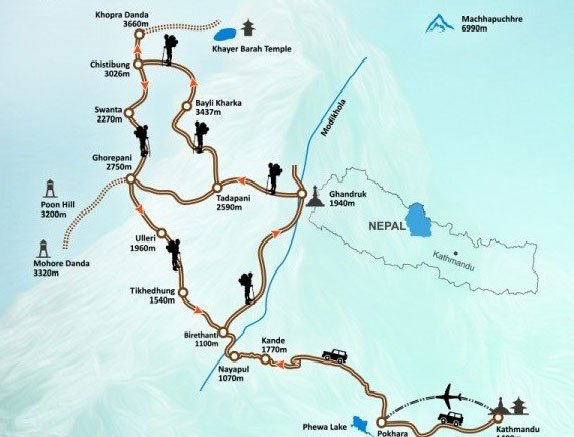
This is our standard 12-day itinerary, including two travel days in Kathmandu and arrival/departure. It can be shortened to as few as 9 days by flying or driving directly between Kathmandu and Pokhara with less buffer, or extended to combine with Mardi Himal or Annapurna Base Camp. Ask us for a custom version if these dates do not suit your schedule.
Day 1: Arrival in Kathmandu
Altitude: 1,400 m | Difficulty: Easy
Arrival at Tribhuvan International Airport, where our tour officer meets you and transfers you to your hotel. Trek briefing and gear check in the evening if time allows. Overnight in Kathmandu.
Day 2: Drive from Kathmandu to Pokhara
Altitude: 827 m | Distance: 205 km, 6 to 7 hours driving | Difficulty: Easy (travel day)
A scenic mountain highway drive along the Trishuli and Marsyangdi river valleys, with Manaslu and Annapurna occasionally visible on a clear day. Overnight in Pokhara.
Day 3: Drive to Nayapul, trek to Ghandruk
Altitude: 1,940 m | Distance: 41 km drive (1.5 to 2 hours) + 12 km hike (6 hours) | Difficulty: Moderate
From Nayapul, the trail climbs steadily through Birethanti, following the Modi Khola valley up to Ghandruk, a large Gurung village with strong mountain views and a well-known Gurung heritage museum. Overnight at a mountain lodge.
Day 4: Ghandruk to Tadapani
Altitude: 2,630 m | Distance: 8 km, 4 hours | Difficulty: Moderate, steady ascent through forest
The trail leaves Ghandruk’s terraced fields behind and enters rhododendron and oak forest. In spring, this section is one of the most photographed on the whole route, with the forest floor and canopy both in bloom. Overnight at a mountain lodge in Tadapani.
Day 5: Tadapani to Dobato
Altitude: 3,420 m | Distance: 12 to 13 km, 6 hours | Difficulty: Moderate to challenging, the longest forest climb of the trek
This is where the crowds thin out. Tadapani is the last point most Ghorepani-bound trekkers pass through; the Dobato trail branches away from that main route into quieter forest. Expect a long, steady climb with a couple of false summits before Dobato’s ridge-top lodges come into view. Overnight at a mountain lodge.
Day 6: Dobato to Khopra Danda (Khopra Ridge)
Altitude: 3,660 m | Distance: 17 km, 6 to 7 hours | Difficulty: Challenging, altitude becomes a factor
A long day along an open ridge line with Dhaulagiri and the Annapurna range visible for much of the walk. This is the first night above 3,600 m, so hydration and a slow, steady pace matter more than speed. Overnight at the Khopra Ridge community lodge, the highest sleeping point on the standard itinerary.
Day 7: Excursion to Khayer Lake and around Khopra Ridge
Altitude: 4,660 m at the lake | Distance: 13 km round trip, 8 to 9 hours | Difficulty: Challenging, high altitude day hike
A pre-dawn or early morning start for the round-trip climb to Khayer Lake, a sacred lake where pilgrims come once a year for a ritual bath. The trail is steep, rocky, and exposed in places, with no technical climbing but real altitude effects above 4,000 m. You return to sleep at the same Khopra Ridge lodge, which keeps the net altitude gain for the night at a safer level than sleeping near the lake itself. Overnight at Khopra Ridge community lodge.
Day 8: Khopra Danda to Swanta
Altitude: 2,214 m | Distance: 15 km, 5 to 6 hours | Difficulty: Moderate, mostly descent
A long descent off the ridge into the Swanta valley, dropping over 1,400 m over the course of the day. Knees and trekking poles both earn their keep here. Overnight at a mountain lodge in Swanta.
Day 9: Swanta to Ghorepani
Altitude: 2,860 m | Distance: 9 km, 4 to 5 hours | Difficulty: Moderate
The trail rejoins the main Annapurna network at Ghorepani, a noticeably busier village after the quiet of the previous days. Overnight at a mountain lodge in Ghorepani.
Day 10: Sunrise at Poon Hill, trek to Nayapul, drive to Pokhara
Altitude: 3,210 m at Poon Hill | Distance: 22 km, 8 hours total | Difficulty: Moderate, early start
A pre-dawn climb to Poon Hill for sunrise over Dhaulagiri, Annapurna South, and Machhapuchhre, one of the most famous viewpoints in Nepal. Back down to Ghorepani for breakfast, then the long descent to Nayapul and a drive back to Pokhara. Overnight at a hotel in Pokhara.
Day 11: Drive from Pokhara to Kathmandu
Altitude: 1,400 m | Distance: 205 km, 6 to 7 hours driving | Difficulty: Easy (travel day)
Return drive to Kathmandu by tourist coach or private vehicle. Overnight in Kathmandu, with time for last-minute shopping in Thamel.
Day 12: Final departure
Transfer to Tribhuvan International Airport for your onward flight.
Walking hours and distances above are averages; your actual pace will depend on fitness, weather, and how many photo stops you take. Distances vary slightly between GPS devices and trail conditions.

Story From the Trail: Yogendra Baniya on Guiding Nur’s Group from Malaysia
In the first week of April 2026, senior guide Yogendra Baniya led a group of trekkers from Malaysia, organized through a trekker named Nur, on the Khopra Danda and Khayer Lake route. Here is his account from the trial.
“Nur’s group had never trekked in Nepal before, and a few of them told me on the first evening in Ghandruk that they were nervous about the altitude at Khayer Lake. I always tell first-time groups the same thing: Khopra Danda is a good trek to start with because the ridge sections give you time to see how your body responds before we go anywhere near 4,000 meters.
April is a good month here. By the time we reached Tadapani and climbed toward Dobato, the rhododendron forest was at its best, red and pink against the green, and the group stopped so often for photographs that we arrived at the lodge later than planned, which nobody minded. From Dobato onward, the trail opens up, and Dhaulagiri sits right in front of you for most of the day. That is usually the moment groups understand why this route is worth the extra effort compared to staying on the main Ghorepani trail.
The Khayer Lake day was the test. We left the Khopra Ridge lodge before sunrise. The air was thin, and the last hour before the lake is steep, loose underfoot in places, and slow going. Nur and two others in her group felt the altitude, headaches, and slower breathing, so we paced down, drank more water, and took longer rests. Nobody needed to turn back. When we reached the lake, it was still and quiet, with prayer flags along the ridge above it. One of the group said it was the first time she had felt truly far from everything. That is usually how people describe Khayer Lake, not as the most dramatic viewpoint on the trek, but as the most peaceful.
Coming down through Swanta and into Ghorepani a few days later, the group was visibly stronger than when we started, and the sunrise at Poon Hill on the last morning gave them the payoff view of Dhaulagiri and Annapurna South they had been waiting for since Ghandruk. Nur told me before they flew home that she wanted to bring a bigger group from Malaysia next year, this time for Mardi Himal. That kind of return interest is the best measure I have of whether a trek delivered what it promised.” — Yogendra Baniya, Senior Trekking Guide, Excellent Himalaya Trek & Expedition.
Best Time for Khopra Danda Trek
Khopra Danda can be trekked most of the year, but season changes both the views and the trail conditions significantly.
Late September to early December (Autumn) — Best
The most reliable season for clear mountain views, stable weather, and the busiest lodges on the main Annapurna trail, though Khopra Danda itself stays comparatively quiet even in peak autumn.
March to April (Spring) — Second best
Slightly less consistent visibility than autumn, but the rhododendron forest between Tadapani and Dobato is in full bloom, which is a major draw on its own. This is the season Yogendra’s April 2026 group trekked in.
Mid-December to February (Winter) — Good, cold
Skies are often at their clearest in winter, but temperatures at Khopra Ridge and especially toward Khayer Lake drop well below freezing at night. The trek rarely closes but requires proper cold-weather gear.
May to June (Pre-monsoon) — Fair
Increasingly hot and humid at lower elevations, with afternoon haze that can obscure distant peaks. The hillsides around Khopra are in bloom.
June to mid-September (Monsoon) — Avoid if possible
Heavy rain, leeches on the lower forested sections, and frequently obscured mountain views make this the least popular window for this trek.
Recent Trail Updates for the 2026/2027 Season
A few things are worth confirming close to your travel dates rather than relying on any single guide, including this one, since trail conditions in this part of the Annapurna region can shift year to year.
The licensed guide requirement introduced across the Annapurna Conservation Area in April 2023 remains in effect for the 2026/2027 season, and the TIMS card continues to go unenforced on this route, as covered in the permits section above. The ACAP fee has held steady at NPR 3,000 for foreign trekkers through 2026.
Jeep roads have been steadily extending toward several trailheads across the wider Annapurna region over the past few years, which has shortened the walking portion of some nearby routes. As of this update, the core Khopra Danda walking sections from Ghandruk through Tadapani, Dobato, Khopra Ridge, and Swanta remain a foot-only trail with no vehicle access, which is a large part of what keeps this route quiet. Trailhead access points around Nayapul and Ghandruk are the sections most likely to see incremental road changes, so confirm current drive-to points with us close to your departure date.
Community lodge capacity along the Khopra Ridge and Dobato sections is limited, and this is not a large-volume trail. In peak autumn weeks, booking your dates a few weeks ahead is worth doing, though nothing close to the advance booking pressure seen on Everest Base Camp or the standard Annapurna Circuit.
Because this section covers conditions that change between seasons, treat it as a starting point and confirm specifics (bridge conditions, any trail rerouting, current lodge availability) with our team a few weeks before departure rather than relying solely on this or any other published guide.
Health and Safety on the Khopra Danda Trek
Khopra Danda is graded moderate to challenging. There is no technical climbing or use of crampons or ropes, but several days involve six to seven hours of walking on uneven forest and ridge trails, with a demanding round-trip day to Khayer Lake above 4,000 m. Trekkers with a reasonable base level of fitness, gained from regular hiking, running, or cardio training in the two to three months before departure, generally manage it comfortably.
The highest sleeping altitude on the standard itinerary is the Khopra Ridge community lodge at 3,660 m, and the highest point reached is Khayer Lake at approximately 4,660 m, visited as a day trip rather than an overnight stay. This itinerary structure, climbing high to the lake and returning to sleep lower, follows the standard “climb high, sleep low” acclimatization principle and reduces, though does not eliminate, the risk of altitude sickness.
Altitude Sickness (AMS)
Watch for early symptoms of Acute Mountain Sickness: headache, nausea, dizziness, and unusual fatigue. Mild symptoms usually respond to rest, hydration, and a slower pace. Symptoms that worsen, or any confusion, loss of coordination, or breathlessness at rest, are signs to descend immediately, and are exactly the situations a licensed guide is trained to manage. This is one of the practical reasons the guide requirement introduced in 2023 matters on a route like this one, where the Khayer Lake day pushes above 4,500 m with no rescue post nearby.
Water and Food Safety
Do not drink untreated tap or stream water anywhere on the trek. Boiled water and bottled water are both available at lodges for a fee that rises with altitude, and a personal purification method (tablets, a filter, or a UV pen) is a cheaper and more sustainable alternative that also cuts down on plastic bottle waste on the trail. Stick to freshly cooked, hot food, and be cautious with meat at higher elevations where refrigeration is limited; dal bhat and other vegetarian staples are generally the safest choice the higher you go.
Emergency Evacuation and Communication
Mobile signal is intermittent from Ghandruk onward and unreliable to absent above Dobato, so do not count on calling for help directly; your guide carries the contact details and process for arranging a helicopter evacuation if one becomes necessary, which is one of the practical safety reasons a licensed guide is required. Confirm your travel insurance explicitly covers emergency helicopter evacuation and trekking at altitudes up to at least 5,000 m before you depart, since the Khayer Lake side trip exceeds many standard travel policies’ altitude limits.
First Aid and Medication
Our guides carry a first aid kit as standard, but bring your own basic personal kit (blister care, any regular prescription medication in its original packaging, rehydration salts, and any altitude medication prescribed by your doctor before travel). Discuss altitude sickness medication such as acetazolamide with your doctor ahead of time if you have a history of AMS; it is not something to start experimenting with for the first time on the trail.
Trail Conditions
Expect uneven, sometimes loose or muddy trail, especially the final approach to Khayer Lake and the long descent into Swanta. Trekking poles reduce strain on knees on the steeper descent days. Leeches are a real concern in the lower forested sections during the monsoon months (June to mid-September), which is one more reason that the window is the least recommended time to trek this route.
The Khopra Community Lodges
One of the things that sets this trek apart from almost every other route in the Annapurna region is its lodging model. Beginning in 2014, local women from villages around Khopra organized to build and run a series of lodges along the ridge, rather than leaving lodge ownership to private operators as happens on most Nepal trekking routes. Guests staying at these lodges are directly supporting local women’s livelihoods and community infrastructure in a part of Myagdi district that otherwise sees very little tourism income.
Facilities at the community lodges are simple: twin share rooms, shared bathrooms, dal bhat and basic Western-style trekking food, and solar-powered lighting. Hot showers and WiFi become less reliable the higher you go, and above Dobato, you should expect to go without both. This is part of what keeps the trail quiet: it self-selects for trekkers who are comfortable with a more basic, unplugged few days on the trail.

Khopra Danda vs. Poon Hill and Annapurna Base Camp
Trekkers often ask how Khopra Danda compares to the two routes it overlaps with, and the honest answer depends on what you are optimizing for.
| Factor | Khopra Danda | Standard Poon Hill / Ghorepani | Annapurna Base Camp |
| Typical length | 9 to 12 days | 4 to 7 days | 7 to 12 days |
| Crowds | Low, even in peak season | High in autumn and spring | Moderate to high |
| Highest point | ~4,660 m (Khayer Lake, day trip) | 3,210 m (Poon Hill) | 4,130 m (ABC) |
| Lodging style | Community-run lodges (from 3,420 m up) | Private teahouses | Private teahouses and lodges |
| Guide requirement | Mandatory since April 2023 | Mandatory since April 2023 | Mandatory since April 2023 |
| Best for | Trekkers who want Annapurna views without the crowds | Short trips, first-time trekkers, tight schedules | Trekkers who want to stand inside the Annapurna Sanctuary itself |
Khopra Danda is, in effect, the quieter and arguably more rewarding alternative for trekkers who have looked at Poon Hill and worried it will be too crowded, or looked at ABC and want something a notch less demanding and a few days shorter while still reaching well above 4,000 m.
Is Khopra Danda Trek Worth the Cost?
For the right trekker, yes, and the “right trekker” question is worth answering honestly rather than generically.
Khopra Danda earns its cost if you value quiet trail time over ticking off the most famous named destination. You are paying, in effect, for a route that keeps the same 8,000 m peak panorama as the more famous Annapurna trails while removing most of the crowding, and for overnight stays that put your lodging spend directly into a local women-run cooperative rather than a private operator. The Khayer Lake side trip, in particular, delivers an altitude and a sense of remoteness that few other treks under two weeks can match without a much larger fitness or budget commitment.
It is a weaker fit if your main goal is reaching a single iconic milestone (Everest Base Camp or Annapurna Base Camp specifically), if you are working with a hard 5 to 6 day window and cannot accommodate a 9 to 12 day itinerary comfortably, or if you are not prepared for basic facilities (limited hot showers and WiFi from Dobato upward) in exchange for the quieter trail.
Compared to arranging permits, guides, and porters independently, our guided package price is close to, and in some group sizes better than, the per-day independent cost once every component is accounted for, while removing the planning, negotiation, and 2023 guide-licensing compliance question entirely. Compared to other operators, as the pricing comparison above shows, the difference is rarely about whether a company is “better,” and almost always about what is or is not included in the number you are quoted. Read the inclusions list, not just the headline price, and the answer to whether a specific quote is worth it becomes much clearer.
Post-Trek Add-Ons: Chitwan Safari and Kathmandu Extensions
Many trekkers extend their trip after Khopra Danda rather than flying straight home, most commonly with a jungle safari in Chitwan National Park or a few extra days exploring Kathmandu.
Chitwan National Park Safari
Chitwan is a warm, low-altitude contrast to the trek, roughly 5 to 6 hours by tourist bus from either Pokhara or Kathmandu, or a short domestic flight to Bharatpur. A standard 2-night, 3-day safari package (jeep safari, canoe ride, Tharu cultural program, and park entry) runs approximately USD 150 to 250 per person at mid-range lodges, with budget options from around USD 100 to 120 and luxury lodges from USD 300 upward. Rhino sightings are very likely on a jeep safari; tiger sightings are rarer and should not be the expectation you build the trip around.
Kathmandu Extensions
A 1 to 2 day extension in Kathmandu after the trek is a low-cost, low-effort addition, typically USD 20 to 60 per night for a comfortable Thamel hotel, and lets you fit in the Kathmandu Durbar Square, Swayambhunath, Boudhanath Stupa, and Pashupatinath Temple, several of which are UNESCO World Heritage Sites within a short taxi ride of each other. It is also a practical buffer day in case of any transport delays before your international flight home.
Neither add-on is included in the Khopra Danda package price above. Ask us for a combined quote if you want Chitwan or extra Kathmandu days built into a single itinerary and invoice rather than arranged separately.
Khopra Danda Trek Packing List
This trek crosses from subtropical valley floor to high alpine ridge, so layering matters more than any single piece of gear.
Footwear
- Broken in trekking boots with ankle support
- Camp shoes or sandals for evenings
- Wool or synthetic hiking socks (4 to 5 pairs)
Clothing
- Windproof and waterproof outer jacket
- Insulated down or synthetic jacket for evenings above 3,000 m
- Long sleeve base layers (moisture-wicking, not cotton)
- Trekking pants (2 pairs) and one pair of shorts
- Thermal layers for the Khayer Lake day
- Warm hat, sun hat, and gloves
Gear
- 30 to 40 liter daypack
- Trekking poles (recommended for the Swanta descent)
- Sleeping bag rated to at least minus 10 to minus 15 degrees Celsius
- Headlamp with spare batteries
- Water bottles and a purification method (tablets or filter)
- Power bank for device charging above Tadapani
Health and documents
- Sunglasses with UV protection
- Sunblock and lip balm with SPF
- Personal first aid kit and any regular medication
- Passport, ACAP permit copy, and travel insurance details
- Nepali rupees in cash for personal expenses; ATMs are not reliable past Pokhara

Khopra Danda Trek: Frequently Asked Questions
Q1. What is the Khopra Danda Trek cost for 2026/2027?
Our guided group package starts at USD 550 per person for groups of 9 to 10, rising to USD 650 per person for a group of 2, with all permits, guide, porter, meals, and accommodation on the trek included. Independent daily costs, if you were arranging things yourself, run approximately $33 to $55 per person per day.
Q2. Is the Khopra Danda Trek suitable for beginners?
It suits fit beginners with some hiking experience rather than complete first timers. There is no technical climbing, but several six-to-seven-hour trekking days and the high altitude excursion to Khayer Lake make it more demanding than a short Poon Hill trip. Trekkers who can comfortably hike five to six hours on uneven terrain over consecutive days are generally well prepared.
Q3. How difficult is the hike to Khayer Lake?
The Khayer Lake day is the hardest single day of the trek: an 8 to 9 hour round trip from the Khopra Ridge lodge, reaching approximately 4,660 m, on a steep and at times loose trail above 4,000 m. It requires good fitness and a slow, steady pace rather than technical skill.
Q4. What permits do I need for Khopra Danda, and how much do they cost?
You need an ACAP (Annapurna Conservation Area Permit), which costs NPR 3,000 (about USD 23 to 25) for foreign nationals. The TIMS card has not been enforced for Annapurna region treks since April 2023, and a licensed guide is mandatory instead.
Q5. Can I do the Khopra Danda Trek solo or without a guide?
No. Since April 2023, all foreign trekkers in the Annapurna Conservation Area, including on the Khopra Danda route, are required to trek with a licensed guide. Fully independent, unguided trekking is no longer permitted here.
Q6. What is the best time of year for the Khopra Danda Trek?
Late September to early December offers the most reliable clear mountain views. March to April is a close second, with the added draw of blooming rhododendron forest between Tadapani and Dobato.
Q7. How does Khopra Danda compare to Poon Hill or Annapurna Base Camp?
Khopra Danda is quieter than both, reaches a higher altitude at Khayer Lake than Poon Hill, and includes a Poon Hill sunrise on its return leg. It is a good middle option for trekkers who want mountain views similar to Annapurna Base Camp with fewer crowds and a shorter overall itinerary.
Q8. Where do you stay on the Khopra Danda Trek?
Mountain lodges for most of the route, and community-run lodges, owned and operated by local women’s cooperatives since 2014, from Dobato through Khopra Ridge. Facilities are simple: twin-share rooms, shared bathrooms, and solar lighting, with hot showers and unreliable WiFi above Dobato.
Q9. Are there ATMs or WiFi on the Khopra Danda trail?
ATMs are not reliable past Pokhara, so carry enough Nepali rupees in cash for the full trek. WiFi is available at some lodges up to Tadapani for a small fee, but is patchy or unavailable from Dobato onward.
Q10. What should I pack for the Khopra Danda Trek?
Layered clothing for a range from subtropical valley to high alpine ridge, a sleeping bag rated to at least minus 10 to minus 15 degrees Celsius, broken-in trekking boots, trekking poles, and a headlamp. A full packing list is included further up this page.
Q11. How long is the Khopra Danda Trek?
Our standard itinerary is 12 days, including Kathmandu arrival and departure days, 9 of which are active trekking days. Shorter 9 to 10-day versions and extensions combining Mardi Himal or Annapurna Base Camp are available on request.
Q12. What is the highest point of the Khopra Danda Trek?
Khayer Lake, at approximately 4,660 m, is the highest point reached, visited as a day excursion. The highest overnight stop is the Khopra Ridge community lodge at 3,660 m.
Q13. Is travel insurance required for the Khopra Danda Trek?
We strongly recommend it. Because the Khayer Lake day trip goes above 4,500 m, make sure your policy covers trekking at that altitude and includes emergency helicopter evacuation.
Why Book Khopra Danda Trek with Excellent Himalaya Trek & Expedition
Excellent Himalaya Trek & Expedition is a government-registered trekking operator (Reg. No. 175840/074/075, Tourism License No. 2432) based in Thamel, Kathmandu, affiliated with TAAN, NMA, NTB, and HRA. Founded and led by Suman Shrestha, who has guided in the Himalaya since 2004/2005 and holds a Master’s degree in Tourism Management, the company is run by local guides with direct route experience across the Everest, Annapurna, Manaslu, and Langtang regions, Khopra Danda included.
Our senior guides, including Yogendra Baniya, Sashi Adhikari, Laxman Bhandari, and Subindra Adhikari, are all licensed under Nepal’s guide licensing system, which has been mandatory in the Annapurna Conservation Area since April 2023. That is not a marketing point; it is the legal requirement for anyone trekking here, and it means the price you pay covers compliant, qualified guiding rather than an unlicensed arrangement.
- Government-registered and TAAN, NMA, NTB, HRA affiliated
- Local guides with direct, current experience on the Khopra Danda route
- Transparent inclusions and exclusions, listed in full above
- Direct WhatsApp and email contact, response within 24 hours
- Flexible itinerary: shorten, extend, or combine with Mardi Himal or Annapurna Base Camp
Get in touch
Contact us by email or WhatsApp/Viber at +977 9851203181 for a quote, a custom itinerary, or any questions about the Khopra Danda Trek.
Ask our experts (Inquiry)
Why Travel with us?
- Run by local experts, guide & Sherpa.
- Focus on your needs.
- Good value for money.
- Real cared services.
- Government recognized company.
- Best reasonable rate.