


Khopra Danda Trek Cost: A Transparent Budget Breakdown
Every year, thousands of trekkers arrive in Nepal armed with wildly inaccurate budget estimates—often gleaned from outdated blog posts, forum threads written in 2019, or agencies hiding fees in fine print. They budget $600 for the Khopra Danda Trek, and they return home having spent $1,400, confused and financially bruised.
At Excellent Himalaya Trek & Expedition, we have coordinated logistics for over 4,500 trekkers in the Annapurna Conservation Area. We have watched permit fees double, watched teahouse prices climb with every 100 meters of altitude gain, and—most importantly—watched unprepared trekkers run out of cash at Khopra Ridge with no ATM within two days’ walk.
This guide of Khopra Danda Trek cost is our remedy. Every figure in this document reflects verified 2026 pricing. We have structured it as an exhaustive phase-by-phase breakdown because incomplete information isn’t just annoying—it is genuinely dangerous in Nepal’s remote high-altitude terrain.
NOTE: All USD figures are calculated at the rate of NPR 132/USD. Exchange rates fluctuate; we recommend carrying a 10% buffer on all USD estimates.
PRO TIP: Bookmark this page and share it with your trekking group. One well-prepared team member saves money for everyone by knowing what to negotiate and what is non-negotiable.

Table of Contents
- Executive Summary: 10-Day Budget at a Glance
- Phase 1: Pre-Trek Expenses — What You Pay Before You Even Arrive at the Trailhead
- Phase 2: Transportation Logistics — Getting from Kathmandu to the Trailhead
- Phase 3: On-Trail Daily Costs — Where Your Money Goes Every Day
- Phase 4: Staffing Costs and the 2026 Mandatory Guide Regulation
- Phase 5: The 'Silent Budget Killers' — The Costs Nobody Warns You About
- Khopra Danda vs. Everest Base Camp: The Value-Per-Dollar Argument
- Agency vs. Independent Booking: Why 'Mandatory Guides' Doesn't Mean Maximum Cost
- Practical Financial Planning: The Cash vs. Card Reality of Khopra Danda
- Seasonal Pricing Variations: When You Trek Determines What You Pay
- Your Personal Budget Planner: A Checklist Before You Book
- Why Excellence Costs Less in the Long Run: A Closing Note
- Book Your Free 2026 Consultation
Executive Summary: 10-Day Budget at a Glance
Before we dive into granular breakdowns, here is the honest overview every trekker needs. We present three tiers: Budget (minimalist but safe), Standard (the recommended sweet spot), and Luxury (maximum comfort with no compromises).
| Expense Category | Budget ($) | Standard ($) | Luxury ($) | Notes |
| Permits (ACAP + E-TIMS) | $42 | $42 | $42 | Fixed government fee |
| Nepal Visa (30 days) | $50 | $50 | $50 | Paid on arrival |
| Travel Insurance | $80–$120 | $130–$180 | $200–$300 | Heli-evac mandatory |
| Kathmandu→Pokhara | $20–$25 | $100 | $150+ | Bus / Flight / Jeep |
| Accommodation (10 nights) | $50–$80 | $100–$150 | $180–$250 | Teahouse rates |
| Meals (10 days x 3) | $180–$240 | $240–$300 | $300–$400 | Rises with altitude |
| Licensed Guide (10 days) | $250–$280 | $280–$320 | $320–$380 | Mandatory 2026 |
| Porter (10 days, optional) | $180–$200 | $200–$220 | $220–$260 | Strongly advised |
| Extras & Silent Killers | $50–$80 | $80–$120 | $150–$250 | WiFi, showers, tips |
| Tipping (Guide + Porter) | $40–$60 | $60–$80 | $80–$120 | 15% of staff wages |
| TOTAL ESTIMATE | $942–$1,177 | $1,282–$1,562 | $1,692–$2,202 | 10-day itinerary |
These figures include all mandatory costs—guide fees, permits, and insurance—but exclude your international flights to Nepal. Budget trekkers can complete Khopra Danda for under $1,200 with careful planning. Luxury travelers should plan for up to $2,200. The middle road—our Standard tier—remains the most popular at $1,282 to $1,562.
NOTE: Since 2026, the Nepal government has made hiring a licensed guide MANDATORY for all trekking routes in the Annapurna Conservation Area, including Khopra Danda. Independent solo trekking is no longer permitted. The ‘No Guide, No Trek’ rule is enforced at all ACAP checkpoints. Budget accordingly from the start.
Phase 1: Pre-Trek Expenses — What You Pay Before You Even Arrive at the Trailhead
Most first-time trekkers dramatically underestimate pre-trek costs. These are the expenses incurred before your boots touch the trail—and they are non-negotiable.
Nepal Visa Fees
Nepal issues visas on arrival at Tribhuvan International Airport in Kathmandu, which is the most convenient option for the majority of international trekkers.
| Visa Duration | USD Fee | NPR Equivalent | Notes |
| 15-Day Single Entry | $30 | NPR 3,960 | Short itineraries only |
| 30-Day Single Entry | $50 | NPR 6,600 | RECOMMENDED for Khopra |
| 90-Day Multiple Entry | $125 | NPR 16,500 | Extended Nepal trips |
The 30-day visa at $50 USD is the standard choice for Khopra Danda trekkers. Budget this fee as fixed. Nationals of SAARC countries and citizens of select nations may receive free visas—confirm with the Nepal Embassy before travel.
Annapurna Permits: The 2026 Dual-Permit System
Khopra Danda falls entirely within the Annapurna Conservation Area. In 2026, two permits are mandatory—there are no exceptions and no workarounds.
- ACAP Permit (Annapurna Conservation Area Project): NPR 3,000 per person (~$25 USD). This fee directly funds conservation work, anti-poaching efforts, and trail maintenance across the 7,629 km² conservation area.
- E-TIMS Card (Electronic Trekkers Information Management System): NPR 2,000 per person (~$17 USD). This is Nepal’s 2024-introduced digital trekker registration replacing the old TIMS card. Your E-TIMS is linked to your passport and tracked at every ACAP checkpoint.
Both permits are obtained at the ACAP offices in Kathmandu (Bhrikutimandap) or Pokhara (Damside Tourist Service Center). Your agency can facilitate this as part of your package. Combined permit cost: NPR 5,000 (~$42 USD). This is a fixed government fee—no agency can legally charge you more or less.
PRO TIP: Obtain your permits in Pokhara rather than Kathmandu to save a full day of pre-trek bureaucracy. Excellent Himalaya’s Pokhara office can process both permits within two hours of your arrival.
Travel Insurance: The Single Most Important Pre-Trek Purchase
Travel insurance for Nepal trekking is not a ‘nice to have’—it is a survival tool. In 2026, Nepal’s mountain rescue system remains helicopter-dependent above certain altitudes. Without insurance covering helicopter evacuation, a medical emergency on Khopra Ridge could result in a bill exceeding $5,000 to $8,000 USD, paid cash to the helicopter operator before takeoff.
- Minimum Required Coverage: Helicopter evacuation up to 4,500m altitude minimum (Khayer Lake sits at 4,500m).
- Recommended Additional Coverage: Medical treatment abroad ($50,000 minimum), trip cancellation, baggage loss.
- Budget Tier Insurance Cost: $80–$120 for a 14-day Nepal trekking policy.
- Comprehensive Tier Insurance Cost: $130–$180 with full medical and $100,000+ evacuation.
- Premium Tier Insurance Cost: $200–$300 with ‘no-quibble’ cancellation and $250,000 evacuation.
Reputable providers commonly used by our clients include World Nomads, True Traveller, and SafetyWing. Always verify that your policy explicitly covers trekking at the altitude you will reach. ‘Adventure sports’ riders are often required—read the fine print.
NOTE: Some agencies claim your trek package includes insurance. It does not. What agencies include is emergency contact facilitation. Your personal travel insurance policy is separate and must be arranged by you before departure.
Gear: Rental vs. Purchase in Thamel and Pokhara
Kathmandu’s Thamel district and Pokhara’s Lakeside area are among Asia’s best-stocked gear markets. In 2026, rental and purchase prices have stabilized.
- Down Jacket Rental: NPR 250–400/day (~$2–$3/day). Bring your own if you already own one.
- Sleeping Bag (-10°C rated) Rental: NPR 200–350/day (~$1.50–$2.50/day). Teahouses provide blankets but a sleeping bag liner is always advisable.
- Trekking Poles (pair): NPR 150–250/day to rent; NPR 1,800–3,000 to buy a mid-range pair.
- Headlamp: Purchase recommended over rental—NPR 600–1,500 for a decent model. Power cuts are frequent in mountain teahouses.
- Rain Poncho / Pack Cover: NPR 400–800 to buy. Essential even in October-November shoulder season.
For a 10-day trek, renting a down jacket and sleeping bag adds approximately NPR 4,500–7,500 (~$34–$57) to your costs. If you plan multiple Nepal treks, purchasing quality gear in Thamel is exceptional value compared to Western retail prices.
Phase 2: Transportation Logistics — Getting from Kathmandu to the Trailhead
Your journey to Khopra Danda begins with reaching Pokhara, the gateway city for all Annapurna treks. Then a short local transfer brings you to the trailhead at Nayapul (for the classic route via Ghandruk) or Tatopani (for those continuing from the Annapurna Circuit). The Kathmandu-to-Pokhara leg offers dramatically different options in 2026.
| Mode | Cost (USD) | Duration | Comfort | Availability | Best For |
| Deluxe Tourist Bus (AC) | $15–$25 | 6–8 hrs | ★★★ | Daily | Budget travelers |
| Normal Tourist Bus | $10–$12 | 8–10 hrs | ★★ | Daily | Ultra-budget |
| Domestic Flight | $100–$130 | 25 min | ★★★★★ | 3–4x daily | Time-savers |
| Private Jeep/Car | $140–$180 | 5–6 hrs | ★★★★ | On demand | Groups 4–6 pax |
| Luxury Cruiser Bus | $35–$45 | 6 hrs | ★★★★ | Select days | Mid-range comfort |
Option 1: Luxury Tourist Bus ($20–$25)
Despite the low price, the modern 2026 AC tourist buses running between Kathmandu’s Kantipath tourist hub and Pokhara’s Lakeside are genuinely comfortable. Operators like Greenline and Tourist Deluxe run fully air-conditioned coaches with reclining seats, onboard snacks, scenic stops, and WiFi. The 200km journey takes 6–8 hours depending on road conditions and Prithvi Highway traffic. For budget and standard trekkers, this is the rational choice. Book 24–48 hours in advance during October-November peak season.
Option 2: Domestic Flight ($100–$130)
Buddha Air and Yeti Airlines operate 8–12 daily flights between Kathmandu (TIA) and Pokhara (PKR) in 2026. The flight takes 25 minutes and offers dramatic Himalayan aerial views on clear days. The price has increased since 2022 due to aviation fuel costs, but the time savings are substantial for trekkers with limited vacation days. Book at least one week ahead during peak trekking season (October and April).
Option 3: Private Jeep ($140–$180)
A private jeep offers door-to-door flexibility, allowing stops at viewpoints, the Manakamana Cable Car, or Bandipur along the way. For groups of 4–6 people splitting the cost ($23–$45 per person), it is often the best value option combining comfort and convenience. Your agency can arrange this as an add-on to your trek package.
Trailhead Transfer: Pokhara to Nayapul
Once in Pokhara, a local jeep or minibus from the Baglung Bus Park reaches the Nayapul trailhead in 1.5–2 hours. Cost: NPR 400–600 (~$3–$5) by shared transport, or NPR 3,000–4,500 (~$23–$34) for a private vehicle. Your guide will coordinate this transfer as part of your trek logistics.

Phase 3: On-Trail Daily Costs — Where Your Money Goes Every Day
This is the section most budget breakdowns get catastrophically wrong. Meal and accommodation prices on the Khopra Danda trek operate on a ‘price ladder’—costs rise steadily with altitude and remoteness for a simple economic reason: every ingredient above Ghandruk is carried there by a porter, on their back, over steep mountain terrain. When you pay NPR 1,400 ($11) for a plate of dal bhat at Khopra Ridge, you are paying for the porter who carried that rice on their back for two days.
The Altitude Price Ladder
| Location / Altitude | Breakfast | Lunch | Dinner | Bed (Per Person) |
| Nayapul / Birethanti (900m) | $4–$5 | $5–$6 | $6–$7 | $3–$5 |
| Ghandruk (1,940m) | $5–$6 | $6–$7 | $7–$9 | $5–$7 |
| Tadapani (2,590m) | $6–$7 | $7–$8 | $8–$10 | $5–$7 |
| Dobato (3,430m) | $7–$8 | $8–$9 | $9–$11 | $6–$8 |
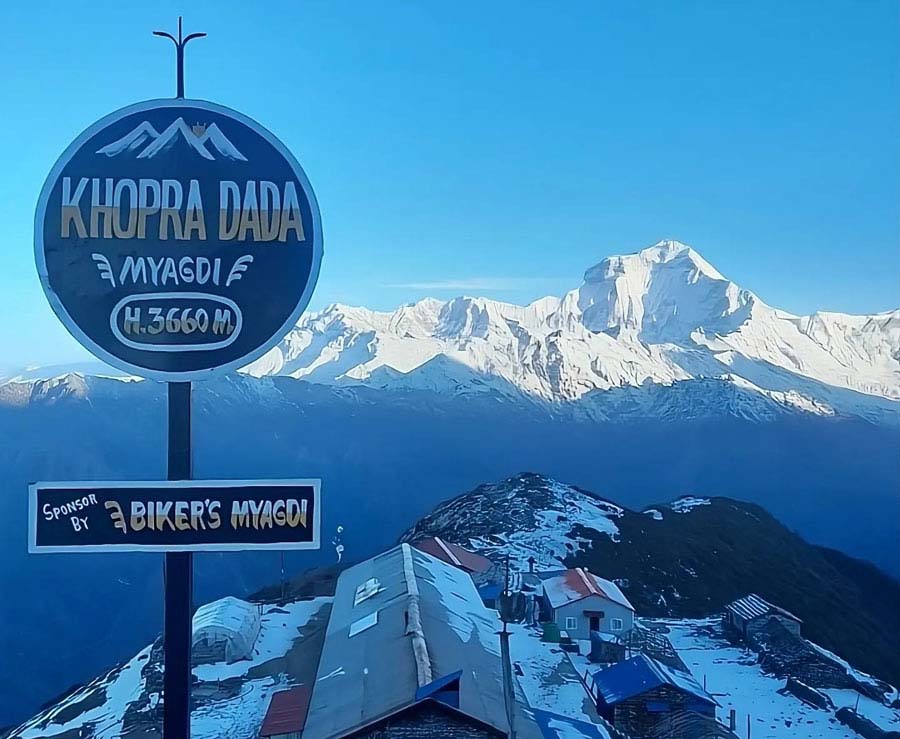
| Khopra Ridge (3,660m) | $8–$10 | $9–$11 | $10–$13 | $7–$10 |
| Khayer Lake (4,500m) | $9–$11 | $10–$12 | $11–$14 | $8–$12 |
Understanding the Price Ladder
Dal bhat—Nepal’s iconic lentil-rice combination—is the best value meal at every altitude and is almost always unlimited refills. At Ghandruk, a dal bhat costs NPR 650–750. The same meal at Khopra Ridge costs NPR 1,200–1,450. The caloric content is identical. The difference is logistics.
The ‘staple menu’ rule: Always order from the teahouse’s regular menu—pasta, rice, dal bhat, noodles—rather than ‘imported’ items like pizza or burgers, which cost 30–40% more and take longer to prepare. A simple breakfast of porridge, eggs, and tea costs $4–$6 at any altitude; a ‘western breakfast’ of toast, pancakes, and imported jam costs $8–$10.
Teahouse Accommodation: The Community Lodge Model of Khopra
Khopra Danda operates on a unique ‘Community Lodge’ model that differentiates it from commercialized trekking routes like the Annapurna Circuit. The lodges at Khopra Ridge and Dobato are managed by the local Magar and Gurung communities under a cooperative structure established with ACAP support. This has two practical implications for trekkers:
- Community-Managed Pricing: Lodge rates are standardized across competing teahouses at each settlement. You will not find one lodge charging $5 and another charging $12 for the same room at Khopra Ridge. In 2026, bed rates at Khopra range from NPR 800–1,200 ($6–$9) per person per night.
- The ‘Eat Where You Sleep’ Expectation: Unlike some commercialized routes where trekkers can sleep at one lodge and eat at another, Khopra’s community lodges operate on the assumption that guests purchasing accommodation will take their meals in that lodge’s dining hall. This unwritten rule is respected by all responsible agencies and guides. Violating it—sleeping at Lodge A and eating at Lodge B—undermines the local economy and creates diplomatic friction. Your guide will brief you on this etiquette.
Below the community lodge zone (Ghandruk, Tadapani), private teahouses operate on standard market pricing. Accommodation is cheaper ($3–$7/night) but rooms are more basic. At Ghandruk—one of Nepal’s most beautiful traditional stone villages—several mid-range lodges offer en-suite rooms at $15–$20/night, making it an optional ‘comfort splurge’ point.
The 2026 Digital Revolution: Starlink Internet in the Himalayas
In 2025-2026, Starlink satellite internet reached a significant number of teahouses on the Annapurna trail network, including lodges at Ghandruk, Tadapani, and even the higher community lodges at Dobato and Khopra Ridge. This is a genuine improvement in trekker experience—and a new line item in your budget.
- Starlink/High-Speed WiFi Daily Access Fee: $3–$5 USD per day per device (NPR 400–660). Some lodges offer 24-hour plans; others charge by the hour ($0.50–$1/hour).
- Lower-altitude lodges (Birethanti, Nayapul) may include WiFi free with room booking or meals, as they have cheaper traditional broadband connections.
- Signal quality varies. Starlink operates best in clear weather; heavy cloud and precipitation reduce speeds. Do not expect Starlink to replace proper offline navigation—always download maps on your device before leaving Pokhara.
PRO TIP: Purchase a Ncell or NTC local SIM with a data package in Pokhara before your trek for NPR 500–800 (~$4–$6). This provides 4G connectivity up to approximately 2,500m altitude and is often cheaper than daily WiFi fees at lower-altitude teahouses.
Phase 4: Staffing Costs and the 2026 Mandatory Guide Regulation
This section requires absolute clarity because it is the area most affected by Nepal’s 2026 regulatory changes—and the area where unscrupulous operators most frequently mislead clients.
The ‘No Guide, No Trek’ Rule: A Non-Negotiable in 2026
Since February 2024, the Nepal government has enforced a mandatory licensed guide requirement for all trekking routes in the Annapurna Conservation Area. In 2026, this enforcement has been substantially strengthened. ACAP checkpoints now verify that every trekking group has a government-licensed guide whose NMA (Nepal Mountaineering Association) license number is registered against your permits in the E-TIMS system.
Attempting to trek Khopra Danda without a licensed guide in 2026 will result in one of three outcomes: (1) being turned back at a checkpoint, (2) being assigned a local guide on the spot at inflated rates, or (3) facing a fine. None of these outcomes saves money. Independent trekking on this route is not a budget strategy—it is no longer a legal option.
Licensed Guide Rates: 2026 Official Scale
Licensed guides in Nepal are certified by the Nepal Tourism Board and the NMA. Their daily rates are set within NTB guidelines and represent a minimum floor, not a maximum. In practice, rates vary with experience, language skills, and high-season demand.
- Entry-Level Licensed Guide: $25/day (NPR 3,300). Typically 2–3 years of experience, fluent Nepali and English.
- Experienced Licensed Guide: $28–$32/day (NPR 3,700–4,200). Five or more years on Annapurna routes, often holds first aid certification.
- Senior Licensed Guide: $33–$40/day (NPR 4,350–5,280). Extensive local knowledge, bilingual or multilingual, can handle altitude emergencies.
For a 10-day trek at standard rates, a licensed guide costs $280–$320. This figure includes their accommodation and meals, which your agency arranges as part of the guide’s daily rate. You do not pay separately for your guide’s food and lodging.
Porter Rates: Strongly Advised, Not Technically Mandatory
A porter carries your heavy pack (up to 20–25kg) while you walk unencumbered. Many experienced trekkers consider hiring a porter not just a comfort but a safety decision—walking the high-altitude sections of Khopra with a 12kg pack significantly increases exhaustion and altitude sickness risk.
- Standard Porter Rate: $18–$22/day (NPR 2,376–2,904). Includes their accommodation and food.
- A porter typically carries two trekkers’ bags, meaning the cost is often split: $9–$11 per trekker per day.
- 10-day porter cost per trekker: $90–$110.
Ethical treatment of porters is not just a moral imperative—it is your agency’s professional obligation. Excellent Himalaya ensures all porters are provided with appropriate clothing, equipment, and insurance per the NTB’s Porters’ Rights Charter. Agencies that quote dramatically lower porter rates ($12–$14/day) are often violating these standards.
The 15% Tipping Culture: A Professional Guide for 2026
Tipping in Nepal’s trekking industry is not optional for responsible trekkers—it constitutes a significant portion of your guide and porter’s annual income. The 2026 industry standard is as follows:
- Licensed Guide: 15% of their total guiding fee, or a minimum of $40–$60 for a 10-day trek.
- Porter: 15% of their total porter fee, or a minimum of $25–$35 for a 10-day trek.
- Teahouse Staff: Not formally expected, but leaving NPR 100–200 (< $2) for exceptional service is appreciated.
Tipping is given on the last day of trekking, usually in a group ceremony at the final teahouse lunch. Bring crisp NPR or USD bills specifically for tipping—worn or torn banknotes are occasionally refused. Most trekkers place tips in a Thank You card or a simple envelope. Your guide will not ask for a tip; it is presented voluntarily. The most gracious gesture you can make is writing a brief handwritten note alongside the cash.
PRO TIP: Carry a separate ‘tip envelope’ in your daypack with the amount pre-calculated and pre-sealed from Pokhara. This removes the awkward math calculation at the end of an exhausting trek day.
Phase 5: The 'Silent Budget Killers' — The Costs Nobody Warns You About
In fifteen years of managing Annapurna treks, we have identified a consistent pattern: trekkers almost never go over budget on permits or guide fees. They go over budget on the $2 hot shower. The $1.50 bottle of water. The $3 WiFi. The extra blanket. These small expenses compound daily across 10 days into a $130–$250 budget hole that most trekkers do not see coming.
| Hidden Cost | Avg. Daily Cost | 10-Day Total | Money-Saving Strategy |
| Phone/Device Charging | $1–$2 | $10–$20 | Carry a solar power bank |
| Hot Shower (bucket/solar) | $2–$4 | $20–$40 | Cold showers at low altitude |
| Extra Blanket Rental | $2–$3 | $20–$30 | Bring 0°C sleeping bag liner |
| Bottled Water (1.5L) | $1.50–$3 | $15–$30 | Use Sawyer/SteriPen filter |
| WiFi / Starlink Access | $3–$5 | $30–$50 | Offline maps; limit usage |
| Snacks & Chocolate Bars | $2–$4 | $20–$40 | Pack from Pokhara market |
| Diamox / Altitude Meds | $0.50–$1 | $5–$10 | Buy in Kathmandu pharmacy |
| Bar / Drinks (tea, juice) | $1–$3 | $10–$30 | Stick to boiled water/tea |
| TOTAL HIDDEN COSTS | $13–$25 | $130–$250 | Budget NPR 15,000 reserve |
Phone Charging: The Altitude Tax on Your Electronics
Teahouses at altitude use micro-hydroelectric or solar-battery systems with limited capacity. Charging a phone or camera battery costs NPR 150–250 ($1.20–$2) per device at most lodges above 2,500m. At Khopra Ridge, with Starlink inverter loads, some lodges have begun charging NPR 300–400 ($2.30–$3) per charge. Budget for two devices charging daily and the cost adds up quickly. A high-capacity solar power bank (20,000–30,000mAh) purchased in Kathmandu for NPR 2,500–4,500 pays for itself in two days at altitude.
Hot Showers: The Mountain Luxury Tax
Below Ghandruk, some lodges offer electric hot showers included with room cost. Above Ghandruk, hot water is either solar-heated (weather-dependent, typically available 2–4pm only) or comes via bucket with boiled water. Budget NPR 250–400 ($2–$3) per shower above 2,500m. Cold showers are always free but require genuine fortitude at 3,660m. Our recommendation: cold shower at lower altitudes, hot shower treat at Khopra Ridge after summit attempt.
Bottled Water vs. Purification: A Financial and Environmental Case
A 1.5-liter bottle of water costs NPR 200 at Birethanti and NPR 350–450 at Khopra Ridge. A trekker drinking 3 liters daily from bottles spends $8–$10 per day on water alone—$80–$100 over 10 days. By contrast, a Sawyer Squeeze water filter ($25–$35, available in Thamel) purifies stream and tap water to safe drinking standards. A SteriPen UV purifier (NPR 3,500–5,000 in Pokhara) serves the same function. Both options pay for themselves within 3–4 days at altitude. The environmental argument is equally compelling: an estimated 350,000 plastic water bottles were discarded on Annapurna trekking routes in 2024-2025.
Emergency Cash Reserve: The Rule of NPR 20,000
Always carry a minimum NPR 20,000 ($150) in cash as an emergency reserve, beyond your planned budget. There are no ATMs above Pokhara on the Khopra Danda route. If your guide fee runs higher than expected, if you need an unplanned rest day at a teahouse, if you fall slightly ill and need to purchase rehydration salts and energy bars, or if your porter needs to turn back early due to illness, this reserve protects you. Keep it in a waterproof bag separate from your main wallet.
Khopra Danda vs. Everest Base Camp: The Value-Per-Dollar Argument
One of the most frequent questions we receive is: ‘Should I do Khopra Danda or Everest Base Camp?’ It is an apples-to-oranges comparison in terms of experience—but for budget-conscious trekkers evaluating value, the numbers tell a compelling story.
| Comparison Factor | Khopra Danda Trek | Everest Base Camp Trek |
| Duration | 8–10 days | 14–18 days |
| Total Cost (Budget) | $950–$1,200 | $1,250–$1,500 |
| Total Cost (Standard) | $1,300–$1,600 | $2,500–$3,200 |
| Total Cost (Luxury) | $1,700–$2,200 | $4,000–$6,000+ |
| Permit Fees | $42 (ACAP + E-TIMS) | $50+ (TIMS + Sagarmatha NP) |
| Crowds | Very Low (off-the-beaten-path) | Very High (Oct–Nov peak) |
| Altitude Max | 4,500m (Khayer Lake) | 5,364m (Base Camp) |
| Acclimatization Days | 1–2 days | 4–5 days (adds cost) |
| Helicopter Risk Cost | Lower altitude = lower risk | High = larger reserve needed |
| Scenic Value | Dhaulagiri & Annapurna panoramas | Khumbu Icefall & Everest views |
| Best For | Value-seekers, first-timers | Bucket-list high-altitude trekkers |
Why Khopra Danda Wins on Value
The Everest Base Camp trek has become one of the most expensive trekking routes in Asia when all costs are honestly accounted for. Sagarmatha National Park fees alone cost more than Khopra’s combined permit fees. The EBC route is heavily commercialized—teahouse prices are among the highest in Nepal, the trail is crowded in season, and the risk of acute mountain sickness is substantially higher due to extreme altitude, which means a larger emergency financial reserve is prudent.
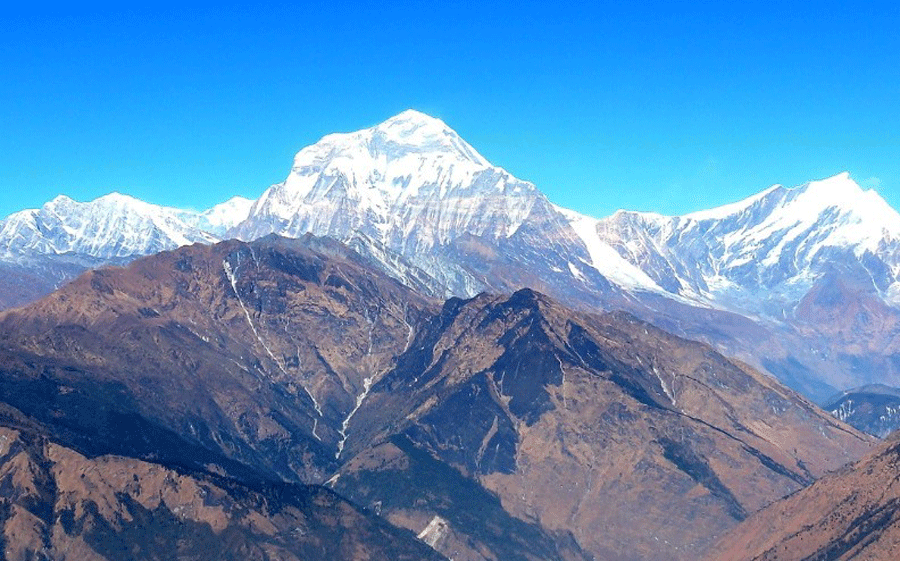
Khopra Danda delivers jaw-dropping panoramas of Dhaulagiri (8,167m), Annapurna South (7,219m), Nilgiri (7,061m), and the Himchuli massif from Khopra Ridge—views that rival EBC in photographic drama without the $2,500+ price tag. The route’s community lodge model ensures more of your money flows directly to local Gurung and Magar families rather than to Kathmandu-based hotel groups with EBC lodge chains.
For first-time Nepal trekkers testing high-altitude walking, for couples seeking a less crowded experience, or for experienced trekkers seeking exceptional scenery without breaking their annual travel budget, Khopra Danda Trek in 2026 represents the single best value per dollar of any Himalayan trekking route.
Agency vs. Independent Booking: Why 'Mandatory Guides' Doesn't Mean Maximum Cost
A common misconception since the ‘No Guide, No Trek’ rule came into force is that mandatory guide hiring automatically means you must book a full agency package. This is incorrect. However, understanding why booking through a reputable agency like Excellent Himalaya often costs less than arranging everything independently requires examining how bulk pricing and logistical efficiency actually work in Nepal’s trekking economy.
The Bulk Lodge Rate Advantage
Excellent Himalaya has operated in the Annapurna region since 2009. In that time, we have established long-term relationships with teahouse owners at every significant stopping point on the Khopra Danda route. This translates into negotiated room rates that are 15–25% below the walk-in price paid by independent trekkers who arrive unannounced. At Khopra Ridge community lodges in particular—where capacity is limited and rooms fill during peak season—pre-booked accommodation at agency rates can save $15–$25 per night compared to on-the-spot negotiation.
Logistical Efficiency: The Hidden Cost of Getting It Wrong
Consider the cost of the following scenarios that our team resolves routinely for pre-booked clients, but that independent trekkers often face as expensive surprises:
- Wrong permit type obtained: We have seen independent trekkers arrive at the ACAP checkpoint with a TIMS card (no longer valid in 2026 as a standalone document) rather than an E-TIMS. Cost of fixing on the day: NPR 3,000–5,000 in the wrong situation.
- Guide no-show: Freelance guides hired directly the day before departure occasionally cancel. Booking through an agency ensures a licensed replacement guide is available within 2 hours.
- Accommodation full at altitude: Community lodges at Khopra Ridge have 6–14 beds total. Without a pre-booking system, arriving groups face sleeping on lodge floors or trekking back down in the dark. Agency pre-booking eliminates this risk.
- Emergency evacuation coordination: In the event of an altitude-related medical emergency, an agency with 24/7 Kathmandu support can coordinate helicopter rescue, contact your insurance provider, and manage the logistics while you focus on the trekker in distress.
What Does an Excellent Himalaya Package Include?
Our standard Khopra Danda packages for 2026 are structured as follows:
- All permits (ACAP + E-TIMS) arranged and paid in advance.
- Airport and city transfers within Kathmandu and Pokhara.
- Kathmandu-Pokhara transportation (bus or flight, based on package tier).
- One senior licensed NMA guide with wilderness first aid certification.
- One porter (for groups of two or more trekkers).
- All teahouse accommodation pre-booked at negotiated rates.
- 24/7 emergency response from our Kathmandu operations center.
- Detailed pre-departure briefing with emergency protocols and packing list.
Meals are not included in our packages—this is a deliberate policy. Meal preferences are deeply personal, and including them would either create waste (trekkers who want to try different lodges’ cooking) or resentment (trekkers locked into a lodge menu for 10 days). We provide a day-by-day meal budget guide and a list of recommended dishes at each altitude.

Practical Financial Planning: The Cash vs. Card Reality of Khopra Danda
ATM Access and Cash Strategy
The last reliable ATM before the Khopra Danda trail is in Pokhara’s Lakeside area, approximately 25km from the trailhead at Nayapul. There are no ATMs, no card payment facilities, and no digital payment infrastructure (including eSewa and Khalti mobile wallets) above Pokhara as of 2026. Cash is the only currency on the trail.
Recommended cash withdrawal breakdown before leaving Pokhara:
- Daily meals for 10 days: NPR 25,000–35,000 ($190–$265)
- Accommodation (your share): NPR 8,000–14,000 ($60–$106)
- WiFi and charging fees: NPR 4,000–7,000 ($30–$53)
- Hot showers and extras: NPR 3,000–5,000 ($23–$38)
- Snacks and personal purchases: NPR 5,000–8,000 ($38–$61)
- Guide and porter tips (pre-converted): NPR 7,000–12,000 ($53–$91)
- Emergency reserve: NPR 20,000 ($150)
Total recommended cash: NPR 72,000–101,000 (~$545–$765). Keep this in two separate locations (daypack and main bag) in small denomination NPR bills. NPR 500 and NPR 1,000 notes are universally accepted; changing a NPR 5,000 note in a mountain teahouse can be problematic.
Currency Exchange: Where to Get the Best Rate in 2026
Nepal’s official exchange rate and the tourist market rate diverge slightly. For best rates:
- Best Rate: Licensed money changers in Kathmandu’s Thamel and Pokhara’s Lakeside consistently beat hotel and airport exchange desks by 3–7%.
- Good Rate: Major bank ATMs in Pokhara (NIC Asia, Himalayan Bank) dispense NPR at close to the interbank rate with a $2–$5 flat international transaction fee.
- Worst Rate: Airport exchange counters and hotel front desks—use these only for immediate small-amount needs upon arrival.
Seasonal Pricing Variations: When You Trek Determines What You Pay
The Khopra Danda Trek Cost 2026 figures in this guide reflect the October–November peak season. Pricing varies meaningfully by season:
| Season | Months | Price vs. Peak | Trail Conditions | Recommendation |
| Autumn Peak | Oct–Nov | 100% (baseline) | Excellent, clear skies | Best overall experience |
| Spring Season | Mar–May | 95–105% | Good, rhododendron bloom | Excellent alternative |
| Winter | Dec–Feb | 75–85% | Cold, possible snow | Budget-savvy, prepared trekkers |
| Monsoon | Jun–Sep | 60–70% | Leeches, landslide risk | Not recommended |
Winter trekking (December–February) offers the lowest prices but requires heavier gear—add NPR 3,000–5,000 to your rental budget for a four-season sleeping bag and additional insulation layers. Some community lodges at Khopra Ridge may be closed in deep winter; confirm with your agency at least four weeks before departure.
Your Personal Budget Planner: A Checklist Before You Book
Use this checklist to verify you have accounted for every cost category before finalizing your Khopra Danda Trek 2026 budget:
- Nepal Visa: $30 (15-day) or $50 (30-day). Fixed.
- ACAP Permit: NPR 3,000 / ~$25. Fixed.
- E-TIMS Registration: NPR 2,000 / ~$17. Fixed.
- Travel Insurance (with heli-evacuation to 4,500m): $80–$300. Non-negotiable.
- International flights to Kathmandu: Variable. Not included in trek cost.
- Kathmandu-Pokhara transfer: $20–$150 depending on mode.
- Gear rental or purchase: $40–$120 depending on what you own.
- Licensed Guide fees (10 days): $250–$350. Mandatory.
- Porter fees (10 days): $180–$220. Strongly advised.
- Guide + Porter tips: $65–$95. Standard professional practice.
- Meals on trail (10 days): $180–$350 depending on diet and altitude.
- Accommodation (10 nights): $50–$250 depending on tier.
- WiFi, charging, hot showers, extras: $100–$200 total.
- Emergency cash reserve: NPR 20,000 (~$150) minimum.
- Miscellaneous personal expenses (souvenirs, pharmacy): NPR 3,000–8,000.
Why Excellence Costs Less in the Long Run: A Closing Note
We want to close this guide with a perspective that is often lost in cost comparisons.
In 2025, we assisted three separate trekking groups who had booked ‘ultra-budget’ packages with agencies offering Khopra Danda treks for $550 all-inclusive. In all three cases, ‘all-inclusive’ turned out to mean: no pre-booked accommodation at altitude (two groups slept in storerooms), guides without first aid training who became genuinely frightened when a client showed symptoms of mild AMS, no 24/7 emergency contact, and permit paperwork errors that delayed two groups at checkpoints by half a day.
Excellence does not mean luxury. It means everything working as it should, which protects both your safety and your budget. An emergency helicopter evacuation due to a guide failing to recognize AMS symptoms costs $5,000–$10,000. A night spent in a teahouse storeroom because accommodation wasn’t booked costs you one of the best nights of your trip. A guide who doesn’t know the community lodge etiquette costs you awkward situations and potential overcharging by teahouse owners who know you’re not under an established agency’s umbrella.
We are proud to say that in over 4,500 guided treks in the Annapurna region, Excellent Himalaya has a zero emergency evacuation due to negligence record. We track every trekker’s location daily during their trek. Our guides carry satellite communicators. Our Pokhara operations team is reachable at any hour.
The difference between a $950 budget trek done right and a $550 ‘budget’ trek that goes wrong is not $400. It is the difference between the trip of your life and a cautionary tale.
Book Your Free 2026 Consultation
Speak with our Annapurna specialists. We will build a personalized cost breakdown
for your exact group size, dates, and budget. No obligation. No hidden costs.
www.excellenttrek.com | Email: [email protected] | WhatsApp: +977-9851203181
Licensed by Tourism Ministry, Nepal Government | Licnese No. 2432 | TAAN Affiliated
About Excellent Himalaya Trek & Expedition: Established by experienced guides and Shepa and licensed by the Tourism Ministry Nepal Government, Excellent Himalaya has guided over 4,500 trekkers and climbers in the Annapurna, Everest, Langtang, and Manaslu regions. Our team of 23 senior licensed guides and 40 porters operates year-round from offices in Kathmandu and Pokhara. We are founding members of the Trekking Agencies’ Association of Nepal (TAAN) and signatories of the Responsible Trekking Nepal Pledge.
About the Author

Suman Shrestha
I am Suman Shrestha. I have dedicated my life to mastering the rhythms of the Nepal Himalayas and its culture. I am also a fully government-licensed trekking and tour guide. I've personally led hundreds of adventure groups across our country's most diverse and demanding landscapes and guided countless tour groups across every special interest imaginable. I know the ground reality of every ridge, every sacred monument, and every remote teahouse along the way, because I've earned that knowledge step by step, not from a brochure. My deep technical knowledge of Nepal’s diverse geography is matched only by my uncompromising commitment to safety. Beyond the physical path, I take a pride in being a bridge for all people by sharing the knowledge of the Himalayas, rich traditions and spiritual heritage of Nepal ensuring every journey is an authentic Experience. Let’s explore the heart of the Himalayas together. You can connect with me via WhatsApp at +9779851203181.