



Kala Patthar vs Everest Base Camp: Which Trek Is Right for You
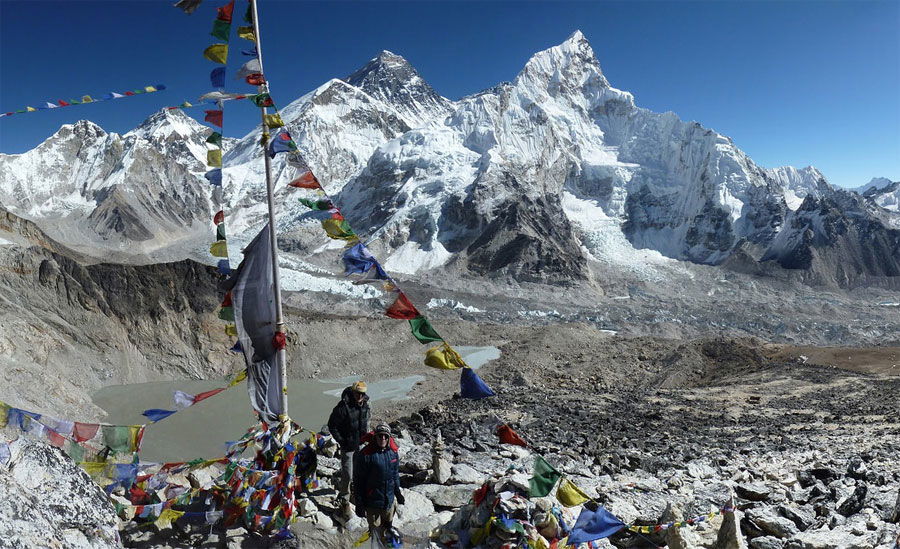
It is 5:12 in the morning, and the temperature at Gorak Shep sits somewhere around minus fifteen degrees Celsius. Your breath turns to mist the instant it leaves your lips. The headlamp on your forehead carves a pale tunnel through the darkness ahead as you place one boot carefully in front of the other on the frozen scree of Kala Patthar. Your thighs are burning. The altitude — 5,644 metres above sea level — makes every step feel like two. Then, just as the sky above the Khumbu Valley begins to bruise from black to deep violet, you reach the rocky summit ridge. And there it is: the south face of Mount Everest, lit from below by the rising sun, glowing orange and gold against a sky that has no business being that blue. In that single moment, every aching muscle becomes irrelevant.
Now picture a different scene. You are walking across the cracked grey moraine of the Khumbu Glacier, the wind carrying the distant sound of aluminium tent poles clinking in an expedition camp. A hand-painted stone marker reads: Everest Base Camp — 5,364 m. You reach out and touch it. You are standing at the foot of the highest mountain on Earth, on the very ground from which some of the world’s most extraordinary human achievements have been launched. The emotion is different here — quieter, heavier, more profound.
Both of these experiences are real, and both are possible on the same trek. But the question most trekkers ask us — and it is one we answer dozens of times each season — is simple: which one should I prioritise? Should I push for the higher, more dramatic viewpoint at Kala Patthar, or is standing at Everest Base Camp the defining moment this journey is really about?
At Excellent Himalaya Trek & Expedition, our local Nepali guides have led hundreds of trekkers from Lukla to Gorak Shep and back. We have stood on Kala Patthar at sunrise and walked the moraine to EBC more times than any of us can count. In this guide, we give you the honest, experience-backed comparison you need to decide — or better yet, plan for both.

Table of Contents
- Understanding the Two Destinations
- The Route: What to Expect on the Trail
- Altitude, Acclimatisation & Health
- The Views: An Honest Comparison
- Difficulty & Fitness Requirements
- Cost & Permits
- Best Time to Visit
- Can You Do Both? The Combined Itinerary
- Frequently Asked Questions
- Conclusion: Your Journey, Your Choice
Understanding the Two Destinations
What Is Kala Patthar?
Kala Patthar — which translates from Nepali as “Black Rock” — is a prominent peak rising to 5,644 metres (18,519 feet) on the southern slopes of Pumori, in the Khumbu region of northeastern Nepal. It sits within the boundaries of Sagarmatha National Park, a UNESCO World Heritage Site, and falls under the administrative reach of the Khumbu Pasang Lhamu Rural Municipality.
Kala Patthar is not a technical mountaineering objective — you do not need ropes, crampons, or expedition-level skills to reach it. What you do need is strong cardiovascular fitness, a well-acclimatised body, and the determination to push through the final steep ascent in thin air. The reward for that effort is arguably the finest 360-degree panoramic view of Mount Everest (8,848.86 m) available to non-technical trekkers anywhere on Earth. From its summit ridge, you can see Everest’s entire south face, the imposing bulk of Nuptse (7,861 m), the sharp pyramid of Lhotse (8,516 m), the graceful outline of Pumori (7,161 m), and the glaciated flanks of Changtse to the north. Kala Patthar is primarily a photographers’ and view-seekers’ peak — best visited at sunrise, when the light on Everest is nothing short of extraordinary.
What Is Everest Base Camp?
Everest Base Camp (EBC) sits at 5,364 metres (17,598 feet) on the lateral moraine of the Khumbu Glacier, at the foot of the infamous Khumbu Icefall. It is the staging ground for all south-side expeditions attempting to summit Mount Everest via the standard South Col route, and it has been the launchpad for virtually every successful Everest summit since Sir Edmund Hillary and Tenzing Norgay Sherpa first reached the top on 29 May 1953.
During the spring climbing season (March to May), EBC transforms into a small, wind-battered city of hundreds of expedition tents — a remarkable sight that carries a palpable sense of human ambition. Outside the spring season, the camp is largely absent of climbers, though the glacier and the icefall remain endlessly dramatic. It is important to note that, from EBC itself, the direct view of Everest’s summit is actually obscured by the surrounding ridgelines and moraines — a surprise to many first-time visitors. The mountain’s true grandeur reveals itself more fully from Kala Patthar above.
How They Relate Geographically
Both destinations are accessible from the small settlement of Gorak Shep (5,164 m), the last teahouse stop before either objective. Most trekkers spend at least one night in Gorak Shep and complete both the EBC walk and the Kala Patthar ascent as separate half-day excursions from the same base. The divergence from the main EBC trail happens right at Gorak Shep — turn left for the flat moraine walk to EBC, or head right and upward for the steep rocky climb to Kala Patthar.
Quick Comparison at a Glance
| Feature | Kala Patthar | Everest Base Camp |
| Elevation | 5,644 m (18,519 ft) | 5,364 m (17,598 ft) |
| Trek Duration | 12–14 days (from Lukla) | 12–14 days (from Lukla) |
| Best For | Panoramic Everest views & photography | Expedition atmosphere & symbolic achievement |
| Difficulty | Moderate–Strenuous | Moderate |
| View of Everest | Direct, unobstructed — the best in the region | Limited/partially blocked by moraine |
| Altitude Challenge | Higher — greater AMS risk | Lower — slightly easier on the body |
| Best Season | Oct–Nov (Autumn); Mar–May (Spring) | Mar–May (Spring); Sep–Nov (Autumn) |
| Permits Required | SNPEP + KPLRM Permit + TIMS | SNPEP + KPLRM Permit + TIMS |
| Summit Style | Rocky peak — 1–2 hour ascent from Gorak Shep | Flat glacier moraine — gradual walk |
The Route: What to Expect on the Trail
The Shared Path from Lukla to Gorak Shep
Whether your goal is Kala Patthar, Everest Base Camp, or both, your journey begins the same way: a short and often exhilarating flight from Kathmandu to Lukla (2,860 m), touching down on one of the world’s most dramatically situated airstrips. From Lukla, the classic Everest Base Camp route winds through the Khumbu Valley, crossing suspension bridges strung with prayer flags, passing through rhododendron and pine forests, and gradually rising through some of the most spectacular mountain terrain on the planet.
The route from Lukla to Namche Bazaar (3,440 m) takes two days and represents your first real introduction to Sherpa culture, yak caravans, and the social life of the trail. Namche is the commercial and cultural hub of the Khumbu region — a bustling hillside town where expedition teams resupply, trekkers acclimatise, and the local Sherpa community lives its daily life against the backdrop of enormous peaks. Your acclimatisation days here are non-negotiable and genuinely enjoyable: you can hike up to the Everest View Hotel for your first glimpse of Everest, explore the Saturday market, or simply sit in a teahouse with a mug of butter tea and watch the world go by.
From Namche, the trail climbs steadily through Tengboche — home to the famous Tengboche Monastery, the spiritual heart of the Sherpa people at 3,867 m — and continues through Dingboche (4,410 m) and Lobuche (4,940 m), with additional rest and acclimatisation days built into any responsible itinerary. The landscape grows starker and more elemental as you gain altitude: fewer trees, more rock and ice, the peaks growing larger and more imposing with every passing kilometre.
The Final Stretch: Lobuche to Gorak Shep
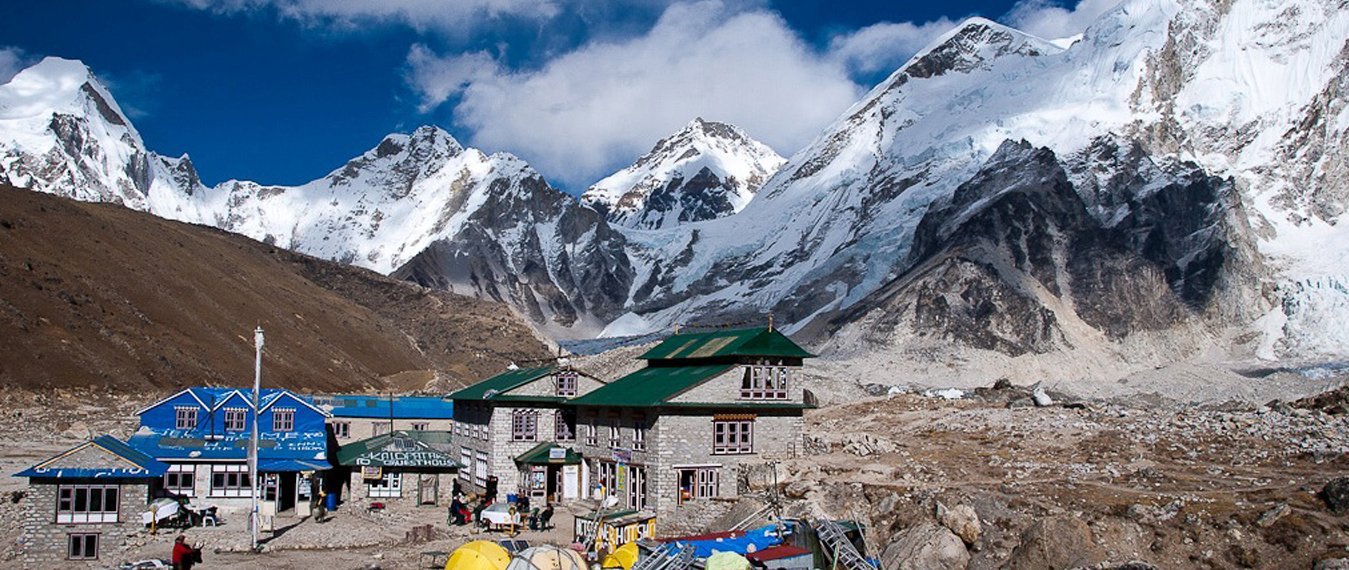
The walk from Lobuche to Gorak Shep is one of the most visually dramatic sections of the entire trek. The trail traverses the edge of the Khumbu Glacier moraine — a vast, grinding river of ancient ice and debris that creaks and groans with slow geological force. You pass the Pyramid Research Laboratory, an Italian high-altitude research station, and encounter the Khumbu Icefall in increasingly dramatic profile. Gorak Shep itself is a collection of teahouses perched on a frozen lakebed at 5,164 m — basic, wind-scoured, and utterly magnificent in its desolation.
The teahouse culture along this route is one of the trek’s great pleasures. Local Sherpa families run these lodges with remarkable warmth and hospitality, serving dal bhat, pasta, garlic soup (excellent for altitude), and surprisingly good coffee at elevations that would have seemed impossible to earlier generations of travellers. You will share dining rooms with an international cross-section of humanity: expedition climbers on their way to attempt Everest, solo trekkers from every continent, Sherpa guides comparing notes, and the occasional yak driver warming cold hands around a yak-dung stove.
This shared journey from Lukla to Gorak Shep is where the Khumbu Valley works its magic on you — long before you reach either summit or base camp. The views of Ama Dablam (6,812 m), often called the most beautiful mountain in the world, accompany you for much of the middle section of the route. By the time you arrive in Gorak Shep, you will already understand why people come back to this valley again and again.
Altitude, Acclimatisation & Health
Understanding the Altitude Difference
The 280-metre difference in elevation between Kala Patthar (5,644 m) and EBC (5,364 m) may appear modest on paper, but at altitude, it is far from trivial. Above 5,000 metres, the human body is operating with roughly half the available oxygen it would have at sea level. Every additional hundred metres gained makes breathing harder, recovery slower, and the risk of Acute Mountain Sickness (AMS) more significant.
AMS symptoms range from mild — persistent headache, fatigue, loss of appetite, disturbed sleep — to severe and life-threatening conditions including High Altitude Pulmonary Oedema (HAPE) and High Altitude Cerebral Oedema (HACE). These serious conditions are rare when a well-paced itinerary is followed, but they are not to be underestimated. Every year, trekkers have to be evacuated from the Khumbu region due to altitude illness, almost always because they ascended too quickly or ignored early symptoms.
The “Climb High, Sleep Low” Principle
The foundational principle of Himalayan acclimatisation is simple: climb high during the day, sleep low at night. This means building acclimatisation days into your itinerary — spending extra nights at Namche (3,440 m) and Dingboche (4,410 m) — and taking short, high-altitude hikes on those rest days to stimulate your body’s adaptation without pushing it past its limits. The additional days feel slow in the moment but are the single most effective tool for preventing AMS and completing the trek safely.
Hydration is equally critical. At altitude, you will need to drink three to four litres of water per day, even when you do not feel thirsty. Garlic soup — a staple of Khumbu teahouse menus — is genuinely believed by local guides and porters to support acclimatisation, and while the science is not conclusive, the warmth and hydration it provides are undeniable. Diamox (acetazolamide) is a medication some trekkers use to accelerate acclimatisation; we recommend discussing this with your physician before departure, as it has contraindications and is no substitute for a properly paced itinerary.
Why Kala Patthar Is the Greater Altitude Challenge
Because Kala Patthar sits 280 metres above EBC, and because the ascent involves a steep, rocky climb from Gorak Shep (typically departing at 3–4 AM to reach the summit at sunrise), it represents the greater physiological challenge of the two. Your body must work significantly harder to push up a steep gradient in the pre-dawn cold at that elevation than it does to walk the relatively flat moraine path to EBC.
That said, the climb to Kala Patthar is entirely manageable for any well-acclimatised, physically prepared trekker. The key word is acclimatised. Rushing the itinerary to save days is the most common mistake we see — and the most dangerous. Our standard itinerary includes 12 to 14 days for a reason: those extra days are not padding, they are protection.
When to Turn Back — An Honest Conversation
We make a point of having this conversation with every trekker we guide: there is no shame in turning back. Altitude does not care about your fitness level, your experience, or how much the trek cost. If a guide tells you to descend, descend. If your headache is worsening overnight rather than improving, that is a signal to go down, not up. The mountain will be there next season. At Excellent Himalaya Trek & Expedition, our guides are trained in wilderness first aid and high-altitude medicine, and we monitor every client’s oxygen saturation and symptoms throughout the trek. Your safety is the only non-negotiable.
The Views: An Honest Comparison
Kala Patthar: The Finest Everest Panorama on Earth
We are going to be direct about this: if seeing Mount Everest is the primary reason you are undertaking this trek, Kala Patthar is the superior destination. From the summit ridge, Everest’s entire south face is fully and dramatically visible — unobstructed, close, and almost incomprehensibly vast. The view encompasses not just Everest but the full western Cwm cirque: Lhotse to the right, Nuptse’s great western wall directly in front, Pumori rising immediately behind you, and the sweep of the Khumbu Valley stretching away to the south. On a clear autumn morning, you can see over a dozen peaks above 6,000 metres from a single vantage point.
The best time to be on the summit of Kala Patthar is at dawn. This requires a pre-dawn departure from Gorak Shep — typically between 3:00 and 4:30 AM, depending on the season and your group’s pace. The darkness and cold of the ascent are real, but they are absolutely worth it. As the sun clears the ridgeline to the east, it strikes Everest’s south face first, igniting the ice and rock in shades of amber, rose, and gold. For about twenty minutes, the mountain seems to be on fire. For photographers, this is as good as it gets anywhere on Earth without climbing technical peaks.
Photography tips for Kala Patthar: Bring a wide-angle lens (16–35mm equivalent) to capture the full panorama, and a telephoto (70–200mm) to isolate Everest’s summit and the Khumbu Icefall. A sturdy tripod is essential for pre-dawn shots. In autumn, expect temperatures at the summit of minus 15 to minus 25 degrees Celsius — bring hand warmers for your batteries and keep your camera close to your body during the ascent to preserve battery life.
Everest Base Camp: Atmosphere Over Vista
EBC offers something genuinely different — and genuinely powerful — but it is important to be honest about the view itself. From the Base Camp marker, Everest is not the centrepiece of the visual scene. The mountain is partially obscured by the surrounding terrain — the West Shoulder of Everest, the Lho La pass, and the glacier moraine block the direct sight line to the summit. What you see instead is the lower section of the Khumbu Icefall: a tortured, grinding cascade of seracs, crevasses, and ice towers that represents one of the most dangerous passages on the entire Everest route.
In spring, when expeditions are active, EBC is a genuinely extraordinary place: a temporary community of hundreds of climbers, Sherpas, doctors, journalists, and support staff, all gathered around a shared and extraordinary ambition. The prayer flags, the expedition tents arranged by team colours, the sound of helicopters ferrying supplies, the sight of climbers in down suits preparing for rotation — it is unlike any other place in the world.
Outside the spring season, EBC is quieter and more austere. The glacier is always present, always moving, always impressive — but the human drama of the climbing season is absent. For many trekkers, the autumn visit to EBC is actually more contemplative and moving precisely because of that quietude.
Photography tips for EBC: The Khumbu Icefall photographs best in morning light. If you are visiting in spring, the expedition camps provide extraordinary colour and human interest. Bring a polarising filter to manage the intense glare from the glacier. In any season, the walk along the moraine offers dramatic leading-line compositions.
The Honest Verdict on Views
For the classic, unmistakable view of Mount Everest — the one you have seen in photographs and imagined from the other side of the world — Kala Patthar wins, without question. For the atmospheric experience of standing at the literal base of the world’s highest mountain, surrounded by the evidence of human ambition at its most extreme, EBC is irreplaceable. The good news is that you do not have to choose. Most trekkers who reach Gorak Shep do both — and should.
Difficulty & Fitness Requirements
Physical Preparation for Each
Neither Kala Patthar nor Everest Base Camp is a casual stroll. Both require sustained physical effort over multiple days at elevations where your body is working significantly harder than at sea level. That said, neither requires technical mountaineering skills, and both are completed every season by trekkers ranging from their twenties to their seventies.
For EBC: The trail is long but mostly follows gradual gradients along valley floors, riverbeds, and moraine edges. The Lobuche-to-Gorak Shep section is the most challenging stretch, with rocky, uneven terrain. A reasonable baseline of cardiovascular fitness — the ability to hike six to eight hours per day for multiple consecutive days — is the minimum requirement.
For Kala Patthar: The additional challenge is the steep 480-metre ascent from Gorak Shep to the summit, conducted at pre-dawn temperatures and at an altitude where every step demands conscious effort. Strong legs, good aerobic capacity, and genuine mental determination are required. It is not technically hard, but it is genuinely tough — and that is part of what makes it so rewarding.
Who Each Trek Is Best Suited For
- EBC is ideal for: first-time Himalayan trekkers, those with moderate fitness levels, trekkers prioritising the cultural and atmospheric experience, and anyone on a slightly tighter schedule.
- Kala Patthar is ideal for: photographers, view-seekers, experienced trekkers, those who prioritise the summit experience, and anyone willing to push a little harder for the defining panorama.
- Both together is ideal for: the vast majority of trekkers who make it to Gorak Shep and want the complete Khumbu experience — which is exactly what we recommend.
Training Recommendations
Begin training at least three months before your departure. Focus on cardiovascular fitness with long-duration activities rather than high-intensity short bursts: hiking, stair climbing with a loaded pack, long-distance running or cycling. Weekend hikes of six or more hours with a 7–10 kg daypack are the most directly applicable training. If you have access to high altitude before the trek — even 2,000 to 3,000 metres — a weekend trip is valuable for understanding how your body responds.
Cost & Permits
Permits Required for the EBC Region
Sagarmatha National Park Entry Permit (SNPEP): NPR 3,000 per person (approximately USD 22–25). This is payable at the park entry checkpoint in Monjo, shortly before Namche Bazaar.
Khumbu Pasang Lhamu Rural Municipality (KPLRM) Permit: USD 20 per person per trip. Introduced in recent years, this permit supports local infrastructure and is checked at multiple points along the route.
TIMS Card (Trekkers’ Information Management System): NPR 2,000 per person (approximately USD 15). Issued by the Nepal Tourism Board or the Trekking Agencies’ Association of Nepal (TAAN). Note: TIMS requirements and fee structures are periodically updated — always verify current requirements with your operator or the Nepal Tourism Board before travel.
Total Package Cost
A full 12–14 day EBC and Kala Patthar trek package from Kathmandu, including all accommodation, meals on the trail, guide fees, porter fees, and permits, typically ranges from USD 1,200 to USD 2,500 per person when booked through a reputable local operator. International agencies booking the same trek can charge two to three times as much, with the difference going largely to the middleman rather than to the local guides, porters, and communities who actually make your trek possible.
At Excellent Himalaya Trek & Expedition, our packages are competitively priced and include the expertise of local Nepali guides who have grown up in the Khumbu region. We are transparent about what is and is not included, and we are happy to customise an itinerary to your schedule, budget, and fitness level.

Best Time to Visit
The Khumbu region offers two primary trekking windows each year, bookending the monsoon season. Choosing the right season significantly affects your experience of both Kala Patthar and Everest Base Camp.
Spring (March to May): This is the Everest climbing season, which means EBC is at its most dramatic and atmospheric — hundreds of expedition teams are active, the camp is alive with human energy, and the icefall is in constant motion. Temperatures are warming, rhododendrons bloom lower in the valley, and the skies are generally clear. This is the best season if experiencing EBC with expedition teams is a priority.
Autumn (September to November): This is widely considered the finest trekking season in Nepal. The monsoon has washed the air clean, visibility is at its best, the skies are a deep, saturated blue, and the mountain views are extraordinary. Temperatures are crisp but manageable. October and November are the peak months for Kala Patthar photography. This is the season we recommend most often to trekkers asking for their best overall experience.
Monsoon (June to August): The monsoon brings heavy rain, cloud cover, leeches on the lower trails, and significantly impaired visibility at altitude. We do not recommend this season for the EBC-Kala Patthar route.
Winter (December to February): The route is technically possible in winter but genuinely demanding. Extreme cold (temperatures can drop to minus 30 degrees Celsius at Kala Patthar), heavy snowfall, and potential route closures make this a season for experienced, well-equipped trekkers only.
Seasonal Overview
| Season | Kala Patthar | EBC | Visibility |
| Spring (Mar–May) | Excellent — warm, clear | Best — expedition camps active | High |
| Summer/Monsoon (Jun–Aug) | Poor — clouds, rain, leeches | Poor — dangerous trails | Low |
| Autumn (Sep–Nov) | Excellent — clearest skies | Very Good — quieter | Very High |
| Winter (Dec–Feb) | Risky — extreme cold, snow | Risky — route closures | Low |
Can You Do Both? The Combined Itinerary
The answer is yes — and it is exactly what we recommend to the overwhelming majority of trekkers who make it to Gorak Shep. Both Kala Patthar and Everest Base Camp are accessible from Gorak Shep, and they can be completed on consecutive half-days without adding a single extra night to your itinerary.
The standard approach is to arrive in Gorak Shep in the early afternoon, drop your bags, and make the two-to-three-hour round trip to Everest Base Camp that same afternoon. You return to Gorak Shep for dinner and an early sleep, then rise at 3:00 to 4:00 AM to begin the ascent to Kala Patthar, timing your arrival at the summit for sunrise. By 8:00 or 9:00 AM, you are back in Gorak Shep for breakfast, having witnessed both the Khumbu Glacier up close and the finest aerial panorama of Everest the trek has to offer — all within approximately 18 hours.
This combined approach gives you the full spectrum of what the Khumbu has to offer: the ground-level drama of Base Camp and the soaring, photographic grandeur of Kala Patthar. It is the most complete version of this trek, and it is the version that most trekkers describe — years later — as one of the defining experiences of their lives.
Our 14-day EBC + Kala Patthar combined itinerary is our most popular package, designed by local guides who know exactly how to pace the route for maximum experience and minimum AMS risk.
Frequently Asked Questions
Q1: Is Kala Patthar harder than Everest Base Camp?
A: Yes, Kala Patthar is generally considered more challenging than Everest Base Camp, primarily due to its higher elevation of 5,644 metres compared to EBC’s 5,364 metres, and the steep, rocky ascent required to reach the summit. The pre-dawn timing of the climb adds a further physical and psychological challenge. That said, both objectives are achievable by any healthy, well-acclimatised trekker with a reasonable level of fitness. The difficulty difference between the two is meaningful but not dramatic — particularly if you have paced your itinerary correctly.
Q2: Can you see Mount Everest from Everest Base Camp?
A: This surprises many trekkers: the direct view of Everest’s summit from EBC is actually limited or partially blocked by the surrounding terrain — specifically the West Shoulder of Everest and the flanking ridgelines. You can see the lower section of the Khumbu Icefall clearly, and the scale of the surrounding peaks is deeply impressive, but the iconic summit view of Everest is best experienced from Kala Patthar, not from EBC. This is one of the key reasons we always recommend visiting both.
Q3: How many days does it take to reach Kala Patthar?
A: A well-structured itinerary from Lukla to Kala Patthar and back takes 12 to 14 days, including necessary acclimatisation days at Namche Bazaar and Dingboche. Faster itineraries of 10 to 11 days exist but significantly increase the risk of altitude sickness. We strongly recommend the longer schedule — the extra days are used for vital acclimatisation hikes, not idle rest, and they make the difference between completing the trek safely and being evacuated by helicopter.
Q4: What permits do I need for the EBC trek?
A: You need three permits for the Everest Base Camp and Kala Patthar trek: the Sagarmatha National Park Entry Permit (SNPEP), the Khumbu Pasang Lhamu Rural Municipality (KPLRM) Permit, and a TIMS (Trekkers’ Information Management System) card. Combined, these currently cost approximately USD 55–60 per person, though fees are updated periodically by the Nepal Tourism Board. Your trekking operator — including us at Excellent Himalaya Trek & Expedition — will arrange all permits on your behalf as part of your package.
Q5: Which is better for photography — Kala Patthar or EBC?
A: For landscape and mountain photography, Kala Patthar is far superior — it offers an unobstructed, elevated panorama of Everest’s south face, best photographed at sunrise when the light turns the mountain golden. For documentary and human interest photography, EBC during the spring climbing season is extraordinary, with expedition camps, Sherpa culture, and the drama of the icefall all within frame. Ideally, visit both: Kala Patthar for the landscape shots, EBC for the human story.
Q6: Is it safe to do Kala Patthar without a guide?
A: Technically, you can trek to Kala Patthar independently. In practice, we strongly advise against it, particularly for the Kala Patthar ascent. The pre-dawn start, unmarked sections of the rocky summit approach, rapidly changing weather, and the genuine risks of altitude sickness at 5,644 metres all make a qualified local guide not just valuable but potentially life-saving. Our guides carry pulse oximeters, altitude medicine, and wilderness first aid training — and they know when it is time to turn back, long before the situation becomes an emergency.
Q7: What is the best season for the Kala Patthar trek?
A: The two best seasons are spring (March to May) and autumn (September to November). For the clearest skies and finest photographic conditions at Kala Patthar, October and November offer unbeatable visibility — the post-monsoon air is clean, the temperatures are crisp, and the light on Everest at sunrise is as good as it gets. For the additional spectacle of active expedition teams at Base Camp, spring is unmatched. Both seasons are excellent; the choice comes down to your priorities.
Q8: How fit do I need to be for EBC or Kala Patthar?
A: You do not need to be an athlete, but you do need a genuine foundation of cardiovascular fitness. If you can comfortably hike six to eight hours per day for several consecutive days, you have the baseline. For Kala Patthar specifically, the ability to sustain effort on a steep ascent at altitude is important — strong legs and good aerobic capacity matter here. We recommend a dedicated training programme of at least three months before departure, focusing on long-duration hiking with a weighted pack. Age is not a barrier — we have guided trekkers in their late sixties to both objectives.
Conclusion: Your Journey, Your Choice
After hundreds of guided treks through the Khumbu Valley, our honest verdict is this: both Kala Patthar and Everest Base Camp are genuinely, profoundly worth doing. They offer fundamentally different experiences of the same extraordinary landscape — one elevated and visual, the other grounded and atmospheric — and together they constitute the most complete trekking experience in the Himalaya.
If you can only choose one: choose Kala Patthar for the view of Everest; choose EBC for the experience of standing where history was made. But if you can make it to Gorak Shep, do both. The extra effort to climb Kala Patthar at dawn, after your afternoon at EBC, is the difference between a great trek and an unforgettable one.
What the right choice always comes down to, in our experience, is this: go with people who know the mountain. Local guides who have grown up in these valleys, who can read the weather, monitor your health, tell you when to push and when to turn back, and share the cultural and human stories that no guidebook fully captures. That is exactly what we offer at Excellent Himalaya Trek & Expedition.
Ready to plan your Khumbu adventure?
Our local Nepali guides are ready to build your perfect itinerary.
Contact us Email: [email protected]/ Whatsapp +9779851203181
About the Author

Suman Shrestha
I am Suman Shrestha. I have dedicated my life to mastering the rhythms of the Nepal Himalayas and its culture. I am also a fully government-licensed trekking and tour guide. I've personally led hundreds of adventure groups across our country's most diverse and demanding landscapes and guided countless tour groups across every special interest imaginable. I know the ground reality of every ridge, every sacred monument, and every remote teahouse along the way, because I've earned that knowledge step by step, not from a brochure. My deep technical knowledge of Nepal’s diverse geography is matched only by my uncompromising commitment to safety. Beyond the physical path, I take a pride in being a bridge for all people by sharing the knowledge of the Himalayas, rich traditions and spiritual heritage of Nepal ensuring every journey is an authentic Experience. Let’s explore the heart of the Himalayas together. You can connect with me via WhatsApp at +9779851203181.