


Annapurna Circuit Trek Cost 2026/27: Real Price Breakdown

Updated [July 13th, 2026]. Written and reviewed by Suman Shrestha, licensed guide (Nepal Government License No. 2212)
So, you’re planning to cross the legendary Thorong La Pass at a breathtaking 5,416 meters, walk through the Kali Gandaki Gorge—the deepest gorge on the planet—and complete a full loop around the majestic Annapurna massif, one of the most celebrated trekking routes in the world. It’s a dream adventure that takes you through subtropical forests, terraced hillsides, high alpine desert, and traditional Gurung and Thakali villages, all while climbing to one of the highest trekking passes on the planet.
But before you commit your time, money, and energy to this journey, you want a clear answer to exactly what it’s going to cost — and if you’ve already gotten a quote from an international operator or booking platform north of $1,500, you’re not being scammed; that’s a genuine market price for this trek. The real question is whether a Kathmandu operator quoting $745-895 for the same route can actually deliver it safely, or whether that price is a warning sign.
As a local trekking guide who has walked this trail more times than I can count, I’ve written this guide to show my math, not just state a number. You’ll see exactly what our package includes and what the same trek costs if you priced out each piece yourself — figures you can check against any other Kathmandu operator’s public pricing.
Quick Answer: How Much Does the Annapurna Circuit Trek Cost in 2026/2027?
The Annapurna Circuit Trek costs $745 to $895 per person with Excellent Himalaya Trek, for a private guided 14 to 19-day itinerary. That price includes the ACAP permit, a licensed guide, teahouse accommodation every trek night, and three meals a day on the trail.
For comparison, other registered Kathmandu-based trekking agencies typically quote $900-1,800 for comparable guided itineraries, and international operators or booking platforms typically charge $1,500-3,000+. If you priced out every piece of this trek yourself — guide, permits, teahouses, food, all booked separately — you’d likely spend more than our package price, not less. That comparison is broken down later in this guide.
Cost Snapshot at a Glance:
| Duration | Route | Price per person |
| 14 days Annapurna Circuit Trek | Classic Circuit | $745 (2+ trekkers) |
| 16 days Annapurna Circuit Trek | With the Tilicho Lake extension | $825 |
| 17 days Annapurna Circuit Trek | Classic circuit, extra acclimatization | $850 |
| 19 days Annapurna Circuit Trek | Full circuit + Poon Hill | $895 |
We operate several fixed itineraries for the Annapurna Circuit in 2026/2027 – all private departures with a dedicated licensed guide. Whether you want the classic 14-day route or an extended circuit with side trips, we build each trip around your dates.
Prices are for 2026/2027 departures and may shift slightly if the government updates permit fees or taxes. We always confirm the final cost of the circuit trek in writing before you pay a deposit. Groups of 5+ trekkers receive additional discounts, and student or youth groups can request special rates. Customizing your itinerary – adding acclimatization days, extra nights in Pokhara, or side trips – will adjust the total cost accordingly.
Annapurna Circuit Trek Cost Per Day (2026/27)
Here’s what a single day on the trail costs, broken down by category. These figures assume mid-range choices — basic teahouse rooms, a mix of local and Western dishes, and normal (not excessive) use of hot showers and Wi-Fi.
| Category | Low estimate | High estimate | Included in our package? |
| Teahouse accommodation | $3 | $15 | Yes — every trek night |
| Food (3 meals) | $15 | $30 | Yes — every trek night |
| Guide (day rate, if independent) | $25 | $40 | Yes — full trek |
| Porter (optional, if independent) | $20 | $25 | Optional add-on |
| Personal extras (shower, charging, Wi-Fi, snacks) | $8 | $18 | No — budget separately |
| Total self-arranged, per day | $71 | $128 | — |
| Total on our package, per day (personal extras only) | $8 | $18 | — |
Over a 14-day trek, that’s roughly $150–250 in personal on-trail spending on top of the $745–895 package price — consistent with the figure already cited in our Miscellaneous & Hidden Costs section.
What’s included in our Annapurna Circuit Packages?
- On your arrival day, an airport pickup service by car.
- Hotel accommodation: 2 nights in Kathmandu + 1 night in Pokhara (tourist standard/3-star with breakfast) – our pre-trek hotel arrangements are handled for you
- Teahouse accommodation on a twin-sharing basis for every trek night
- 3 Meals (breakfast, lunch, and dinner) in a day during the trek.
- Drive from Kathmandu to Bhulbhule by Bus.
- Other ground transportation as per the itinerary.
- Drive from Pokhara to Kathmandu by Tourist Bus
- Experienced, friendly licensed trekking Guide.
- Expenses for food, accommodation, insurance, transport, and the wages of the trekking guide.
- Annapurna Conservation Area Permit (ACAP) fee.
- Trekking Permit (TIMS Card fee.
- Altitude medicines, an oximeter, and first aid medicines.
- Micro Spikes (Crampons) if needed.
- Seasonable fruits in trek.
- Map of the Annapurna Circuit Trekking route.
- The Trip Achievement Certificate will be awarded after completion of the trip.
- All government taxes, local taxes, and tourist service charges.
- On your departure day, airport drop-off service by car.
What’s Not Included (Extra & Personal Expenses)?
- Airfare for your international flight.
- Nepal Visa Fee (You can easily get a Nepal visa upon arrival at the airport in Kathmandu)
- Your travel insurance (As the Annapurna Circuit trek is a high altitude journey, it is advised to do travel insurance which covers medical & helicopter evacuation from a high altitude, 5500 meters)
- Alcoholic beverages, hot and cold drinks, hot water, bottled water, and dessert.
- All kinds of personal expenses like phone calls, internet use, laundry, battery charge, hot shower during trekking, excess baggage charge, etc.
- Lunch and dinner in Kathmandu and Pokhara
- In case of emergency, helicopter rescue/ evacuation & its cost.
- Porter (Porter is optional)
- Tips for Trekking Staff.
- Any expenses arising due to unforeseen situations like flight cancellation, personal sickness, natural calamities, political strikes, etc.
Notes:
I. The above cost is on a per-person basis for a minimum group size of two persons.
I. If you are single and want to go Solo trekking. We also organize the Annapurna Base Camp Trek for solo trekkers. For the solo trekker, we have a separate special price. Please contact us for the price of Solo Trekking.

Why Excellent Himalaya’s price sits below the market average
Most Annapurna Circuit packages priced above $1,000 aren’t more expensive because the trek itself costs more. They’re more expensive because of how many hands the booking passes through before it reaches you. International trekking marketplaces and booking platforms typically resell itineraries built by local operators, adding a commission layer of 20–30% on top of the ground cost. Excellent Himalaya Trek is the operator on the ground. We run this trek ourselves, with our own guides and porters, rather than subcontracting it out or selling someone else’s itinerary under our name. When you book directly with us, you’re paying for the trek, not for the marketing and referral fees stacked on top of it elsewhere.
The second reason is structural, not promotional: our itineraries are built to match what the trek actually requires, not padded to justify a higher price tag. We don’t add unnecessary hotel nights in Kathmandu or Pokhara, and we don’t inflate group sizes past the point where a guide can realistically manage everyone’s safety and pace. Every night in the itinerary is either a travel day, an acclimatization day, or a night on the trail; nothing is added simply to make the package look longer or more comprehensive than it needs to be.
We pay fair guide and porter wages, carry proper insurance, include acclimatization days, and never cut corners on safety equipment. Suspiciously cheap deals from unlicensed local service providers often mean uninsured guides, skipped rest days, and zero emergency backup – risks that can cost thousands in helicopter evacuation fees.
Finally, being a Kathmandu-based operator with direct, long-standing relationships with our guides and porters rather than a subcontracted network assembled per season keeps our fixed costs lower without affecting what you actually get on the trail: the same permits, the same licensed guide standard, the same teahouse-based route every other operator in this price range offers.
Overview of Annapurna Circuit Trek
Annapurna Circuit is one of the best trekking trails in the world in terms of its outstanding scenery. This trail lies in the northwestern Himalayas of Nepal. Annapurna Circuit Trek is also called Annapurna Round Trekking because it circles the Annapurna massif/ Himalayan Range. The Annapurna Circuit trek offers an amazing panorama of snowy Mt. Manaslu (8187 m), Mt. Annapurna, Mt. Hiunchuli, Mt. Gangapurna, Mt. Nilgiri, Mt. Dhaulagiri, and many other Himalayan peaks.
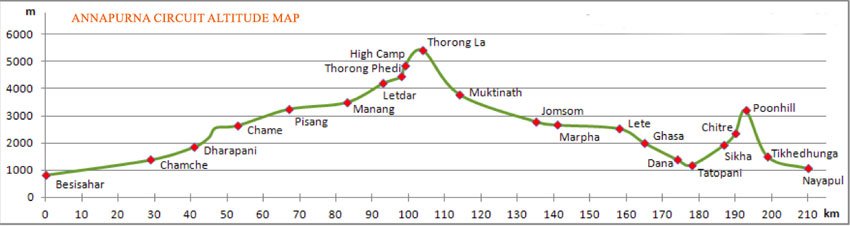
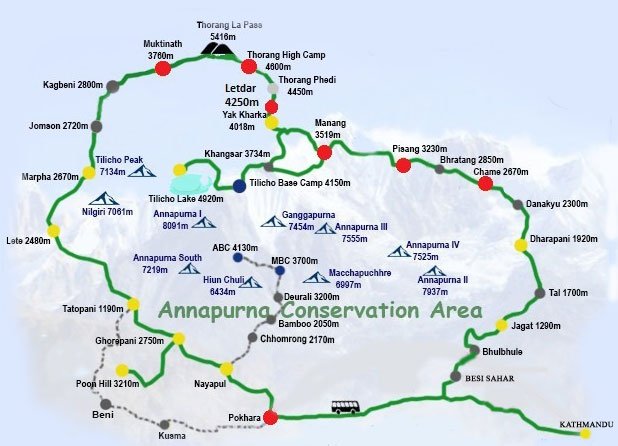 The Annapurna Circuit Trek route opened to foreign nationals in 1977. This trail starts at less than 1,000 m and reaches a height of 5,416 m. It passes through distinct regional scenery of rivers, flora, and fauna, and above different mountains. It passes through lowland Brahmin and Chhetri villages to the remote village of Manang and also descends via the Kali Gandaki Gorge, the deepest gorge in the world.
The highest point of the Annapurna Circuit is the Thorong La (5416m/17769ft). Thorong La is also considered the longest mountain pass in the world. It is a dream of all trekkers to look over the magnificent Himalayan peak with their own eyes, just sitting down on the top of that pass.
In the Annapurna Circuit Trek, the trekkers pass through four regions: Lamjung, Manang, Mustang, and Myagdi. Lamjung and Myagdi are at a lower altitude with lush green subtropical valleys with villages and terraced farming. Manang and Mustang are at a higher altitude with an arid Tibetan-style landscape. The majority of people in Manang and Mustang are Buddhists whose culture is predominantly influenced by the Tibetan people. Mustang is also one of the few places in the world to view the ancient Bonpo Religion in action. Life in this region has remained almost unchanged throughout the centuries.
Annapurna Circuit Trek starts counter-clockwise from Besisahar, following the Marsyangdi River upstream to its source near the village of Manang. Then it goes to reaches its summit in Thorung La (pass) at the height of 5416m, or 17,769 feet. The route goes past the views of mountains in the Annapurna range, Mt Gangapurna, Dhaulagiri, and also passes through the world’s deepest gorge in between two 8,000-plus meter peaks: Mt. Annapurna I and Mt Dhaulagiri. A side trip from Manang offers the icy Gangapurna Lake and the incredible natural paradise surrounding Gangapurna Glacier. Poon Hill, at the end of the trek, provides magnificent views of Mount Dhaulagiri, Annapurna South, and Macchupucchre “Fishtail Mountain.”
The trek also goes through Buddhist and Hindu villages, and also the holy sites of both religious groups. Muktinath is one of the most sacred temples for both Buddhists and Hindus. On the route from Dharapani to Kagbeni, you will be walking the Annapurna section of The Great Himalaya Trail, a long-distance trekking route that links Nepal from East to West.
People in reasonably good health can do the Annapurna Circuit trek comfortably. Trekkers slowly ascend the trail to allow for full acclimatization and optimum enjoyment of the Annapurna Circuit trek.
Highlights of the Annapurna Circuit Trek are as follows:
• Annapurna Circuit Trek is one of the best trekking routes in the world.
• Enjoy spectacular views of Mt. Annapurna I, II, III, IV, Dhaulagiri, and more.
• Cross the Thorong La pass (5416 m)- the widest pass in the world.
• Challenge yourself to cross Throng La Pass, which is an amazing hiking achievement.
• Explore Manang Village at an altitude of 3800 m.
• Discover the oldest Buddhist monastery in Braga/ Manang.
• Visit Muktinath Temple, the holy shrine of Buddhists and Hindus.
• Pass through villages occupied by diverse ethnic groups and experience vibrant local culture.
Annapurna Circuit Trek 14 Days Itinerary
| Day 1: Arrival at Kathmandu International Airport. You will be welcomed by our Tour officer at the airport & transfer to the hotel. Overnight at Hotel in Kathmandu. |
| Day 2: Morning drive from Kathmandu to Bhulbhule, 186 km west of Kathmandu by bus. Driving 7/8 hours. Overnight at Tea House. Meal: Breakfast, lunch, dinner. |
| Day 3: Trek from Bhulbhule to Jagat (1300 m/4265 ft). Walking 6:30 hours. Overnight at Tea House. Meal: Breakfast, lunch, dinner |
| Day 4: Trek from Jagat to Dharapani (1860 m/6102 ft). Walking 6 hours. Overnight at Tea House. Meal: Breakfast, lunch, dinner. |
| Day 5: Trek from Dharapani to Chame (2725m/8940ft). Walking 6 hours. Overnight at Tea House. Meal: Breakfast, lunch, dinner. |
| Day 6: Trek from Chame to Pisang (3190m/10466ft). Walking 6 hours. Overnight at Tea House. Meal: Breakfast, lunch, dinner. |
| Day 7: Trek from Pisang to Manang (3500m/11483ft). Walking 6 hours. Overnight at Tea House. Meal: Breakfast, lunch, dinner. |
| Day 8: Day in Manang for acclimatization. Explore the beautiful Manang Valley. Overnight at Tea House. Meal: Breakfast, Lunch & Dinner. |
| Day 9: Trek from Manang to Yak Kharka (4090m/13418ft). Walking 3/4 hours. Overnight at Tea House. Meal: Breakfast, lunch, dinner. |
| Day 10: Trek from Yak Kharka to Thorang Phedi (4441m/14570ft). Walking 4 hours. Overnight at Tea House. Meal: Breakfast, lunch, dinner. |
| Day 11: Trek from Thorung Phedi to Thorang-la Pass (5416m/17769ft) to Muktinath. Walking 8 hours. Overnight at Tea House. Meal: Breakfast, lunch, dinner. |
| Day 12: Drive from Muktinath to Pokhra by bus. Driving 7 hours. Overnight at the hotel in Pokhara. Meal: Breakfast & Lunch. |
| Day 13: Drive from Pokhara to Kathmandu by tourist bus. Driving 7 hours. Overnight at the hotel in Kathmandu. Meal: Breakfast. |
| Day 14: Departure for your home country. Our tour officer will drop you off at Kathmandu International Airport and see you off. End of Service. |
Annapurna Circuit Trek with Poon Hill 16 Days Itinerary
| Day 1: Arrival at Kathmandu International Airport. You will be welcomed by our Tour officer at the airport & transfer to the hotel. Overnight at Hotel in Kathmandu. |
| Day 2: Morning drive from Kathmandu to Bhulbhule, 186 km west of Kathmandu by bus. Driving 7/8 hours. Overnight at Tea House. Meal: Breakfast, Lunch & Dinner. |
| Day 3: Trek from Bhulbhule to Jagat (1300 m/4265 ft). Walking 6:30 hours. Overnight at Tea House. Meal: Breakfast, Lunch & Dinner. |
| Day 4: Trek from Jagat to Dharapani (1860 m/6102 ft). Walking 6 hours. Overnight at Tea House. Meal: Breakfast, Lunch & Dinner. |
| Day 5: Trek from Dharapani to Chame (2725m/8940ft). Walking 6 hours. Overnight at Tea House. Meal: Breakfast, lunch, dinner. |
| Day 6: Trek from Chame to Pisang (3190m/10466ft). Walking 6 hours. Overnight at Tea House. Meal: Breakfast, lunch, dinner. |
| Day 7: Trek from Pisang to Manang (3500m/11483ft). Walking 6 hours. Overnight at Tea House. Meal: Breakfast, lunch, dinner. |
| Day 8: Day in Manang for acclimatization. Explore the beautiful Manang Valley. Overnight at Tea House. Meal: Breakfast, Lunch & Dinner. |
| Day 9: Trek from Manang to Yak Kharka (4090m/13418ft). Walking 4 hours. Overnight at Tea House. Meal: Breakfast, lunch, dinner. |
| Day 10: Trek from Yak Kharka to Thorang Phedi (4441m/14570ft). Walking 3 to 4 hours. Overnight at Tea House. Meal: Breakfast, lunch, dinner. |
| Day 11: Trek from Thorung Phedi to Muktinath via Thorang-la Pass (5416m/17769ft). Walking 8 hours. Overnight at Tea House. Meal: Breakfast, lunch, dinner. |
| Day 12: Drive from Muktinath to Tatopani by bus. Distance around 64 km. Driving 4/5 hours. In Tatopani, you can visit dip and take a bath at Natural Hot Spring Water on the bank of Kali Gandaki River. Overnight at Tea House. Meal: Breakfast, Lunch & Dinner. |
| Day 13: Trek from Tatopani to Ghorepani (2834 m/9298 ft). Walking 7 hours. Overnight at Tea House. Meal: Breakfast, lunch, dinner. |
| Day 14: Early morning hiking to Poon Hill, then back to Ghorepani. Trekking from Ghorepani to Nayapul. Walking 7 hours. Drive to Pokhara. Drive for 1:30 hours. Overnight at Hotel in Pokhara. Meal: Breakfast & lunch. |
| Day 15: Drive from Pokhara to Kathmandu by tourist bus. Driving 7 hours. Overnight at the hotel in Kathmandu. Meal: Breakfast. |
| Day 16: Departure for your home country. Our tour officer will drop you off at Kathmandu International Airport and see you off. Meal: Breakfast. End of Service. |
Annapurna Circuit Trek with Tilicho Lake 17 Days Itinerary
| Day 1: Arrival at Kathmandu International Airport. You will be welcomed by our Tour officer at the airport & transfer to the hotel. Overnight at Hotel in Kathmandu. |
| Day 2: Morning drive from Kathmandu to Bhulbhule, 186 km west of Kathmandu by bus. Driving 7/8 hours. Overnight at Tea House. Meal: Breakfast, Lunch & Dinner. |
| Day 3: Trek from Bhulbhule to Jagat (1300 m/4265 ft). Walking 6:30 hours. Overnight at Tea House. Meal: Breakfast, Lunch & Dinner. |
| Day 4: Trek from Jagat to Dharapani (1860 m/6102 ft). Walking 6 hours. Overnight at Tea House. Meal: Breakfast, Lunch & Dinner. |
| Day 5: Trek from Dharapani to Chame (2725m/8940ft). Walking 6 hours. Overnight at Tea House. Meal: Breakfast, Lunch & Dinner. |
| Day 6: Trek from Chame to Pisang (3190m/10466ft). Walking 6 hours. Overnight at Tea House. Meal: Breakfast, Lunch & Dinner. |
| Day 7: Trek from Pisang to Manang (3500m/11483ft). Walking 6 hours. Overnight at Tea House. Meal: Breakfast, Lunch & Dinner. |
| Day 8: Day in Manang for acclimatization. Explore the beautiful Manang Valley. Overnight at Tea House. Meal: Breakfast, Lunch & Dinner. |
| Day 9: Trek from Manang to Shri Kharka (4050m/13284ft). Walking 5 hours. Overnight at Tea House. Meal: Breakfast, Lunch & Dinner. |
| Day 10: Trek from Shri Kharka to Tilicho Base Camp (4150m/13615ft). Walking 3 to 4 hours. Overnight at Tea House. Meal: Breakfast, Lunch & Dinner. |
| Day 11: Trek from Tilicho Base Camp to Tilicho Lake (4919m/16138ft) and back to Shri Kharka (4050m/13284ft). Walking 7 to 8 hours. Overnight at Tea House. Meal: Breakfast, Lunch & Dinner. |
| Day 12: Trek from Shri Kharka to Yak Kharka (4090m/13418ft). Walking 5 to 6 hours. Overnight at Tea House. Meal: Breakfast, Lunch & Dinner. |
| Day 13: Trek from Yak Kharka to Thorang Phedi (4441m/14570ft). Walking 3 to 4 hours. Overnight at Tea House. Meal: Breakfast, Lunch & Dinner. |
| Day 14: Trek from Thorung Phedi to Muktinath via Thorang-la Pass (5416m/17769ft). Walking 8 hours. Overnight at Tea House. Meal: Breakfast, lunch, dinner. |
| Day 15: Drive from Muktinath to Pokhara by bus. Driving 7 hours. Distance around 154 km mountain road. Overnight at the hotel in Pokhara. Meal: Breakfast & Lunch. |
| Day 16: Drive from Pokhara to Kathmandu by tourist bus. Driving 7 hours. Overnight at the hotel in Kathmandu. Meal: Breakfast. |
| Day 17: Departure for your home country. Our tour officer will drop you off at Kathmandu International Airport and see you off. Meal: Breakfast. End of Service. |
Annapurna Circuit Trek with Tilicho Lake and Poon Hill 19 Days Itinerary
| Day 1: Arrival at Kathmandu International Airport. You will be welcomed by our Tour officer at the airport & transfer to the hotel. Overnight at Hotel in Kathmandu. |
| Day 2: Morning drive from Kathmandu to Bhulbhule, 186 km west of Kathmandu by bus. Driving 7/8 hours. Overnight at Tea House. Meal: Breakfast, Lunch & Dinner. |
| Day 3: Trek from Bhulbhule to Jagat (1300 m/4265 ft). Walking 6:30 hours. Overnight at Tea House. Meal: Breakfast, Lunch & Dinner. |
| Day 4: Trek from Jagat to Dharapani (1860 m/6102 ft). Walking 6 hours. Overnight at Tea House. Meal: Breakfast, Lunch & Dinner. |
| Day 5: Trek from Dharapani to Chame (2725m/8940ft). Walking 6 hours. Overnight at Tea House. Meal: Breakfast, lunch, dinner. |
| Day 6: Trek from Chame to Pisang (3190m/10466ft). Walking 6 hours. Overnight at Tea House. Meal: Breakfast, lunch, dinner. |
| Day 7: Trek from Pisang to Manang (3500m/11483ft). Walking 6 hours. Overnight at Tea House. Meal: Breakfast, lunch, dinner. |
| Day 8: Day in Manang for acclimatization. Explore the beautiful Manang Valley. Overnight at Tea House. Meal: Breakfast, Lunch & Dinner. |
| Day 9: Trek from Manang to Shri Kharka (4050m/13284ft). Walking 5 hours. Overnight at Tea House. Meal: Breakfast, lunch, dinner. |
| Day 10: Trek from Shri Kharka to Tilicho Base Camp (4150m/13615ft). Walking 3 to 4 hours. Overnight at Tea House. Meal: Breakfast, lunch, dinner. |
| Day 11: Trek from Tilicho Base Camp to Tilicho Lake (4919m/16138ft) and back to Shri Kharka (4050m/13284ft). Walking 7 to 8 hours. Overnight at Tea House. Meal: Breakfast, lunch, dinner. |
| Day 12: Trek from Shri Kharka to Yak Kharka (4090m/13418ft). Walking 5 to 6 hours. Overnight at Tea House. Meal: Breakfast, lunch, dinner. |
| Day 13: Trek from Yak Kharka to Thorang Phedi (4441m/14570ft). Walking 3 to 4 hours. Overnight at Tea House. Meal: Breakfast, lunch, dinner. |
| Day 14: Trek from Thorung Phedi to Muktinath via Thorang-la Pass (5416m/17769ft). Walking 8 hours. Overnight at Tea House. Meal: Breakfast, lunch, dinner. |
| Day 15: Drive from Muktinath to Tatopani (1110 m/3636 ft). Driving distance 102 km. Driving 6 to 7 hours. You can take bath/dip at Natural Hot spring on the bank of the Kali Gandaki river. Overnight at Tea House. Meal: Breakfast, lunch, dinner. |
| Day 16: Trek from Tatopani to Ghorepani (2834 m/9298 ft). Walking 7 hours. Overnight at Tea House. Meal: Breakfast, lunch, dinner. |
| Day 17: Early morning hiking to Poon Hill, then back to Ghorepani. Trek from Ghorepani to Birethanti/ Nayapul. Walking 7 hours. Drive to Pokhara. Drive for 1:30 hours. Overnight Hotel in Pokhara. Meal: Breakfast and lunch. |
| Day 18: Drive from Pokhara to Kathmandu by tourist bus. Driving 7 hours. Overnight at the hotel in Kathmandu. Meal: Breakfast. |
| Day 19: Departure for your home country. Our tour officer will drop you off at Kathmandu International Airport and see you off. Meal: Breakfast. End of Service. |

How Itineraries Affect Trek Cost?
Annapurna Circuit itineraries range from 9 days on-trail (road-supported) to 19+ days with side trips. Each extra day adds approximately USD 40–70 per person in food, accommodation, guide, and porter costs. All itineraries cross Thorong La Pass at 5,416 m, but pacing and acclimatization differ – which directly affects both your budget and your safety.
Extended Itineraries: Tilicho Lake, Poon Hill & Other Add-Ons
The 16-day version adds a 2-day side trip to Tilicho Lake from Manang – one of the world’s highest lakes at 4,919 m. Extra teahouse nights, food, and guide/porter time push the cost up. Our Annapurna Circuit packages detail these options.
The 18–19-day itinerary extends through the full Kali Gandaki section and Poon Hill with additional rest days. Each extra day adds roughly USD 40–70, depending on inclusions. Side trips to Tilicho may include small local fees (monastery donations, local transport) and higher lodging costs at elevation.
Nar Phu Valley Add-On
Trekkers wanting a more remote detour can combine the Annapurna Circuit with the Nar Phu Valley, a restricted area with its own permit requirement. This adds roughly $130–150 per person to the total cost, covering the Restricted Area Permit (RAP) on top of the standard ACAP fee, plus 3–4 additional trek days of accommodation, food, and guide/porter wages. Contact us for a combined Annapurna Circuit + Nar Phu itinerary and quote.
Contact us for a custom quote tailored to your available dates – customized does not mean overpriced.
Key Factors That Influence Annapurna Circuit Trek Cost
Your final Annapurna Circuit cost varies with trek duration, season, group size, comfort choices, and whether you book with a direct trekking company or through intermediaries.
Duration of the Annapurna Circuit Trek
More days on the trail mean more teahouse nights, meals, and guide/porter wages. A shorter 9–10-day road-supported circuit using jeeps to skip sections costs less in on-ground fees but sacrifices much of the trekking experience. Cutting acclimatization days to save money risks expensive evacuations – the opposite of saving.
Trekking Season & Weather
Spring (March-May) and autumn (late September-November) are peak seasons: accommodation prices and jeep fares run 10-20% higher than the rest of the year because lodges fill up and demand for guides peaks. In exchange, you get the most stable weather and the clearest mountain views of the year — this is what most first-time trekkers should book.
Winter (December-February) and monsoon (June-August) run 20-40% cheaper across teahouses and transport, but conditions carry real trade-offs, not just fewer crowds. Snow can close Thorong La Pass entirely in winter; some high-elevation teahouses shut down. Monsoon brings leeches at lower elevations, poor visibility, and higher landslide risk on certain trail sections. We recommend March-May and late September-November for most trekkers; winter and monsoon suit experienced, flexible trekkers who can adjust the itinerary if the weather closes the pass.
Group Size & Private vs Group Departure
Per-person costs drop as group size increases because guide fees, transport, and permit processing get shared. A couple pays more per head than four friends traveling together. Solo trekking is possible but carries a higher per-person fee due to fixed costs. Solo trekkers in 2026/2027 can join a fixed departure date through Excellent Himalaya to share guide and local transport costs.
Comfort Level: Budget Teahouses vs Upgraded Options
Basic teahouses with shared bathrooms and simple food are the standard. Where available – Manang, Jomsom, larger villages – upgraded rooms with attached bathrooms and better menus cost an extra USD 5–15 per night. Our standard trekking packages focus on reliable, clean basic teahouses. Upgrades can be requested and typically shift the total cost by USD 100–300. Decide where comfort matters most: cities before and after the trek, or on the trail itself.
Independent Trekking vs Guided Package (New Regulations)
Since April 1, 2023, foreign trekkers in the Annapurna Conservation Area are required to trek with a licensed guide attached to their permit — see the full explanation and current enforcement status under Permits & Regulations below. Independent trekking without any guide at all is not a legal option today; what’s left of “independent” is arranging your own guide and logistics piece-by-piece rather than booking a package, and that’s rarely cheaper — see the full cost comparison in the breakdown below.
Currency Fluctuations, Permit Updates & Local Inflation
Government permit fees and local transport rates can change annually. The Nepal Tourism Board offices and TAAN publish updates, and we adjust our 2026/2027 prices accordingly. We quote final package prices in USD but settle many on-ground costs in Nepali Rupees at current market rates. Once your booking is confirmed and deposit paid, we honor the quoted trek cost even if local inflation rises moderately.
Detailed Annapurna Circuit Trek Cost Breakdown (2026/2027)
This is the core of the article – a detailed cost breakdown based on real 2025/2026 and early 2027 operating costs in Nepal. All figures assume a mid-range teahouse trek with a licensed English-speaking guide. Most trekkers use the Annapurna Circuit as a teahouse trek, eliminating the need for camping equipment.
A. What our $745-895 package price actually covers
| Category | What’s included | Approx. cost if priced separately |
| ACAP permit | Processed for you | $25-30 |
| Licensed guide (14-19 days) | Included: wages/insurance/food covered | $25-30/day if hired independently |
| Teahouse accommodation | Every trek night, twin-sharing | $5-15/night if booked independently |
| Meals (3x daily) | Breakfast, lunch, dinner on the trail | $20-35/day if paid per meal |
| Ground transport | KTM-Bhulbhule, Muktinath-Pokhara-KTM | $40-80 if booked separately |
| Insurance, taxes, admin | Included | Varies |
We can hold the package at $745-895 because we book teahouses and meals in volume across dozens of groups a season, negotiate standing rates with lodge owners who know us, and don’t pay a marketing commission to an international platform reselling our itinerary. That’s margin structure, not corner-cutting — the same licensed guide, same ACAP, same acclimatization days as any operator charging twice as much.
B. What does it cost if you price the same trek out yourself, piece by piece
For a 14-day trek, priced independently at standard 2026 Kathmandu rates:
| Category | Estimated cost (USD) |
| Permits (ACAP only — TIMS not enforced) | 25-30 |
| Accommodation (13 nights, booked night-by-night) | 65-195 |
| Food & drinks (14 days, no group discount) | 280-490 |
| Guide, hired independently (14 days) | 350-420 |
| Porter, hired independently (optional, 14 days) | 280-350 |
| Local transport (approach + exit) | 40-80 |
| Equipment rental | 80-150 |
| Travel insurance | 50-150 |
| Miscellaneous | 150-250 |
| Total, self-arranged | $1,320-2,115 |
This total is higher than our package price, not lower. That’s the actual finding: piecemeal, night-by-night booking at posted rates costs more than a negotiated group package, because you’re paying retail for every transaction instead of a bulk rate. The old assumption that DIY is automatically cheaper stopped being reliably true once the 2023 guide mandate removed “skip the guide entirely” as a legal cost-cutting option.
Let’s break each category down.
Permit Costs: ACAP & the Guide Requirement (2026 status, direct answer)
Foreigners need the Annapurna Conservation Area Permit to trek in the region. For 2026/2027:
- ACAP: NPR 3,000 (~$25-30). Checked at multiple points along the trail, including Besisahar and Manang.
- TIMS: Not currently enforced at Annapurna checkpoints as of 2026. Checkpoints verify ACAP only. We still process TIMS documentation for clients as a safety-registration backup, since this specific policy has shifted before and could shift again.
Permit and Visa Costs for SAARC and Indian Nationals
| Item | Non-SAARC foreign nationals | SAARC nationals (incl. Indian citizens) |
| ACAP permit | NPR 3,000 (~$25–30) | NPR 1,000 (~$8–9) |
| Nepal tourist visa | $30–100 depending on duration | Not required for Indian citizens |
This brings the overall package cost down for SAARC trekkers by roughly $50-70 compared to the headline price, once the reduced permit fee and waived visa cost are factored in. Contact us, and we’ll adjust your quote accordingly.
Do you need a guide? Yes — and this is settled, not ambiguous. Nepal’s mandatory guide regulation for foreign trekkers on major routes, including the entire Annapurna Conservation Area, took effect on April 1, 2023, jointly issued by the Nepal Tourism Board and TAAN. What changed by 2026 is enforcement: checkpoints now verify guide credentials, not just guide presence, at multiple points along the Circuit, including Birethanti. You cannot obtain an ACAP permit without a licensed guide’s registration number attached to the application — the requirement is enforced at the permit-issuance stage in Kathmandu or Pokhara, before you ever reach the trail.
One clarification worth making because it trips people up: “mandatory guide” does not mean mandatory group travel. Solo trekkers book with us regularly — as of March 22, 2026, Department of Immigration notice, solo trekkers can now obtain even restricted-area permits without the old two-person minimum, provided a licensed guide accompanies them. The guide requirement and the group-size requirement are two separate rules, and only the first still applies on the Annapurna Circuit.
All our trekking packages include ACAP processing, service charges, and government taxes. No hidden permit costs once you book with us.
Accommodation Costs on the Annapurna Circuit
Accommodation along the Annapurna route is mostly in tea houses – simple lodges offering twin rooms with basic beds, blankets, and shared restrooms. Accommodation prices in teahouses range from $2 to $15 per night, depending on altitude. At lower altitude villages like Besisahar and Chame, expect to pay around USD 5–8 per night. Higher elevations have more basic accommodations with fewer amenities, and prices at remote stops above 3,500 m can reach USD 8–15.
Accommodation costs range from $5 to $20 per night overall. Private rooms with attached bathrooms cost $15–$20, where available (mainly in larger villages like Manang or Jomsom). Many lodges discount or waive room charges when you eat dinner and breakfast there – a system our guides leverage for you.
| Altitude Zone | Typical Nightly Rate | What to Expect |
| Below 2,500 m | USD 3–7 | Basic but comfortable, shared bathrooms, some Wi-Fi |
| 2,500–3,500 m | USD 5–10 | Simpler rooms, cold at night, limited electricity |
| 3,500–4,500 m+ | USD 8–15 | Very basic teahouses, no heating, minimal amenities |
Our guided packages include teahouse accommodation every night on the trail, so you don’t need to negotiate prices or worry about availability during peak months.
Food & Drink Costs (Breakfast, Lunch, Dinner & Snacks)
Food is usually the largest variable within the Annapurna Circuit trek cost because menus shrink and prices climb as altitude increases. Food prices increase with altitude due to transport difficulties – supplies are carried by mule or porter to higher altitudes, and that cost gets passed to you.
Realistic 2026/2027 meal prices:
- Breakfast: USD 5–7 (eggs, potatoes, toast, tea/coffee)
- Lunch: USD 6–8 (dal bhat, noodle soup, fried rice)
- Dinner: USD 6–10 (dal bhat, pasta, soup combinations)
Meals cost approximately NPR 500–1,000 ($4–8) each at lower altitudes. One-time meal prices at higher stops can range from NPR 1,500 to 2,500 ($13 to $20). Daily food and drink costs typically range from $15 to $30, while daily expenses for food and accommodation on the trail typically average $30 to $50.
The cost of food per day usually ranges from $20 to $35, depending on what you order. The best budget hack? Dal bhat. Many lodges offer unlimited refills, making it the most cost-effective and energy-dense option for high-altitude trekking.
What Individual Dishes and Drinks Actually Cost
| Item | Lower villages (below 2,500m) | Higher villages (above 3,500m) |
| Dal bhat (rice, lentils, veg — free refills) | $5–7 | $9–12 |
| Noodle soup / thukpa | $4–6 | $7–10 |
| Momo (dumplings) | $4–6 | $7–9 |
| Fried rice / chow mein | $5–7 | $8–11 |
| Pizza (lower villages only) | $7–10 | Rarely available |
| Apple pie (Bhratang / Marpha specialty) | $3–5 | $4–6 |
| Porridge/muesli breakfast | $4–6 | $6–8 |
| Black tea / hot lemon | $1–2 | $2–3 |
| Coffee (instant or brewed) | $2–3 | $3–5 |
| Bottled soft drink | $2–3 | $3–5 |
| Beer (bottled, where available) | $4–6 | $7–10 |
| Bottled water (1 litre) | $1–1.50 | $2–2.50 |
Note on alcohol: beer and other alcoholic drinks are available at most teahouses below Manang and become rare above it. They’re excluded from every guided package on the Annapurna Circuit, ours included, and altitude makes alcohol a genuinely bad idea above 3,500m regardless of budget.
Lower villages like Besisahar or Chame offer pizza, momos, and Western dishes. Higher up – Manang, Yak Kharka, Thorong Phedi – menus focus on carb-heavy staples. A 1-liter bottle of water costs around NPR 100 to 300 ($1 to $2.5), with prices rising sharply above 4,000 m.
Our Excellent Himalaya packages include three full meals per trekking day plus safe drinking water arrangements. You only need extra cash for snacks, soft drinks, and alcohol.
Guide & Porter Costs on the Annapurna Circuit
A guide enhances safety and provides cultural insights – essential when you’re navigating road and trail sections, communicating with local communities, managing weather risks, and making altitude-related decisions. Guided treks include a licensed guide and porter services in most packages.
Realistic 2026/2027 daily rates:
- Licensed guide: Hiring a licensed guide typically costs $25 to $40 per day. Most experienced guides rate the Annapurna Circuit at around $25 to $30 per day, including their food, accommodation, and insurance.
- Porter: A porter generally costs $20 to $25 per day. Porter services typically cost $20 per day at the baseline. Porters carry up to 20kg of gear for trekkers.
In our packages, guide wages, insurance, accommodation, and meals are fully included. Porter hire is an optional add-on with clear per-day pricing. We enforce ethical porter loads (max 20–25 kg) and provide proper gear for our staff, which may make our porter costs slightly higher than extreme-budget options, but it’s the responsible approach.
Cutting guide or porter costs too low usually means unlicensed staff without insurance, poor equipment, and risky decisions at higher altitudes. That can lead to far higher rescue or medical costs.
Local Transport Costs (Kathmandu–Besisahar–Chame / Pokhara–Return)
The typical approach route: drive from Kathmandu to Besisahar, then continue by jeep on rough roads to Chame or Dharapani, then trek. Return is usually via Jomsom to Pokhara by road or flight.
Expenses for transportation from Kathmandu to the trek start range from $10 to $50, depending on comfort:
- Kathmandu → Besisahar by tourist bus or local buses: USD 10–20 per person. Public buses are the cheapest transportation option for trekkers.
- Besisahar → Chame by shared jeep: USD 25–40 per person. A private jeep from Kathmandu direct to Chame runs about USD 250–300 per vehicle.
- Jomsom → Pokhara by local bus or jeep: USD 15–30 per person. Domestic flights from Jomsom to Pokhara cost approximately USD 120–140 one way when operating.
Our standard packages include a bus from Kathmandu, a shared jeep to the trailhead, a bus/jeep back to Pokhara, and tourist bus or equivalent ground transportation back to Kathmandu. Private vehicles and flights are available as upgrades. If you choose local buses for the full journey, you’ll save on transportation costs but should expect a bumpy ride on mountain roads.
Road conditions in the Marsyangdi and Kali Gandaki valleys are rough and weather-dependent. As a local operator, we pre-arrange realistic, safe options and buffer time for delays.
Equipment & Gear Costs (Buying vs Renting)
Core trekking gear for a safe annapurna circuit in 2026/2027: broken-in trekking boots, warm layers (fleece, down jacket), waterproof shell, sleeping bag rated to -10°C or colder, trekking poles, a 40–50L backpack, gloves, hat, and headlamp.
Estimated equipment costs if buying new at home: USD 500–1,000 for a full quality kit. But if you only trek occasionally, renting in Kathmandu or Pokhara’s Thamel and Lakeside areas makes more sense:
- Rental prices: USD 1–2 per day for items like a down jacket, a sleeping bag, and trekking poles
- Total rental for a 14-day circuit trek: approximately USD 80–150
We help clients find trusted rental shops and check gear suitability for high altitude. Renting trekking gear on the trail itself is rare and much more expensive – do all fitting in Kathmandu or Pokhara at least one day before departure.
Travel Insurance Costs (High Altitude & Helicopter Evacuation)
Comprehensive travel insurance is mandatory for trekking in Nepal. Your policy must cover high altitude trekking (minimum up to 5,500 m) and helicopter evacuation – generic policies often max out at 3,000–4,000 m, which won’t cover crossing Thorong La at 5,416 m.
Travel insurance costs range from $50 to $150 for 30 days of coverage, depending on age, country, and insurer. Companies like World Nomads are popular among trekkers for their altitude-specific plans. Insurance should cover high-altitude trekking and helicopter evacuation, plus emergency medical treatment, trip cancellation, and lost baggage – with at least USD 5,000–10,000 of evacuation cover.
Without insurance, helicopter evacuation costs can reach $5,000. Excellent Himalaya Trek does not sell insurance but requires all clients to send policy details before departure so our guides can coordinate rescue through the insurer if needed.
Miscellaneous & “Hidden” Costs on the Circuit
These are the costs that live outside any package price — ours or anyone else’s — because they’re personal, on-trail spending, not trek logistics. Budget an extra $150-250 over a 14-day trek for this category if you want hot showers and charging most nights. This is the single most underestimated cost on the entire circuit.
| Item | Cost | Notes |
| Hot shower | $2-5 | Above 3,000m, gas/solar heated |
| Phone/device charging | $2-4/hour | Above 3,500m, especially |
| Wi-Fi | $3-5/day | Patchy above Manang often doesn’t work as advertised |
| Coffee / hot lemon tea | $2-5/item | Roughly doubles every 1,000m of elevation gain |
| Bottled water (if not treating your own) | $1-3/liter | Avoid — bring a filter or purification tablets |
| Snacks (chocolate, energy bars) | 3-4x Pokhara price in Manang | Buy in Kathmandu/Pokhara |
Tipping (customary, not included in any operator’s package price):
| Role | Recommended tip |
| Guide | $8-12/day, or ~10% of package cost |
| Porter | $5-8/day |
Tips are paid as a lump sum in cash on your final day. This is separate from your package price industry-wide, not specific to us.
Where to Get Cash and Exchange Currency
ATMs exist only in Besisahar, Chame, Manang, and Jomsom — and even these can run out of cash during peak season or lose power for days at a time. Withdraw everything you expect to need before leaving Kathmandu or Pokhara.
For currency exchange, Thamel in Kathmandu and Lakeside in Pokhara typically offer the best USD-to-NPR rates — better than the airport counters and far better than any exchange available on the trail. Exchange in cash denominations you’ll actually use; NPR 1,000 notes can be hard to break at small teahouses.

Do you need a guide? (2026 regulation)
Yes, and this isn’t optional. Since Nepal’s 2023 trekking regulation, foreign nationals cannot obtain the ACAP permit required to enter the Annapurna Conservation Area without a licensed guide attached to the application. Checkpoints at Besisahar, Chame, and Manang verify this. Independent, unguided trekking on the Annapurna Circuit is not permitted for foreign passport holders, regardless of prior trekking experience. This is enforced at the permit-issuance stage, not just on the trail, so there’s no way to “get in” and then trek solo. Source: Nepal Tourism Board / Trekking Agencies’ Association of Nepal (TAAN).
DIY vs. guided: what it actually costs to attempt this yourself
Since 2023, DIY no longer means guideless. It means arranging your own guide, permits, and logistics piece by piece instead of booking a package. Here’s how that compares:
| Cost item | Self-arranged | Excellent Himalaya package |
| Guide (hired independently in Kathmandu) | $25-30/day, no vetting guarantee | Included, license-verified |
| Permits (ACAP) | Arranged yourself at the NTB office, up to a full day in Kathmandu | Arranged for you |
| Teahouse booking | Pay per night, no group rate | Bundled, negotiated group rate |
| Emergency backup | None — you’re on your own if your guide is unavailable | Agency-level support and replacement guide |
| Total for 14 days (typical) | $1,320-2,115, plus 1-2 lost planning days | $745-895, zero planning time |
The self-arranged total is genuinely higher than our package price, not close to it — the gap comes from losing group-rate teahouse pricing, the guide’s day rate not being split across other travelers, and a lost planning day in Kathmandu handling permits yourself. What you’re actually buying with a package isn’t just peace of mind — it’s a lower total cost, with certainty and someone accountable if something goes wrong at 4,500 meters.
How to Save Money on the Annapurna Circuit Trek (Without Risk)
Smart budgeting keeps the circuit trek cost in the lower half of the USD 650–1,193 range while maintaining a fully guided, well-supported experience. Here’s practical advice from two decades on these trails.
Plan for Shoulder Season & Flexible Dates
Trek in late March–early April or late October–mid November for good weather with slightly less lodge pressure. Flights and hotels in Kathmandu and Pokhara are cheaper outside the absolute holiday peaks (Dashain/Tihar festivals). We can advise on specific 2026/2027 weeks when conditions and prices are optimally balanced.
Use Local Transport Wisely
Choose local buses or shared jeeps instead of private transportation when possible. Examples: Kathmandu–Besisahar tourist bus instead of a private jeep saves USD 50+ per person. Jomsom–Pokhara local bus versus a chartered jeep or flight saves USD 90–110. Our standard packages are designed around cost-effective but reliable transport; private upgrades remain available.
Rent Gear in Kathmandu or Pokhara Instead of Buying Everything New
Renting a sleeping bag, down jacket, and trekking poles locally for ~USD 80–150 total beats spending USD 500–1,000 on gear you’ll use once. First-time trekkers should still bring their own broken-in boots and base layers for fit and hygiene. We help clients find trusted rental shops and check gear suitability for the annapurna range’s conditions.
Limit “Hidden” Daily Spending on the Trail
Carry a refillable water bottle and purification tablets to avoid buying plastic bottles at inflated prices. Download offline maps and podcasts in Kathmandu so paid Wi-Fi use drops to key check-ins only – saving USD 30–60 over two weeks. Stick mostly to dal bhat and local dishes rather than imported snacks and alcohol, which dramatically inflate miscellaneous costs at higher altitudes.
A Guide’s Perspective: Real Story from a 14-Day Circuit (No Hidden Costs)
Last season, I guided a group of four friends from the UK on the classic 14-day Annapurna Circuit. One of them was worried about hidden costs after reading inflated prices online – he’d seen quotes from international operators ranging from USD 2,000–3,000 per person for essentially the same route we walk every month.
We stuck to our quoted $745 per person package, and everything ran smoothly – from crossing Thorong La in perfect weather to enjoying fresh dal bhat in Manang tea houses. They even added a spontaneous side trip to a viewpoint above Manang without breaking the bank. Watching their faces light up at the pass after careful acclimatization reminded me why transparent, experience-backed pricing matters.
Over 20 years, I’ve seen too many trekkers overpay through overseas agents or, worse, cut corners with unlicensed “cheap” guides who have no insurance and no altitude sickness training. With Excellent Himalaya, you get the real deal – my licensed team ensures safety and joy without the markup. That’s the honest middle path between paying a fortune and taking dangerous shortcuts.
Safety, High Altitude & Why Cutting Costs Can Be Dangerous
When you cross Thorong La pass at 5,416 m, you’re in serious high altitude territory. Altitude sickness – including AMS, HAPE, and HACE – is a real risk above 3,500 m, and the most common cause is inadequate acclimatization. Acclimatization days cost money (guide wages, extra teahouse nights, food), but they’re non-negotiable for safety.
Safe cost-saving: sharing jeeps, renting gear, drinking treated water, and booking direct with a local operator.
Unsafe cost-cutting: skipping acclimatization days, hiring unlicensed guides, trekking without insurance, rushing the circuit to save on lodge nights.
Our 14+ day itineraries include at least one acclimatization day in Manang plus daily health checks by your experienced guide. We always prioritize safe decisions over rigid schedules – if weather or health requires adjustments, we rearrange logistics, even if it means extra costs. Among the most popular treks in Nepal, the Annapurna Circuit deserves respect, not shortcuts.
Group size discounts
| Group size | Per-person saving |
| 2 people | Baseline |
| 4 people | 10–15% lower per person |
| 6+ people | 20–25% lower per person |
Frequently Asked Questions — Annapurna Circuit Trek
Cost & Booking
How much does the Annapurna Circuit Trek cost in 2026/27?
A guided teahouse package with Excellent Himalaya Trek runs $745–$895 per person for a 14 to 19-day itinerary, covering permits, guide, porter, teahouse lodging, and three meals a day on the trail. Personal spending on hot showers, charging, and snacks typically adds another $150–300, depending on how many comfort extras you want above 3,500m.
Is the Annapurna Circuit cheaper than the Everest Base Camp?
Generally, yes, by roughly 10–20%. Annapurna’s route has partial road access along sections like Besisahar to Chame, which lowers transport and supply costs compared to Everest Base Camp, where everything moves by plane or porter into Lukla.
What’s not included in the package price?
International airfare, Nepal visa fees, travel and high-altitude rescue insurance, personal gear, wifi/charging/hot showers on the trail, and tips for your guide and porter. Every operator excludes these — treat any quote that claims to include all of them as worth double-checking.
How much should I tip my guide and porter?
$8–12 per day for a guide and $5–8 per day for a porter is standard practice, paid as a lump sum in cash on your final day. This is separate from your package price industry-wide, not specific to us.
What is a realistic daily budget on the Annapurna Circuit trail?
Daily expenses for food and accommodation on the trail typically average $30 to $50 if paying individually, including food, lodging, and small extras. With our package, daily on-trail costs are covered except for personal expenses like snacks and Wi-Fi.
How much cash should I carry?
Budget USD 150–250 in Nepali Rupees for miscellaneous expenses over 14 days. ATMs are scarce along the trail – withdraw everything you’ll need in Kathmandu or Pokhara.
What does a solo trek cost vs a group?
Solo trekkers pay approximately USD 895–1,150 for our 14-day package due to unshared fixed costs. Groups of 4+ see per-person prices drop to the USD 745–795 range. This is higher than our group headline price because fixed costs like the guide’s daily wage aren’t split across multiple trekkers — not because solo trekkers are charged a premium.
Is the Annapurna Circuit trek worth the cost?
Absolutely. You circle the entire annapurna range, cross one of the world’s highest trekking passes, see views of Annapurna II and the full annapurna massif, walk through climate zones from subtropical to arctic, and soak in Tatopani hot springs – all for roughly the price of a long weekend in a European city.
How much does food cost per day on the Annapurna Circuit?
Independently, expect $20–35 a day for three meals. At the dish level, dal bhat runs $5–12 depending on altitude, noodle soup or momo $4–10, and pizza $7–10 where available in lower villages. Prices roughly double between the lowest and highest points on the trail. Our packages include all three meals every trek day, so this cost is already covered.
How much do drinks cost on the trail — tea, coffee, soft drinks, and beer?
Tea and hot lemon run $1–3, coffee $2–5, bottled soft drinks $2–5, and beer $4–10, with prices rising sharply above 4,000m. A 1-litre bottle of water costs $1–2.50. None of these are included in guided packages industry-wide, ours included — budget $8–18 a day if you want tea, coffee, or the occasional soft drink beyond what’s covered.
Is alcohol available on the Annapurna Circuit, and is it included in the package?
Beer and other alcoholic drinks are sold at most teahouses below Manang and become rare at higher elevations. It’s never included in a guided package — ours or any operator’s — and we’d recommend against it above 3,500m regardless of budget, since alcohol worsens acclimatization.
Can vegetarians or vegans eat affordably on the Annapurna Circuit?
Yes. Dal bhat is naturally vegetarian, comes with free refills at most teahouses, and is the cheapest, most filling option on the entire route. Vegan requests (no ghee, butter, or dairy) are easy to arrange with advance notice to your guide, though options thin out at higher elevations along with the rest of the menu.
Are there ATMs on the Annapurna Circuit trail?
Only in Besisahar, Chame, Manang, and Jomsom, and they can run out of cash or lose power during peak season. Withdraw everything you need in Kathmandu or Pokhara before starting the trek.
What is the Annapurna Circuit Trek cost per day, all-inclusive?
On a self-arranged basis, expect $71–128 a day covering accommodation, food, guide, porter, and personal extras. With our package, on-trail accommodation, food, and guide/porter costs are already covered, so your daily out-of-pocket spending drops to roughly $8–18 for personal extras like hot showers, charging, and snacks.
Do Indian or SAARC nationals pay less for the Annapurna Circuit?
Yes. The ACAP permit costs NPR 1,000 for SAARC nationals versus NPR 3,000 for other foreign nationals, and Indian citizens don’t need a Nepal visa at all — together this brings the total cost down by roughly $50-70 compared to our standard headline price. Contact us, and we’ll adjust your quote.
How much extra does the Nar Phu Valley extension cost?
Roughly $130–150 more per person, covering the additional Restricted Area Permit on top of the standard ACAP fee, plus 3–4 extra trek days of food, accommodation, and guide/porter wages.
How should I carry money for the trek — USD or Nepali Rupees?
All on-trail spending needs to be in NPR cash — card payments don’t exist once you’re past Besisahar. Exchange money in Kathmandu (Thamel) or Pokhara (Lakeside) before you start, since rates there typically beat the airport and are far better than anything available on the trail.
Is the Annapurna Circuit cheaper than the Manaslu Circuit Trek?
Generally, yes. The Annapurna Circuit has an easier permit structure (ACAP only, versus RAP, MCAP, and ACAP combined for Manaslu) and more road access along the lower sections, which keeps transport and supply costs down. See our Manaslu Circuit Trek Cost guide for a full breakdown.
Permits & Regulations
What permits do I need for the Annapurna Circuit?
You need the ACAP (Annapurna Conservation Area Permit), which costs NPR 3,000 (about $25-30) for non-SAARC foreign nationals and NPR 1,000 for SAARC nationals. This is the only permit currently enforced at trail checkpoints, including Besisahar and Manang. We still process TIMS registration as a safety-registration backup — see the next question for why.
Is the TIMS card still needed in 2026/2027?
No. TIMS is not currently enforced at Annapurna checkpoints — only the ACAP permit is checked. We still process TIMS documentation as a safety-registration backup since this specific policy has shifted before and could shift again.
Are permits included in your packages?
Yes. All our packages include ACAP and TIMS processing with no additional fees.
Do I need a guide for the Annapurna Circuit Trek in 2026?
Yes. Since Nepal’s April 1, 2023, trekking regulation, foreign nationals cannot obtain the ACAP permit required to enter the conservation area without a licensed guide attached to the application. This is enforced at permit issuance, not just on the trail, so there’s no way around it once you’re in Nepal. Enforcement has tightened further by 2026 — checkpoints, including Birethanti, now actively verify guide credentials, not just a guide’s presence.
Can I get my permits without a trekking agency?
Yes, technically, you can apply directly at the Nepal Tourism Board office in Kathmandu or Pokhara, but you’ll still need a licensed guide’s credentials on the application, so “independent” now means arranging your own guide rather than trekking without one.
Has the guide requirement actually been enforced, or is it just on paper?
It’s enforced at the permit desk: without a guide’s license number on your ACAP application, the permit is not issued. Some regions of Nepal have had inconsistent on-trail enforcement of similar rules in the past, so we’d rather tell you plainly what’s required to get the paperwork than let you find out at a checkpoint.
Difficulty, Health & Safety
How difficult is the Annapurna Circuit Trek?
It’s rated moderate to challenging, mainly because of altitude rather than terrain. Thorong La Pass sits at 5,416m, and most of the trail is a well-graded path rather than technical climbing. Prior trekking experience helps, but the real preparation is acclimatization discipline, not fitness alone.
What’s the biggest health risk on this trek?
Altitude sickness, specifically above Manang (3,500m). We build acclimatization days into every itinerary at Manang and monitor trekkers daily above this elevation — this is one of the core things a licensed guide is actually for, beyond route-finding.
Do I need travel insurance, and what should it cover?
Yes, and this isn’t optional cost-cutting territory. Your policy needs to explicitly cover trekking up to 5,500m with helicopter evacuation included — a policy that covers general “hiking” but not high-altitude trekking will not pay out for a rescue from Thorong La Pass, so check this before you buy, not after.
What’s the highest point on the trek, and how hard is the pass day?
Thorong La Pass, at 5,416m, is the highest point. Most itineraries schedule this as a long single day, starting before dawn from Thorong Phedi or High Camp to cross before afternoon winds pick up. It’s the single hardest day physically, but not technically difficult if you’re properly acclimatized.
Logistics & Planning
What’s the best time of year to trek the Annapurna Circuit?
Spring (March–May) and autumn (September–November) offer the most reliable weather and trail conditions, though teahouse prices and jeep fares run 10–20% higher due to demand. Winter can close Thorong La Pass with snow, and the monsoon brings limited visibility and leeches at lower elevations.
How many days do I need for the Annapurna Circuit?
Most itineraries run 14–19 days, depending on whether you add the Tilicho Lake extension or Poon Hill, plus buffer days for acclimatization. Shorter versions exist, but compress acclimatization time, which increases altitude sickness risk rather than saving meaningful cost.
What kind of accommodation should I expect?
Teahouse lodges throughout twin-sharing rooms, shared bathrooms at most stops, with private-bathroom options becoming rarer above 3,500m. Rooms are basic but functional; the real variable in comfort is food and heating, not the bed itself.
What should I pack that people usually forget?
A portable battery pack (charging costs $2–4/hour above 3,500m and isn’t always available), water purification tablets or a filter (bottled water gets expensive and creates plastic waste on the trail), and cash in small denominations. Card payments don’t exist once you’re past Besisahar.
How early should I book for autumn/spring 2026/2027?
Book 2–4 months ahead for peak season to secure the best teahouses and stable transport prices.
Do Indian or SAARC nationals get different pricing?
Yes – permit fees are lower for SAARC nationals, and we adjust package prices accordingly.
Can I combine the Annapurna Circuit with other treks?
We regularly combine the circuit with Annapurna Base Camp or extend to the Manaslu Circuit. Contact us for a custom quote.
How the Big Three Nepal Treks Compare on Cost
| Trek | Typical duration | Our package price | Key permits | Why the price differs |
| Annapurna Circuit | 14–19 days | $745–895 | ACAP only | Partial road access lowers transport and supply costs |
| Manaslu Circuit | 14–17 days | See Manaslu Circuit Trek Cost guide | RAP, MCAP, ACAP | Restricted-area permit adds cost; less road access |
| Everest Base Camp | 12–14 days | 10–20% above Annapurna | Sagarmatha NP permit, local area fee | No road access; everything moves by air or porter into Lukla |
How to Book Your 2026/2027 Annapurna Circuit with Excellent Himalaya Trek
Booking is straightforward:
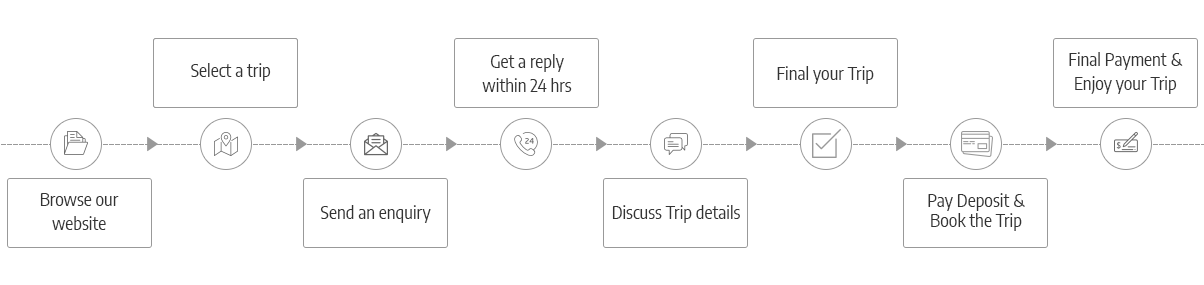
- Inquire: Contact us via our website form, email, or WhatsApp with your preferred dates, group size, and any special requests.
- Receive your quote: We send a customized cost breakdown within 24 hours – no generic templates, no hidden annapurna circuit charge surprises.
- Confirm & deposit: Secure your spot with a deposit (typically 20–30% of the total cost). Final payment is due upon arrival in Kathmandu.
- Permit preparation: We arrange all necessary permits (ACAP, TIMS) and handle logistics.
- Arrival briefing: Meet your guide in Kathmandu for a pre-trek briefing, gear check, and final questions.
Early booking (2–4 months in advance for spring or autumn 2026/2027) helps lock in stable domestic transport prices and secures preferred teahouses. We bundle airport transfers, pre-trek hotel arrangements, and extra nights in Kathmandu or Pokhara into a single transparent quote – no juggling multiple bookings.
Ready to plan your Annapurna Circuit? Contact Excellent Himalaya Trek today for a free customized cost breakdown based on your dates, budget, and fitness level.
Conclusion: Planning Your Annapurna Circuit Budget the Smart Way
Our package price for 2026/2027 is $745-895 per person for a 14-19 day guided Annapurna Circuit trek, all-inclusive: permits, licensed guide, teahouse lodging, and three meals a day on the trail. Other Kathmandu-based operators typically quote $900-1,800 for comparable itineraries; international operators and booking platforms typically run $1,500-3,000+. If you priced every component out yourself instead of booking a package, expect to spend $1,320-2,115 — more than our package price, not less, for the reasons broken down above.
Good budgeting and transparent pricing free you to focus on what actually matters: crossing Thorong La at sunrise, watching the light hit Annapurna II from Manang, and soaking tired muscles in Tatopani’s hot springs.
Contact Excellent Himalaya Trek & Expedition today for a 2026 or 2027 Annapurna Circuit quote tailored to your dream itinerary. Your mountains are waiting.
Why trust this guide
This breakdown is written by Suman Shrestha, founder and lead guide of Excellent Himalaya Trek & Expedition, government-registered since 2002 (Reg. No. 175840/074/075, Tourism License No. 2432), holder of Nepal Government Guide License No. 2212, and a Master’s degree holder in Tourism Management. Excellent Himalaya Trek is affiliated with TAAN, NMA, NTB, and HRA. Every price above reflects our current 2026/27 rates, verified against Nepal Tourism Board and permit fees.
Travel Tips
The best season and most favored time of Annapurna Circuit Trek (Round Annapurna) is autumn (From September to November) and spring (From March to May). During this period day time is sunny and warm with outstanding views. At this time the temperature in the day is between 10 C to 30 C. The nights are often cold with a temperature between 5 C to -20 C. Trekking to Round Annapurna in winter (Dec, Jan, Feb) is also possible but the temperature during winter could be harsh for most people. Trekking in the summer season (June, July, Aug) will be affected by rain/monsoon but the Summer trek could be an advantage for a keen botanist.
All foreign nationals except Indian Nationals are required to arrange a visa in order to enter Nepal. A Nepalese Visa can be obtained either prior to your arrival at a Nepalese embassy abroad or upon arrival in Kathmandu at the airport. But nationals from Afghanistan, Iraq, Cameroon, Ghana, Somalia, Swaziland, Palestine, Zimbabwe, Nigeria, Ethiopia, and Liberia cannot secure the Nepalese Visa upon arrival. The Visa can also be taken at entry points at the Nepalese borders. For a Nepalese Visa, it requires your passport with at least six months’ validity,a recent digital photo (size: 1.5″ x 1.5″), and the following fees either in USD dollars cash or the equivalent local currency:
| Visa Facility | Duration | Fee |
| Multiple entry | 15 days | US$ 30 or equivalent Nepalese currency |
| Multiple entry | 30 days | US$ 50 or equivalent Nepalese currency |
| Multiple entry | 90 days | US$ 100 or equivalent Nepalese currency |
We would offer you the meeting and greeting service in Kathmandu International Airport on your arrival time. For this, you need to pass us your International flight details at least 2 days before your arrival date in Kathmandu. After you get down from the aircraft you just pass on the Customs and come out of the Terminal building where you will see our tour officer standing with your name card. He will greet and welcome you with auspicious garland and escort you to the hotel.
In Annapurna Circuit Trek it does not require tremendous logistics in terms of accommodation as you will find plenty of clean and friendly lodges along the trail. Lodges typically offer a room with a wooden bed with a simple mattress or foam pad, a cotton pillow, and a blanket or quilt. A few have electric lights and all have a spacious dining room-lounge. We will accommodate you and your group in local lodge available each day. We send a porter ahead of us to book the required rooms for you (here rooms cannot be booked in advance).
In the case of Kathmandu and Pokhara, we offer you tourist standard hotel under 3-star categories unless it is mentioned otherwise or clients have a special choice.
In the trail of Annapurna Circuit it’s commonly available of Authentic Nepali meal: Dal Bhat (rice with lentils soup and seasonable vegetables), noodles, pasta, chapatis, eggs, French fries, porridge and muesli. The restaurant of lodges also serves Tibetan foods like momo, thukpa, chowmein, along with pizza, spring rolls, pancake and other continental as well as Indian foods.
Tea and hot lemon are traditionally the main drinks on the trail though coffee is found everywhere. Bottled soft drinks, bottled water and even beer are common along the route but price of each bottle rises each day when you move upward.
The trekking team who will go with you is the most significant thing that makes your Annapurna Circuit trekking successful, enjoyable and memorable. We would provide you skilled, experienced, courteous, knowledgeable and helpful trekking guide and porters. The trekking guide leads you on the trail and brief you all the about this route and porters carry your luggage. Our all trekking guides are carefully selected in terms of their appropriate experience, leadership skills and their knowledge about local culture, ecosystem, geography, flora and fauna, and history. With aim of sustaining local communities, we only employ local people as trekking guide and porter. Our all trekking guides are certified by Nepal Government, Ministry of Tourism. We manage trekking team such a way that one trekking guide in each group and porters like one porter for two trekkers.
During the trek, your main luggage will be carried by porters or pack animals (usually yaks or cross-breeds). You simply carry a day pack with water bottle, camera, sunscreen, spare jacket, etc. – a small load that allows full enjoyment of the trek. A trek bag is ideal for your main luggage, plus a small lockable bag for travel clothes or anything that you do not need during trek which you can leave at hotel’s locker room in Kathmandu for free of charge.
Every morning, first of all, packing your bags and then have a hearty breakfast at the lodge restaurant. Then set off on the day’s walk. After walking for 3-4 hours you all stop for lunch in local restaurant. Then continue walking to your destination. After lunch, it’s the only a couple of hours walking. You usually arrive at your destination in the time of afternoon tea. Check in at the lodge. The rest of the day is at leisure. At the free time, you may explore surrounding village, do a bit of washing or simply relax by reading books and writing a diary. On some days you will arrive at your destination by lunch time and entire afternoon will be free. Most people also spend free time by playing cards and other games reliving the day’s adventures. Then in the evening have a dinner and you will be briefed by your trekking guide about your next day’s walking and then go to your bed for well-earned sleep.
Annapurna Circuit Trekking is moderate trek suitable for any passionate walkers who able to walk at least 5-7hours a day with a light day pack. Walking in higher altitudes is more physically demanding than walking in lower altitudes; however, if you are in excellent health with average physical fitness and have a positive attitude, self-confidence, and strong determination, you can do this trek successfully. Exercising and jogging regularly for some weeks prior to the trip is a good idea to enhance your strength and stability. Past hiking experience would be an asset but no compulsorily required for this trip. It is vital for participants with pre-existing medical conditions such as heart, lung, and blood diseases to consult their doctor before taking the trip.
We believe casualty and a serious sickness will not happen on the trip. If it happens we will do everything to transfer you to the nearest hospital. Since all the expenses incurred in evacuation liable to you please make sure that it is covered by your insurance before assigning for it or be prepared to pay on your own after getting back to Kathmandu.
We strongly advise you to take travel insurance before joining a tour which should cover medical expenses, emergency repatriation and helicopter evacuation at high altitude places and loss of your luggage. We would request you to bring your insurance documents when you come to Nepal.
This is a basic checklist of the essential items that you are advised to pack for your Annapurna Circuit Trek:
• A sturdy pair of trekking boots with good ankle support
• Rucksack (5o to 65 liters) with waterproof cover
• Trekking pants and waterproof trousers
• T-shirts or shirts
• Down jacket*
• Wind/ waterproof light jacket
• Fleece jumper or jacket
• Inner Thermal (top and trousers)
• 4 to 6 pairs of Socks and underwear
• Sunglasses, sun hat, woolen cap, or balaclava
• Inner and outer gloves
• Headlamp, power bank, and extra batteries
• Sun protection cream, lip balm, wet wipes, and hand sanitizer
• Towel, flip-flop or rubber sandal, toiletries
• Water bottle and water purification tablets
• 4-season Sleeping bag (good to -20 degrees C or 28 degrees F); *
• Hiking poles, if you need
• If you are taking any medicines daily, please carry them.
• A small daypack/backpack for carrying your valuables
*Down jacket and sleeping bag you can rent/hire from Trekking gear shops in Kathmandu.
The itinerary for each trip should be taken as a guideline only. Depending on the situation, you can modify it to some extent after consulting with your guide. However, the date of trip ending should always coincide with the original itinerary.
Kindly keep in mind that sometimes unforeseen events may contribute to the need for a change in itinerary. In such cases, we or your guide will suggest the best alternative similar to your original.
Naturally, the Annapurna Region is so beautiful, but equally, it is fragile as well. Increasing population density and the number of trekkers threaten the very beauty of this area. We at Excellent Himalaya Trek and Expedition are extremely conscious about protecting our beautiful natural environment and preserving the fascinating local culture. We are doing our level best to minimize our impact as much as possible. All our trekking guides and porters are well-trained and motivated to follow the guidelines of responsible tourism and eco-friendly tourism. In trekking, they also advise you on do’s and don’ts to minimize your impact on the local environment.
In addition to your Trekking trip, you can join in various side Trips in Nepal like a cultural tour of UNESCO World Heritage Sites, Jungle Safari in National Park, White Water Rafting in Himalayan Rivers, Golfing, Adventure activities like Bungee Jumping, Altra Light Flight, Paragliding, Jeep flyer etc. You also can extend your trip to neighboring Himalayan Countries: Bhutan, Tibet, Sikkim (India) which seems more appealing to you. On your request, we will give you the detail of the side trips.
Trip Reviews
 I finished Annapurna circuit trek including Poon Hill last November 2017. It was the awesome trekking that I had ever done in my life in terms of perfect Himalayan views, beautiful villages, nice local people and several sceneries. My trek was organized by Excellent Himalaya Trek and Expedition. Before the start of the trek, Mr. Suman, the team leader of this company, briefed me overall about this trip. He introduced my guide Lhakpa and porter Hari. With these two people, I started my trek from Besisahar. I took our time, spending two days in Manang for acclimatization purpose. But it was not a free day. My guide took me to visit glacier and lake. After Manang, we moved up to cross Thorung La Pass. It was my dream to cross this world’s longest pass and I achieved it with my good guide and porter. After Thorung La via Muktinath, Tatopani I also trekked to Poonhill. This is also very nice place. To my opinion everybody who go for Annapurna Circuit they also should include Poonhill for the more exciting experience. Finally, I am very much thankful to the whole team of Excellent Himalaya for organizing me this best trekking. See you guys again for next great trekking.
Shilan
Australia
Ask our experts (Inquiry)
Why Travel with us?
- Run by local experts, guide & Sherpa.
- Focus on your needs.
- Good value for money.
- Real cared services.
- Government recognized company.
- Best reasonable rate.