


Mardi Himal Trek Cost 2026/2027: Complete Budget Guide & Package Price

Updated [July 18th, 2026]. Written and reviewed by Suman Shrestha, licensed guide (Nepal Government License No. 2212)
Quick Answer: The Mardi Himal Trek costs between USD 450 and USD 900 per person for most trekkers in 2026/2027. A fully organized package with a licensed guide, teahouse accommodation, meals, permits, and Kathmandu–Pokhara transport through Excellent Himalaya Trek & Expedition starts at USD 495 per person for a 10-day (9-night) group departure and rises to USD 770 for a solo/private booking. Independent budget trekking without a guide is no longer legal in the Annapurna Conservation Area, so genuine “no-guide” pricing you may see quoted elsewhere ($250–$350) is not a compliant option as of 2026.
Overview: Mardi Himal Trek
 Mardi Himal Trek is one of Nepal’s most rewarding short treks, tucked inside the eastern Annapurna Conservation Area directly beneath Machhapuchhre (Mt Fishtail, 6,993 m). Opened to trekkers in 2012, it climbs through rhododendron forest to an open ridge at High Camp (3,600 m) and a day-hike viewpoint at Mardi Himal Base Camp (4,500 m), with close-range views of Annapurna I, Annapurna South, Hiunchuli, and Machhapuchhre. Because it is shorter and less crowded than Annapurna Base Camp or the Annapurna Circuit, it is consistently one of the most affordable guided treks in the Annapurna region — but “affordable” still means understanding exactly where your money goes. This guide breaks down every cost category for 2026/2027, corrects a few persistent myths about permits, and lays out our published package pricing.
Mardi Himal Trek Cost: Quick Reference
| Trip Style | Duration | Starting Point | Typical Cost (USD) |
| Shortest guided trek | 4 days | Pokhara to Pokhara | USD 320 – 420 pp |
| Standard guided trek | 5–6 days | Pokhara to Pokhara | USD 420 – 550 pp |
| Full package (our standard) | 10 days / 9 nights | Kathmandu to Kathmandu | USD 495 – 575 pp (group) |
| Solo/private booking | 10 days / 9 nights | Kathmandu to Kathmandu | USD 750– 770 pp |
| Luxury/boutique lodge add-on | 10–11 days | Kathmandu to Kathmandu | USD 900 – 1,200 pp |
Full Cost Breakdown by Category
Every Mardi Himal trek budget is built from the same line items. Here is what each one typically costs in 2026/2027:
| Cost Category | Typical Range (USD) | Notes |
| ACAP permit (Annapurna Conservation Area) | $22 – 25 (NPR 3,000) | Mandatory, one-time entry; NPR 1,000 for SAARC nationals |
| Licensed trekking guide | $25 – 35 / day | Mandatory in the Annapurna region since April 2023 |
| Porter (optional, recommended) | $20 – 25 / day | One porter typically carries gear for two trekkers |
| Teahouse accommodation, Deurali–High Camp | $5 – 15 / night | Basic twin room; often discounted when you eat dinner at the same lodge |
| Meals on the trail (breakfast, lunch, dinner) | $25 – 35 / day | Rises with altitude; Dal Bhat is the best value |
| Kathmandu–Pokhara transport (return) | $25 – 45 total | Tourist coach, private jeep, or domestic flight costs more |
| Pokhara–Kande–Siding local transport | $20 – 35 total | Car to Kande, jeep back from Siding |
| Hotel in Kathmandu & Pokhara (per night, twin share) | $15 – 60 | Budget to 3-star tourist standard |
| Gear rental (down jacket, sleeping bag) | $1 – 3 / item/day | Only needed outside your own kit |
| Travel insurance with helicopter evacuation | $60 – 150 | For the full trip duration, non-negotiable above 3,500 m |
| Guide & porter tips (customary, not included) | $5 – 10 / day/staff member | Usually given as a lump sum on the final day |

Budget, Mid-Range, and Premium Tiers
| Budget Tier | 9-Day Total (USD) | What Changes |
| Budget | $450 – 600 | Shared teahouse rooms, set Dal Bhat meals, group departure, basic Kathmandu/Pokhara hotel |
| Mid-range (our standard package) | $600 – 800 | Private twin rooms where available, a wider menu, 3-star hotel nights, a licensed guide + porter |
| Premium / private | $800 – 1,200+ | Private guide and porter, best-available lodges, flexible pace, upgraded Pokhara/Kathmandu hotel |
Excellent Himalaya Trek — Mardi Himal Package Price 2026/2027
Our standard package is a 10-day, 9-night Kathmandu-to-Kathmandu itinerary with a licensed guide, teahouse accommodation, and all ground transport included. Pricing is per person and scales with group size:
| Group Size | Price Per Person (USD) |
| Solo (1 person, private guide) | USD 770 |
| 2 people | USD 575 |
| 3–4 people | USD 555 |
| 5–6 people | USD 535 |
| 7–8 people | USD 515 |
| 9–10 people | USD 495 |
Prices are for the standard 10-day, 9-night Kathmandu-to-Kathmandu package described below. Solo travelers still receive a full licensed guide — Nepal law no longer permits unguided trekking inside the Annapurna Conservation Area.
What’s Included
- Airport pickup in Kathmandu by private vehicle on arrival
- 2 nights in Kathmandu at a tourist-standard hotel with breakfast
- 2 nights in Pokhara at a tourist-standard hotel with breakfast
- Teahouse accommodation throughout the trek (twin-sharing basis)
- 3 meals a day (breakfast, lunch, dinner) while on the trail
- Kathmandu–Pokhara–Kathmandu transport by tourist bus
- Pokhara–Kande drive and Siding–Pokhara jeep at the end of the trek
- An experienced, English-speaking, government-licensed trekking guide
- All staff wages, food, accommodation, and insurance for guide (and porter, if added)
- Annapurna Conservation Area Permit (ACAP) fee
- First-aid kit, oximeter, and altitude medicine (Diamox) carried by your guide
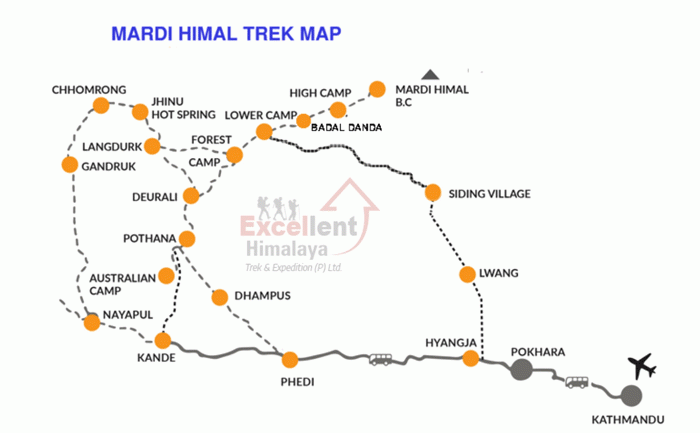
- Trekking map of the Mardi Himal route
- Seasonal fruit during the trek
- Trip completion certificate
- All applicable government and local taxes
- Departure transfer to Kathmandu airport
What’s Not Included
- International airfare
- Nepal visa fee (available on arrival at Kathmandu airport)
- Travel insurance, including helicopter evacuation cover
- Alcoholic drinks, hot and cold beverages, bottled or boiled water, and desserts
- Personal expenses: phone calls, Wi-Fi, battery charging, hot showers on the trail
- Lunch and dinner in Kathmandu and Pokhara, and meals during the road transfer
- Tips for your guide (and porter, if hired)
- A porter (available on request; typically $20–25/day, arranged before departure)
- Costs from unforeseen events: illness, natural disasters, political disruption, or trail closures
- Any service not explicitly listed in the inclusions above
What’s New for 2026
- ACAP permit fee confirmed at NPR 3,000 for foreign nationals for the 2026/2027 season; a licensed guide remains mandatory for every foreign trekker in the Annapurna Conservation Area, a rule in force since April 2023.
- Several teahouses between Low Camp and High Camp have added solar hot-water showers and expanded charging points, though both still carry a small per-use fee.
- Mobile data coverage (NTC/Ncell) now reaches most of the route as far as High Camp, reducing reliance on paid lodge Wi-Fi.
- Trail erosion repairs were completed on the Forest Camp–Low Camp section in early 2026, shortening the muddiest stretch of the climb.

Detailed 10-Day / 9-Night Itinerary
This is the single, reconciled version of our itinerary — camp names and altitudes are consistent throughout the trek.
| Day | Route | Altitude | Walking Time | Meals |
| Day 1 | Arrival in Kathmandu | 1,400 m | — | — |
| Day 2 | Drive from Kathmandu to Pokhara | 820 m | 7 hrs drive | Breakfast |
| Day 3 | Drive to Kande, trek to Pothana / Deurali | 2,100 – 2,140 m | 4–5 hrs | Breakfast, Lunch, Dinner |
| Day 4 | Trek to Forest Camp | 2,520 m | 5–6 hrs | Breakfast, Lunch, Dinner |
| Day 5 | Trek to Low Camp (Badal Danda) | 3,050 – 3,210 m | 4–5 hrs | Breakfast, Lunch, Dinner |
| Day 6 | Trek to High Camp | 3,580 – 3,600 m | 3–4 hrs | Breakfast, Lunch, Dinner |
| Day 7 | Sunrise hike to Mardi Himal Base Camp, return to Low Camp | 4,500 m (day hike), overnight 3,050 m | 7–8 hrs round trip | Breakfast, Lunch, Dinner |
| Day 8 | Trek to Siding, drive to Pokhara | 1,700 m, then 820 m | 3 hrs trek + 2.5–3 hrs drive | Breakfast, Lunch |
| Day 9 | Drive from Pokhara to Kathmandu | 1,400 m | 7 hrs drive | Breakfast |
| Day 10 | Final departure | — | — | Breakfast |
Day 1: Arrival in Kathmandu
Our team welcomes you at Tribhuvan International Airport and transfers you to your hotel by private vehicle. Trip briefing and trek preparation in the evening.
Day 2: Drive from Kathmandu to Pokhara
A scenic 200 km, roughly 7-hour drive by tourist coach. Evening is free to walk along Phewa Lake.
Day 3: Drive to Kande, trek to Pothana / Deurali
A 1-hour drive to Kande, then an uphill walk through Australian Camp (Thulo Kharka) and into the rhododendron forest to Pothana or Deurali.
Day 4: Trek to Forest Camp
The trail climbs through dense rhododendron forest along the Mardi ridge, leaving the main Annapurna trekking trail behind.
Day 5: Trek to Low Camp (Badal Danda)
A steady, steep climb with views of Hiunchuli and Annapurna South opening up as the forest thins into rhododendron scrub.
Day 6: Trek to High Camp
The trail breaks above the tree line onto an open ridge with grassland and scattered rhododendron bushes — the best sunset viewpoint on the route.
Day 7: Sunrise hike to Mardi Himal Base Camp, return to Low Camp
Pre-dawn start along the ridge trail to Base Camp for panoramic views of the Annapurna Sanctuary, Hiunchuli, and Machhapuchhre, then back down to Low Camp for the night.
Day 8: Trek to Siding, drive to Pokhara
A different descent route through forest and terraced fields to the traditional village of Siding, then a jeep ride back to Pokhara.
Day 9: Drive from Pokhara to Kathmandu
7-hour return drive by tourist coach. Free evening in Kathmandu.
Day 10: Final departure
Private transfer to Kathmandu airport for your international flight home.
Highlights of the Mardi Himal Trek are as follows:
- A short, moderate route is great for beginners and all trekkers.
- Relatively less crowded and a newly started trekking route
- Hike through Nepal’s iconic giant rhododendron forest.
- Experience Nepal’s mountain culture and local hospitality.
- Beautiful views of the magnificent Mt Annapurna South, Mt Dhaulagiri & Mt Machhapuchhare.
- Enjoy a sensational sunrise over snowcapped peaks.
- Hike through a beautiful trail.
- Enjoy a scenic landscape and diverse flora and fauna
- Gain insights into the rich natural and cultural diversity of the Annapurna region.
- Enjoy forest walks and gradual ascents up to 4500m.

A Story From the Trail: Yogendra Baniya, First Week of June 2026
I led a group of four up to Mardi Himal Base Camp in the first week of June this year — right at the edge of pre-monsoon, when most operators start steering clients toward other routes. I still tell people it was one of the clearest short treks I’ve guided all season, but I also tell them exactly why: mornings were the window, and we planned around it.
We left Kande a little earlier than usual on Day 3 to beat the midday heat climbing to Australian Camp, and by the time we reached Forest Camp the following afternoon, cloud was already building over the Modi Khola valley — normal for June, not a bad sign. The rhododendrons were past their March–April peak but the forest was green and full, with the kind of humidity that makes the trail smell different from October’s dry cold.
High Camp was the highlight, as it usually is. We had one clear evening out of two, which is a fair trade in early June — Machhapuchhre came out from the cloud for about forty minutes at sunset, and that was enough. For the Base Camp push the next morning, I moved our wake-up call to 3:45 a.m. instead of the usual 4:30, because June mornings cloud over faster than October ones. We were on the ridge by first light and had Annapurna South and the Sanctuary open in front of us before the cloud rolled back in around 8 a.m.
The trail itself was in good shape — a little muddier below Forest Camp than in dry season, and I had the group switch to gaiters and trekking poles a day earlier than I would in autumn. We saw almost nobody else above Low Camp, which is the real trade-off of a June trek: fewer views guaranteed, far more trail to yourself.
My honest advice to anyone considering Mardi Himal in early June: it can absolutely work, but only with a guide who adjusts timing to the weather pattern rather than following an autumn schedule out of habit. That’s the difference between a good pre-monsoon trek and a frustrating one.
Permits: What You Actually Need
Two documents govern access to the Mardi Himal trail, and getting them right avoids delays at the Ghandruk-area checkpoints.
Annapurna Conservation Area Permit (ACAP)
Mandatory for every foreign trekker. NPR 3,000 (about USD 22–25) for non-SAARC nationals, NPR 1,000 for SAARC nationals, issued by the National Trust for Nature Conservation in Kathmandu or Pokhara. It is a single-entry permit valid for the length of your registered trek.
Mandatory licensed guide
Since April 2023, Nepal’s government has required all foreign trekkers in the Annapurna Conservation Area to travel with a licensed guide from a registered trekking agency. Independent, unguided trekking is no longer permitted on the Mardi Himal route, regardless of what older blog posts or forum threads suggest.
TIMS card
The TIMS card is not required for treks inside the Annapurna Conservation Area; the mandatory-guide rule has effectively replaced it. Ignore package listings that still charge separately for a TIMS card on this route.
Hidden and Personal Expenses
These are the costs most first-time trekkers underestimate — none are included in any Mardi Himal package price, ours included:
- Hot showers: $1–4 near Low Camp, rising to $3–6 at High Camp
- Device charging: $1–3 per charge above Forest Camp, more where lodges rely on solar/generator power
- Wi-Fi or local SIM data: $1–3 per day for lodge Wi-Fi; a Nepali SIM with data is cheaper over the whole trip
- Bottled or boiled water: $1–3 per liter, increasing with altitude — a bottle with a filter or purification tablets saves real money
- Snacks, chocolate, and extra bakery items: $2–8 per day, depending on appetite
- Souvenirs in Pokhara and Kathmandu: budget $20–50 if you want singing bowls, pashmina, or trekking gear as gifts
- Guide and porter tips: customary at $5–10 per staff member per day, usually handed over as a lump sum on your last evening
Best Time to Trek Mardi Himal (and How Season Affects Price)
Autumn (late Sept – Nov)
Peak season: clearest mountain views, stable weather, highest lodge prices, and busiest trail. Book 2–3 weeks ahead.
Spring (Mar – May)
Second peak season: rhododendron forests in bloom, good visibility, comparable pricing to autumn.
Winter (Dec – Feb)
Colder at High Camp (down to -10°C at night) but clear skies and 15–25% lower lodge and package rates; some upper lodges reduce services.
Monsoon (Jun – Aug)
Cheapest season and lush scenery, but frequent afternoon rain, leeches on the lower trail, and reduced mountain visibility above Forest Camp.

Excellent Himalaya Trek vs. the Average Market Package
| What You Get | Excellent Himalaya Trek | Typical Market Package |
| Licensed guide | Included, government-certified | Included, but credentials rarely stated |
| Altitude medicine, oximeter, and first-aid kit | Included and carried by the guide | Rarely mentioned |
| ACAP permit handling | Arranged in advance by our office | Usually included |
| Trip completion certificate | Included | Uncommon |
| Seasonal fruit on trek | Included | Rarely included |
| Pricing transparency (per-pax breakdown) | Published group tiers, solo pricing available | Often quoted only on request |
| Direct operator (no middleman) | Yes — Tourism License No. 2432 | Varies; some listings are resellers |
Local Operator vs. International Operator vs. OTA: Who Should You Book With?
“Mardi Himal Trek company” searches usually turn up three very different kinds of sellers: a local, government-registered operator like us; an international trekking company that markets the trip abroad and subcontracts the actual guiding to a Nepal-based partner; and an OTA or booking marketplace that lists many operators’ trips side by side. All three can get you up the mountain — but the layers between you and your guide change what you pay, how fast you get answers, and who is accountable if the itinerary needs to change.
| What Matters | Local Direct Operator (US) | International Operator | OTA / Booking Marketplace |
| Who actually runs the trek | Our own licensed guides, based in Kathmandu, are on the ground year-round | Often, a Nepal-based ground handler operating under a foreign brand | A local operator is selected after your booking is confirmed — usually the lowest bidder |
| Price you pay vs. cost of service | Direct — no international agency margin on top | Higher — includes the foreign company’s marketing, staff, and margin | Platform commission (15–25%) added on top of the ground operator’s price |
| Local trail knowledge | First-hand: our guides trek this route regularly and adjust for the season, as in the story above | Varies — depends entirely on which local partner is subcontracted | Unknown until after booking; quality is not standardized |
| Customization and last-minute changes | Direct conversation with the guide/founder, same-day changes possible | Requests routed through a head office in another time zone | Limited; changes often require a new booking or platform fee |
| Accountability if something goes wrong | Single, government-registered company (License No. 2432) responsible from start to finish | Split between the foreign brand and its local subcontractor | The platform typically limits liability to a refund policy, not on-ground support |
| Response time for questions | Direct WhatsApp/email with our own team, usually within hours | Often, 24–48 hours through a booking coordinator | Varies by platform; support is rarely trek-specific |
| Where your money goes | Stays largely within the local guide/porter/lodge economy | A meaningful share goes to overseas overhead | A share goes to the platform before it reaches the ground operator |
None of this means international operators or OTAs are unsafe — many are reputable. The difference is layers: each additional layer between you and the guide who actually walks the trail adds cost, slows communication, and dilutes accountability if plans need to change.
Safety and Altitude Sickness on Mardi Himal
The route’s highest point, Mardi Himal Base Camp at 4,500 m, is high enough to bring on mild acute mountain sickness (AMS) symptoms in some trekkers — headache, dizziness, or loss of appetite are common and usually manageable. Our itinerary builds in a gradual altitude gain with an overnight at Low Camp before and after the High Camp to Base Camp push, and every guide carries an oximeter and Diamox (acetazolamide) as a precaution. The standard rule if symptoms worsen is to stop ascending and descending; our guides are trained to make that call. Because emergency helicopter evacuation from this altitude can cost several thousand US dollars without cover, travel insurance that explicitly includes high-altitude trekking and helicopter evacuation is essential, not optional.
What to Pack
- Down jacket and fleece mid-layer
- Waterproof, breathable shell jacket and trousers
- Sturdy broken-in trekking boots plus camp shoes
- Warm hat, sun hat, and gloves (liner + insulated)
- 4-season sleeping bag rated to at least -10°C
- Headlamp with spare batteries (for the pre-dawn Base Camp hike)
- Trekking poles
- Water bottle or hydration bladder plus purification tablets or a filter
- Basic personal first-aid kit and any personal medication
- Sunglasses with UV protection and high-SPF sunscreen
- Power bank for charging above the point where the lodge’s power costs extra
Why Choose Excellent Himalaya Trek & Expedition
Excellent Himalaya Trek & Expedition Pvt. Ltd. is a government-registered trekking company (Reg. No. 175840/074/075, Tourism License No. 2432) based in Thamel, Kathmandu, and affiliated with TAAN, NMA, NTB, and HRA. As a direct operator rather than a reseller, our Mardi Himal pricing has no hidden middleman fees, and every group is led by a government-licensed guide who knows the route’s trail conditions, ecology, and culture firsthand.
About the Author
This guide is written and fact-checked by Suman Shrestha, founder and lead trekking guide of Excellent Himalaya Trek & Expedition (Tourism License No. 2432, Reg. No. 175840/074/075), based in Thamel, Kathmandu. Suman holds a Master’s degree in Tourism Management and has guided treks across the Annapurna, Everest, Manaslu, and Langtang regions since 2004/2005. Excellent Himalaya Trek & Expedition is affiliated with TAAN, NMA, NTB, and HRA. Prices and permit rules on this page were verified in July 2026 against Nepal Tourism Board and National Trust for Nature Conservation sources and our own recent bookings.

Mardi Himal Trek Cost: Frequently Asked Questions
How much does the Mardi Himal Trek cost in 2026/2027?
Most trekkers spend between USD 450 and USD 900 per person. A full guided package with Excellent Himalaya Trek & Expedition starts at USD 495 per person for a group of 9–10 on the 10-day Kathmandu-to-Kathmandu itinerary, and USD 695 for a solo traveler with a private guide.
What is included in the Mardi Himal Trek package price?
Airport transfers, Kathmandu and Pokhara hotel nights with breakfast, teahouse accommodation and three meals a day on the trail, all ground transport, a licensed English-speaking guide, ACAP permit, altitude medicine and an oximeter, a trekking map, seasonal fruit, and a completion certificate.
Is a guide mandatory for the Mardi Himal Trek?
Yes. Since April 2023, Nepal’s government has required every foreign trekker in the Annapurna Conservation Area, including the Mardi Himal route, to trek with a licensed guide from a registered agency. Solo, unguided trekking is not permitted.
Do I need a TIMS card for Mardi Himal?
No. The TIMS card is not required for treks within the Annapurna Conservation Area. You need the ACAP permit and a licensed guide; that combination has replaced the old TIMS requirement on this route.
How much is the ACAP permit for Mardi Himal Trek?
The Annapurna Conservation Area Permit costs NPR 3,000 (about USD 22–25) for non-SAARC foreign nationals and NPR 1,000 for SAARC nationals. It is a one-time, single-entry fee covering your whole trek.
What is the difference between a 4-5-day and a 10-day Mardi Himal itinerary?
A 4–5 day trek starts and ends in Pokhara and skips the Kathmandu hotel nights and long road transfer, costing roughly USD 320–550. Our 10-day package starts and ends in Kathmandu, includes 4 hotel nights, and gives more acclimatization buffer before Base Camp, which is why it costs more but is considerably safer at altitude.
Is Mardi Himal cheaper solo or in a group?
In a group. Guide, porter, and transport costs are shared, which is why our per-person price drops from USD 695 for a solo private booking to USD 495 for a group of 9–10. A solo trekker still requires and receives a full licensed guide under current Annapurna regulations.
What is the best time to trek Mardi Himal for the best value?
Winter (December–February) offers 15–25% lower lodge and package rates with clear skies, though nights at High Camp drop to around -10°C. Autumn and spring have the best visibility but the highest demand and prices.
How do you handle altitude sickness risk on Mardi Himal?
Our guides carry an oximeter and Diamox (acetazolamide) on every trek, monitor clients daily, and follow the standard rule of descending immediately if symptoms worsen. The itinerary already builds in a Low Camp to High Camp acclimatization buffer before the Base Camp push.
What should I pack for the Mardi Himal Trek?
A down jacket, a waterproof shell, broken-in trekking boots, a sleeping bag rated to at least -10°C, a headlamp for the pre-dawn Base Camp hike, trekking poles, and a water bottle with purification tablets or a filter. See the full packing list above.
Are there hidden costs on the Mardi Himal Trek?
Yes — hot showers, device charging, bottled water, and Wi-Fi are not included in most package prices and typically add USD 5–15 per day above Forest Camp. Guide and porter tips (customary at USD 5–10 per person per day) are also separate.
Do I need travel insurance for the Mardi Himal Trek?
Yes. Because the route reaches 4,500 m at Base Camp, you need travel insurance that specifically covers high-altitude trekking and helicopter evacuation. Standard travel insurance policies often exclude altitudes above 3,000–4,000 m, so check the policy wording carefully.
Can I hire a porter for the Mardi Himal Trek?
Yes. A porter typically costs USD 20–25 per day and usually carries gear for two trekkers. It is not included in the base package price but can be added when you book.
How does the Mardi Himal Trek cost compare to the Annapurna Base Camp?
Mardi Himal is shorter and generally cheaper: a comparable guided package runs roughly USD 450–900, versus USD 700–1,300+ for Annapurna Base Camp, largely because ABC takes 2–4 extra trekking days.
What’s new for Mardi Himal Trek prices in 2026?
ACAP fees and the mandatory guide rule remain unchanged from 2023 levels. On the trail, more teahouses between Low Camp and High Camp now offer solar hot showers, and mobile data coverage extends further up the route, both of which slightly reduce day-to-day hidden costs compared to a few years ago.
Itinerary
Our tour officer will be receiving you at Tribhuvan International airport, Kathmandu. He will meet, greet and welcome you with auspicious garland and escort you to your respective hotel by our private tourist vehicle. At the hotel, he will assist you to check in and will be briefed about your overall program, introduced your guide and clear your questions/queries if any. Overnight at hotel.
Our trekking guide will pick you up at the hotel at 6:15 am and escort you to the bus station. The bus to Pokhara leaves at around 7:00 am. This is 7 hrs scenic drives through mountain terrain. On the way, the bus stops for half an hour for lunch. Then drive continues till you reach Pokhara. Pokhara is a beautiful valley and gateway to Annapurna Trekking. Evening you enjoy strolling around Lakeside street market. Overnight at hotel.
Day 3: Drive from Pokhara to Kande. Driving 1 hour. Trek from Kande to Deurali (Alt. 2142m/ 7028ft).
After breakfast start the drive from Pokhara to Kande (40 minutes drive). You start trekking from Kande with an uphill walk to Australian Camp. It’s around 1 hr hiking to reach Australian camp, locally known as Thulo Kharka. It is a grazing pasture land with an amazing panorama of Annapurna range with Dhaulagiri, Manaslu, and Machhapuchare. After the scenic break, continue walking on the forested trail to reach Potana, a small village located in the midst of the alpine forest. Overnight at a mountain lodge.
After breakfast you start trek following the trail passes through the rhododendron forest to Deurali, mountain pass overlooking into the Modi Khola Valley stuck between Annapurna South and Mardi Himal / Mt Fishtail. From here the route leads into complete wilderness away from the main Annapurna trekking trail. You head towards north along a ridgeline into deep forested area where the temperature drops to cool with fresh. While walking you enjoy on super views of Annapurna I and South, Huinchuli, and Lamjung Himal. Today your night halt will be at lodge in the forest. Overnight at a mountain lodge.
From Forest Camp, the trail leads higher on the uphill ridge with a steep climb. While climbing you see views of Hinuchuli and Annapurna South. Far below, to the left, you also can see the Modi River Valley leading up to the Annapurna Base Camp. When you ascend the vegetation starts to change with more rhododendron and the trees are covered with moss, lichen and tree ferns. Low Camp is the beautiful pasture land from where Mount Fishtail is visible. Overnight at a mountain lodge.
An hour or so above Low Camp the trail breaks out above tree line and towards the west where you have a good view of Annapurna South and Hiunchuli. The trail continues along the Mardi Himal ridge mainly on the grassland with some isolated rhododendron bushes along the way. You may see colorful Danphe pheasant on this section of the trail. The view from High Camp is superb to Annapurna South, Hiunchuli and Machhapuchhre (Fishtail). Overnight at a mountain lodge.
The plan for today is to wake early for the sunrise view then walks up the ridge towards Mardi Himal Base Camp. There is a well-established trail through the grassland with a couple of steeper sections however overall not too challenging. Look out for the dzokpo (yak/ cow crossbreds) grazing up here as well as Danphe pheasant. In the summer the sheep and goats from lower villages are brought up to graze in this area so you will pass a number of herder’s huts along the way. After three hours of walking you reach Mardi Himal Base Camp at the elevation of 4500m. From the Base Camp, you can look into the Annapurna Sanctuary with a panoramic view of the south face of Annapurna, Hiunchuli, and Machhapuchhre (Fishtail). Then hike back to Low camp for night halt. Overnight at a mountain lodge.
After breakfast, you follow another trail that goes down to Siding village rather than going back down to Forest Camp. The trail passes through the shade of the forest and out onto terraced fields. Sidhing is a traditional Nepalese village. From Sidhing you take a drive to Pokhara. It takes 3 to 3:30 hours of drive to reach Pokhara. Overnight at the hotel.
After breakfast, you walk to tourist bus station with trekking guide. The bus leaves Pokhara at 7 A.M. You will reach Kathmandu around 2 pm. The rest of the day at leisure/ you can do some last minute souvenirs shopping for your family and friends. Evening you will be offered farewell dinner with Nepali cuisines and cultural dances at typical Nepali Restaurant. Overnight at hotel.
The trip concludes today. Our tour officer will drop you at Kathmandu International Airport for your flight departure from Nepal.
Travel Tips
All foreign nationals except Indian Nationals are required to arrange a visa in order to enter Nepal. A Nepalese Visa can be obtained either prior to your arrival at a Nepalese embassy abroad or on arrival time in Kathmandu at the airport. But nationals from Afghanistan, Iraq, Cameroon, Ghana, Somalia, Swaziland, Palestine, Zimbabwe, Nigeria, Ethiopia, and Liberia cannot secure the Nepalese Visa upon arrival. The Visa can be also taken at entry points at Nepalese borders. For Nepalese Visa it requires your passport with at least six months validity, recent digital photo (size: 1.5″ x 1.5″) and the following fees either in USD dollars cash or the equivalent local currency:
| Visa Facility | Duration | Fee |
| Multiple entry | 15 days | US$ 30 or equivalent Nepalese currency |
| Multiple entry | 30 days | US$ 50 or equivalent Nepalese currency |
| Multiple entry | 90 days | US$ 125 or equivalent Nepalese currency |
We would offer you the meeting and greeting service in Kathmandu International Airport on your arrival time. For this, you need to pass us your International flight details at least 2 days before your arrival date in Kathmandu. After you get down from the aircraft you just pass on the Customs and come out of the Terminal building where you will see our tour officer standing with a playing card with your name written on it. He will greet and welcome you with auspicious garland and escort you to the hotel.
Trekking to Mardi Himal does not require tremendous logistics in terms of accommodation as you will find a couple of lodges along the trail. Lodges typically offer a room with a wooden bed with a simple mattress or foam pad, a cotton pillow, and a blanket or quilt. They have electric lights and all have a spacious dining room-lounge. We will accommodate you and your group in local lodge available each day. We send a porter ahead of us to book the required rooms for you (here rooms cannot be booked in advance).
In the trail of Mardi Himal Trekking, it’s commonly available for Authentic Nepali meal: Dal Bhat (rice with lentils soup and seasonable vegetables), noodles, pasta, chapatis, eggs, French fries, porridge, and muesli. The restaurant of lodges also serves Tibetan foods like momo, thukpa, chow mien, along with pizza, spring rolls, pancake and another continental as well as Indian foods.
Tea and hot lemon are traditionally the main drinks on the trail though coffee is found everywhere. Bottled soft drinks, bottled water, and even beer are available but the price of each bottle rises each day when you move upward.
The trekking team who will go with you is the most significant thing that makes your Mardi Himal trekking successful, enjoyable and memorable. We would provide you skilled, experienced, courteous, knowledgeable and helpful trekking guide and porters. The trekking guide leads you on the trail and brief you all the about this route and porters carry your luggage. Our all trekking guides are carefully selected in terms of their appropriate experience, leadership skills and their knowledge of local culture, ecosystem, geography, flora and fauna, and history. With aim of sustaining local communities, we only employ local people as trekking guide and porter. Our all trekking guides are certified by Nepal Government, Ministry of Tourism. We manage trekking team such a way that one trekking guide in each group and porters like one porter for two trekkers.
During the trek, your main luggage will be carried by porters or pack animals (usually yaks or cross-breeds). You simply carry a day pack with water bottle, camera, sunscreen, spare jacket, etc. – a small load that allows full enjoyment of the trek. A trek bag is ideal for your main luggage, plus a small lockable bag for travel clothes or anything that you do not need during trek which you can leave at hotel’s locker room in Kathmandu for free of charge.
Every morning, first of all, packing your bags and then have a hearty breakfast at the lodge restaurant. Then set off on the day’s walk. After walking for 3-4 hours you all stop for lunch in local restaurant. Then continue walking to your destination. After lunch, it’s the only a couple of hours walking. You usually arrive at your destination at the time of afternoon tea. Check in at the lodge. The rest of the day is at leisure. At a free time, you may explore surrounding village, do a bit of washing or simply relax by reading books and writing a diary. On some days you will arrive at your destination by lunchtime and entire afternoon will be free. Most people also spend free time by playing cards and other games reliving the day’s adventures. Then in the evening have a dinner and you will be briefed by your trekking guide about your next day’s walking and then go to your bed for well-earned sleep.
Mardi Himal Trekking is moderate trek suitable for any passionate walkers who able to walk at least 5-7 hours a day with a light daypack. Walking in higher altitudes is more physically demanding than walking in lower altitudes; however, if you are in excellent health with average physical fitness and have a positive attitude, self-confidence, and strong determination, you can do this trek successfully. Exercising and jogging regularly for some weeks prior to the trip is a good idea to enhance your strength and stability. Past hiking experience would be an asset but not compulsorily required for this trip. It is vital for participants with pre-existing medical conditions such as heart, lung, and blood diseases to consult their doctor before taking the trip.
At high elevations, the combination of reduced oxygen and lower atmospheric pressure can produce a variety of unpredictable effects on the body, known collectively as Acute mountain sickness (AMS) is also commonly known as Altitude Sickness. Everyone who treks over 3500 m experiences some mild symptoms of AMS like slowness, dizziness, headache, nausea, loss of appetite, shortness of breath, racing pulse, disturbed sleep and swelling of the hands and feet but serious cases are very rare. The golden rule of prevention from Altitude Sickness doesn’t walk too fast at altitude, drink plenty of liquids, eating well, getting plenty of sleep and avoiding alcohol. If in case you feel any mentioned symptoms the simple cure is to move down (descend) and you shouldn’t ascend further until you start feeling better. To treat AMS there is also available medication Acetazolamide (better known under the brand name Diamox). The dosage is 250 mg every twelve hours. Diamox improves respiration at altitude and can, therefore, accelerate acclimatization. Some doctors recommend a preventive dose (125 mg twice a day) for people trekking at high elevations. At the time of trekking our trekking team always guides you to prevent from Altitude Sickness and they always have Diamox along with first aid kit.
We believe casualty and a serious sickness will not happen on the trip. If it happens we will do everything to transfer you to the nearest hospital. Since all the expenses incurred in evacuation liable to you please make sure that it is covered by your insurance before assigning for it or be prepared to pay on your own after getting back to Kathmandu.
Ask our experts (Inquiry)
Why Travel with us?
- Run by local experts, guide & Sherpa.
- Focus on your needs.
- Good value for money.
- Real cared services.
- Government recognized company.
- Best reasonable rate.