


Everest Base Camp Trek from Australia: The Definitive Resource from the Experts
There is a moment somewhere above Namche Bazaar — at around 3,900 metres, gasping slightly more than you’d like to admit — when the clouds part and the south face of Mount Everest (8,849 m) reveals itself for the very first time. No amount of footage on your laptop, no YouTube compilation of summit attempts, prepares you for that instant. The mountain simply fills the sky. And every single year, thousands of Australians make that moment their own reality.
The Everest Base Camp Trek (EBC) is, by any measure, the world’s most iconic high-altitude walk. It threads through the heart of the Khumbu Valley in Nepal’s Sagarmatha National Park — a UNESCO World Heritage Area — past roaring rivers, ancient monasteries, and teahouses perched on impossible ridgelines. For Australians, it sits at that perfect sweet spot: achievable without technical climbing skills, accessible with direct flights from Sydney, Melbourne, and Perth, and life-altering in every possible sense.
In 2025, Nepal recorded over 184,000 trekking permits issued for the Everest region alone. Australians consistently ranked among the top five nationalities represented. The reasons aren’t hard to fathom: we’re a nation of outdoor enthusiasts raised on Kokoda Track mythology, the Overland Track, and the Larapinta Trail. EBC is simply the next logical chapter — the one where the mountains get a little bigger.
This guide is built specifically for the Australian trekker. We’ll cover the ‘Kathmandu Gap’ in flight routing, exactly which insurance products cover helicopter evacuation above 5,000 m, how to train in the Blue Mountains or the Dandenongs, and the precise 2026 permit framework. Whether you’re 28 and fresh off Cradle Mountain, or 58 and ticking off bucket-list adventures, this guide — and Excellent Himalaya Trek & Expedition — has you covered.

Table of Contents
- Getting There: Logistics from Australia
- The Classic 14-Day EBC Itinerary: Day-by-Day Breakdown
- EBC Vs ABC Trek: Which is Right for Your First Nepal Adventure?
- Training for EBC in Australia: The Sea-Level Challenge
- Australian Travel Insurance for EBC: A Non-Negotiable Briefing
- Permits: What Australian Trekkers Need
- Equipment & Packing List: 2026 Australian Edition
- FAQs: Your Questions Answered
- Why Excellent Himalaya Trek & Expedition
- A Final Word: Why This Matters
Getting There: Logistics from Australia
2.1 The ‘Kathmandu Gap’ — Understanding Your Flight Route
Here is the first thing every Australian planning an EBC trek must understand: there are no direct flights from Australia to Kathmandu. Every Australian trekker must transit through at least one Asian hub — and choosing the right airline and layover city will directly impact your arrival energy and acclimatisation schedule.
The three most reliable routing options for 2026 are:
- Singapore Airlines via Singapore (SIN): Widely regarded as the gold standard for Australian trekkers. Flights depart Sydney, Melbourne, and Perth daily. The Singapore–Kathmandu leg is 5 hours, making total journey times from Sydney approximately 13–15 hours with a comfortable layover. Singapore Changi Airport’s world-class transit facilities make a 5–8 hour layover genuinely pleasant.
- Qatar Airways via Doha (DOH): An excellent alternative with competitive pricing and a well-regarded business class if you’re treating this as a true once-in-a-lifetime trip. Sydney to Doha is 14.5 hours; Doha to Kathmandu is 4 hours. Total: 20–24 hours with layover.
- Thai Airways via Bangkok (BKK): A solid budget option, particularly useful for Melbourne and Perth departures. Bangkok’s Suvarnabhumi Airport handles the KTM connection efficiently. Total journey: 14–18 hours.
Flights typically land at Tribhuvan International Airport (KTM) in Kathmandu. Allow at least one full rest day in Kathmandu before onward travel — not just for logistics, but for your body to begin adjusting to the 1,400 m altitude of the Nepali capital.
2.2 The 2026 Nepal Visa on Arrival
The great news: Nepal offers a straightforward Visa on Arrival (VoA) for Australian passport holders. In 2026, the process works as follows:
- 15-day visa: USD $30
- 30-day visa: USD $50 (recommended for a standard EBC itinerary with buffer days)
- 90-day visa: USD $125
The VoA is available at Tribhuvan International Airport. Have two passport-sized photographs and the fee in USD cash (crisp, post-2006 notes preferred) or by card. Alternatively, the Nepal eVisa portal (online.nepalimmigration.gov.np) allows pre-application and significantly reduces queuing time — especially recommended for group departures.
PRO TIP: Time Zone Transition for Aussie Trekkers
Nepal Standard Time is UTC+5:45 — a quirky 15-minute offset that confounds every traveller. From AEST (Sydney/Melbourne), you’re going backwards 4 hours and 15 minutes. From AWST (Perth), you’re backwards 2 hours and 15 minutes. Pre-adjust your sleep schedule 3 nights before departure. Melatonin 0.5 mg, taken at local Nepal bedtime during your Singapore/Doha layover, genuinely helps.
2.3 The Lukla Flight: Manthali vs. Kathmandu in 2026
Once you’re in Kathmandu, the next critical leg is reaching Tenzing-Hillary Airport in Lukla (2,860 m) — consistently rated one of the world’s most dramatic airstrips. In recent years, domestic flight operations have shifted partially to Manthali Airport (Ramechhap District), approximately 4–5 hours’ drive east of Kathmandu, to reduce air traffic congestion over KTM.
In the 2026 spring and autumn seasons, the following applies:
- Morning flights (before 10:00 AM): Depart from Manthali Airport. Your operator will arrange a 3:00–4:00 AM hotel pickup for the drive.
- Afternoon slots: Some operators secure Kathmandu-direct departures, though these are increasingly rare and premium-priced.
- Tara Air and Summit Air are the primary carriers. Flight duration: approximately 25 minutes. Minimum check-in weight for duffel bags: 15 kg.
Weather cancellations are common. Build a minimum of two buffer days at the end of your itinerary for potential Lukla flight delays. Excellent Himalaya Trek & Expedition includes contingency planning for this in all our EBC packages.
The Classic 14-Day EBC Itinerary: Day-by-Day Breakdown
The following itinerary is Excellent Himalaya Trek & Expedition’s recommended 14-day schedule for Australian trekkers departing in spring (March–May) or autumn (September–November) 2026. Distances and elevations are approximate and vary with trail conditions.
| Day | Route | Distance | Elevation | Key Highlight |
| 1 | Fly Kathmandu → Lukla; Trek to Phakding | 8 km | 2,652 m | First rhododendron forests; suspension bridges |
| 2 | Phakding → Namche Bazaar | 11 km | 3,440 m | Sagarmatha National Park gate; first Everest view |
| 3 | Namche Bazaar (Acclimatisation) | 4 km loop | 3,440 m | Sherpa Museum; panoramic hike above town |
| 4 | Namche → Tengboche | 10 km | 3,860 m | Tengboche Monastery; Ama Dablam views |
| 5 | Tengboche → Dingboche | 12 km | 4,410 m | Imja Khola valley; thinning air felt |
| 6 | Dingboche (Acclimatisation) | 5 km loop | 4,410 m | Hike to Nangkartshang Peak (5,083 m) |
| 7 | Dingboche → Lobuche | 9 km | 4,940 m | Thukla Pass memorials; dramatic moraine |
| 8 | Lobuche → Gorak Shep; EBC | 13 km | 5,364 m | Everest Base Camp; Khumbu Icefall views |
| 9 | Gorak Shep → Kala Patthar → Pheriche | 16 km | 5,545 m | Iconic sunrise summit; panoramic Himalayan views |
| 10 | Pheriche → Namche Bazaar | 17 km | 3,440 m | Rapid descent; knees earn their keep |
| 11 | Namche → Lukla | 19 km | 2,840 m | Final valley walk; celebration Dal Bhat |
| 12 | Fly Lukla → Kathmandu | — | 1,400 m | Rest day; Thamel exploration |
| 13 | Kathmandu (Cultural Day) | — | 1,400 m | Pashupatinath; Boudhanath Stupa |
| 14 | Depart Kathmandu | — | — | Fly home to Australia |
3.1 The Experience: What No Guidebook Adequately Describes
Day 1 — The Phakding Trail: If you’ve spent weekends bushwalking the Dandenong Ranges or the Royal National Park, the Phakding section will feel familiar in structure but gloriously alien in detail. The rhododendron forests here are unlike anything in the Australian bush — trees draped in moss and prayer flags, with petals of blood-red and pink carpeting the trail in April and May. The suspension bridges over the Dudh Koshi River — some 60–80 metres above the churning glacial water — test your nerve in ways Ku-ring-gai Chase simply cannot.
Teahouse Culture: Forget camping. The EBC route is served by a remarkable network of family-run teahouses (lodges) from Phakding all the way to Gorak Shep. You sleep in simple twin rooms with wool blankets, and gather in communal dining rooms warmed by yak-dung stoves. The food is a revelation. Dal Bhat — a lentil soup served over rice with vegetable curry and pickled greens — is the trekker’s fuel of choice, and rightly so. It’s nutritionally dense, hygienic (boiling kills everything), and, crucially, available in unlimited refills at most teahouses. After eight hours on the trail, you will develop an evangelical devotion to it.
Namche Bazaar (3,440 m): This is the beating heart of Sherpa country — a horseshoe-shaped market town that somehow manages to host Wi-Fi cafes, bakeries selling apple pie, and the Sherpa Culture Museum within a few hundred metres of each other. Your mandatory acclimatisation day here is not a rest day; it’s your first lesson in altitude physiology. You’ll hike 300–400 metres above town to a viewpoint where Everest, Lhotse, and Ama Dablam align in a single frame.
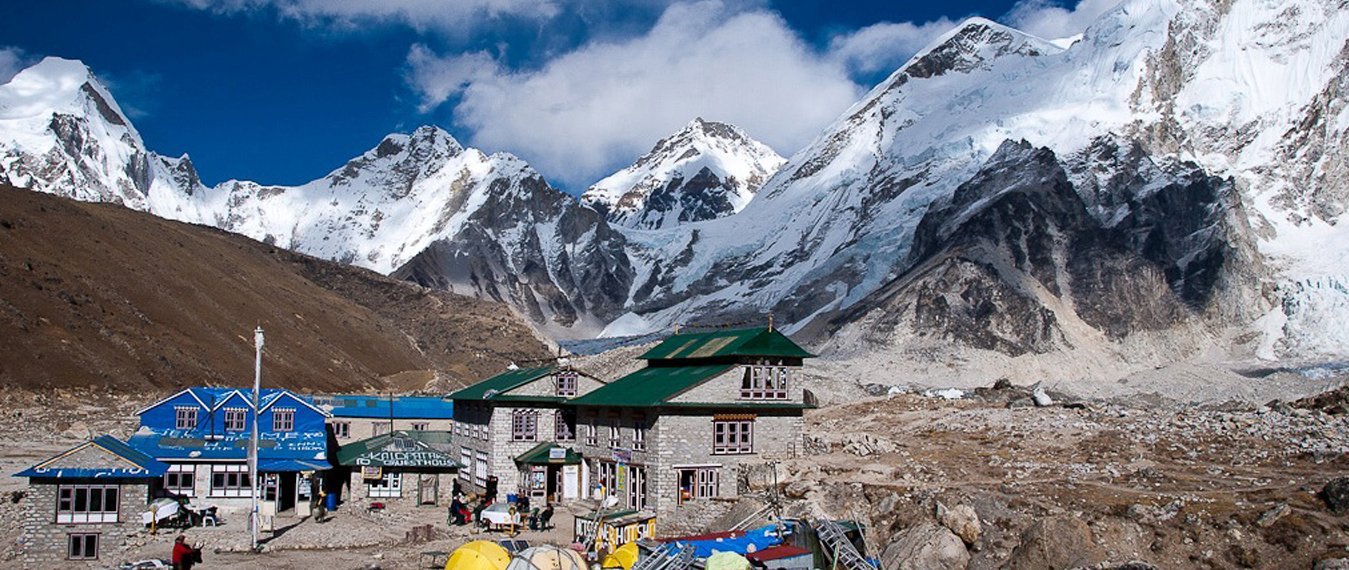
Khumbu Icefall and Base Camp: From Gorak Shep, the 3-hour trail to Base Camp crosses the terminal moraine of the Khumbu Glacier — a jumbled, shifting landscape of ice, rock, and altitude-induced humility. Base Camp itself, at 5,364 m, is a city of coloured tents during the spring climbing season (late March to late May). You’ll hear the periodic rumble of avalanches calving from the Khumbu Icefall above — the most dangerous section of any Everest summit attempt, and the reason the Icefall Doctors earn every rupee of their wage.

EBC Vs ABC Trek: Which is Right for Your First Nepal Adventure?
Not every Australian heading to Nepal has 14 days, 5,000-metre aspirations, or a budget for the EBC’s permit stack. The Annapurna Base Camp Trek — nestled in the Annapurna Sanctuary — has emerged as one of Nepal’s most compelling alternatives, and it deserves serious consideration. This section is your definitive comparison.
| Category | Everest Base Camp Trek | Annapurna Base Camp Trek |
| Max Elevation | 5,545 m (Kala Patthar) | 4,130 m (Annapurna Base Camp) |
| Duration | 12–14 days | 7–10 days |
| Best Season | Mar–May, Sep–Nov | Mar–May, Sep–Nov |
| Crowds | High (main EBC trail) | Low–Moderate |
| Scenery | Ice giants, glaciers, Sherpa culture | Rhododendron forests, Annapurna massif, glacial amphitheatre |
| Key Landmarks | Khumbu Icefall, Ngozumpa Glacier | Machapuchare Base Camp, Annapurna Sanctuary |
| Flight Required? | Yes (Lukla flight) | No (drive/bus Kathmandu–Pokhara, then trek from Nayapul) |
| 2026 Cost (Guided) | USD 1,400–1,900 | USD 900–1,200 |
| Difficulty | Moderate–Strenuous | Moderate |
| Permit Required | Sagarmatha NP + TIMS + KP-LM Permit | Annapurna Conservation Area Permit (ACAP) + TIMS Card |
4.1 Annapurna Base Camp Trek Cost 2026: A Detailed Breakdown
The Annapurna Base Camp trek is significantly more accessible in cost than EBC. Here’s what Australian trekkers should budget for in 2026:
- Guided Group Trek (8–10 days): USD $900–$1,100 per person. Includes guide, porter, teahouse accommodation, all meals on trek, Annapurna Conservation Area Permit (ACAP), and TIMS Card.
- Private Guided Trek (8–10 days): USD $1,100–$1,400 per person. Same inclusions, dedicated guide, more flexible itinerary.
- Solo Independent Trek: USD $400–$600 all-in (own accommodation, food, permits). Viable but note: navigating the 2015 earthquake-affected trail network without a local guide significantly increases risk.
- International Flights (included in neither): Budget AUD $1,100–$1,800 return from Sydney/Melbourne to Kathmandu.
- Travel Insurance (CRITICAL — see Section 6): AUD $150–$400 depending on provider and trip length.
Total estimated Annapurna Base Camp trek cost from Australia (2026): AUD $3,500–$5,500 for an 8–10 day experience, compared to AUD $6,500–$10,000+ for a fully guided 14-day EBC trek. The EBC cost reflects the Lukla flights, the higher-altitude teahouse premiums, and the more complex permit structure.
4.2 Difficulty: Is EBC Harder Than ABC?
In a word: yes. But context matters enormously.
EBC’s maximum elevation of 5,545 m (Kala Patthar) is 561 metres higher than ABC’s summit point of 4,130 m (Annapurna Base Camp itself). Above 4,000 m, every additional 100 metres elevation carries meaningful increased risk of Acute Mountain Sickness (AMS). EBC also demands a longer daily commitment — several days cover 15–19 km — and the cold at Lobuche and Gorak Shep is genuinely savage, with overnight temperatures reaching -20°C in shoulder season.
ABC, by contrast, is rated moderate — comparable to a challenging multi-day Australian alpine walk. The trail is well-maintained with clear signage, the elevation gain gradual through spectacular rhododendron and bamboo forests, and the 9–11 day standard itinerary allows solid acclimatisation without pharmaceutical support for most fit adults.
OUR VERDICT
If you have fewer than 10 days, a tighter budget, or no previous trekking-at-altitude experience — start with ABC. It will introduce you to Nepal’s teahouse culture, altitude awareness, and trail life inside one of the world’s most beautiful mountain sanctuaries. Come back for EBC the following year with genuine confidence. Both can be arranged through Excellent Himalaya Trek & Expedition.
4.3 Can I Trek Both EBC and ABC Back-to-Back?
Yes — and this is an increasingly popular ‘Grand Nepal’ itinerary. The logistics require approximately 22–26 days total:
- Recommended order: ABC first (days 1–11), then return to Kathmandu for 2 nights, then fly to Lukla for EBC (days 14–27). This allows ABC to serve as genuine pre-acclimatisation for EBC — your body arrives at Namche Bazaar having already spent a week above 3,500 m.
- Permits: You’ll need separate permit sets for each region. The TIMS Card is valid for both but must be obtained separately per trek. Excellent Himalaya Trek & Expedition handles all permit logistics for back-to-back bookings.
- Budget: Allow AUD $12,000–$16,000 for the full combined experience, including international flights.
Training for EBC in Australia: The Sea-Level Challenge
This is the section that Australian EBC aspirants most underestimate — and where Excellent Himalaya Trek & Expedition’s pre-trek coaching program adds the most value. Training for a 5,000-metre trek when you live at sea level in Sydney, Melbourne, or Perth requires a specific, multi-month approach.
5.1 The Cardiovascular Foundation
Begin your training programme a minimum of 16 weeks before departure. In the first 8 weeks, the goal is aerobic base-building:
- 3–4 cardio sessions per week: Mix trail running, cycling, and stair climbing. The goal is sustained Zone 2 effort (conversational pace) for 60–90 minutes.
- One long weekend hike: Build to 20–25 km over hilly terrain with 800–1,000 m elevation gain. In Sydney, the Six Foot Track and the Blue Mountains Grand Canyon circuit are ideal. In Melbourne, use the Kokoda Track Memorial Walk or the Dandenong Ranges’ 1000 Steps with a 10–15 kg weighted pack.
- Perth options: The Bibbulmun Track’s Perth Hills section offers excellent training terrain. The Lesmurdie Falls circuit makes a good weekly benchmark.
5.2 Strength & Stability
EBC’s descent sections — particularly the Lobuche-to-Gorak-Shep moraine and the long Namche-to-Lukla run — destroy undertrained quads and knees. Prevent this:
- Weighted step-ups onto a 40 cm box: 4 sets of 15 each leg, twice weekly
- Romanian deadlifts: strengthens the posterior chain for downhill braking
- Single-leg wall sits and Bulgarian split squats: mimics uneven EBC trail terrain
- Calf raises on a step: protects Achilles tendons under pack weight at altitude
5.3 Altitude Simulation
You cannot replicate 5,000 m in coastal Australia. But you can prepare your body intelligently:
- Altitude tents/masks: Altitude tents (from AUD $1,500 rental) can simulate up to 4,500 m while sleeping. Useful but expensive. Hypoxic training masks have limited scientific backing for altitude preparation — save your money.
- Acclimatisation days in Nepal: Do not skip acclimatisation days in Namche and Dingboche. Our guides carry pulse oximeters; they will monitor your SpO2 and adjust pace accordingly.
- Diamox discussion: Consult your GP or a travel medicine clinic (e.g., The Travel Doctor — TMVC) about acetazolamide (Diamox) at least 8 weeks before departure. Starting at 125 mg twice daily from the day before Lukla is standard practice for sea-level-based trekkers. Side effects — increased urination, tingling fingers — are manageable and worth the prophylactic benefit.
Australian Travel Insurance for EBC: A Non-Negotiable Briefing
Altitude trekking insurance is the single most important administrative decision you’ll make. In the Khumbu region, a helicopter evacuation from 5,000 m to Kathmandu costs between USD $4,000 and USD $8,000. Without adequate insurance, that bill is yours. Every year, trekkers are airlifted at their own expense because their policies excluded ‘high-altitude activity’ above a threshold. Do not let this be you.
6.1 What Your Policy MUST Include
- Helicopter evacuation coverage up to 6,000 m: This is non-negotiable. Verify the exact altitude limit — some standard adventure policies cap at 4,000 m or 5,000 m. You need 6,000 m to cover Kala Patthar (5,545 m) and any emergency scenario.
- Medical evacuation and repatriation to Australia: If you develop High Altitude Pulmonary Oedema (HAPE) or High Altitude Cerebral Oedema (HACE), evacuation is urgent and non-negotiable. Repatriation can cost USD $30,000+.
- Trip cancellation/interruption: Nepal weather, Lukla flight delays, and family emergencies happen. Ensure coverage includes missed connections and trip curtailment.
- Pre-existing conditions declaration: Declare everything. Non-disclosure voids claims at the worst possible moment.
6.2 Recommended Providers for Australian Trekkers
- World Nomads (Explorer Plan): The most popular choice among Australian adventure travellers. Covers trekking up to 6,000 m, helicopter evacuation, and emergency dental. Underwritten by Lloyd’s of London. Note: purchase before departure; cannot be extended once a claim is in progress.
- NIB Travel Insurance (High Adventure addon): Strong medical evacuation limits and solid 24/7 emergency assistance. Requires the ‘High Adventure’ product add-on for above-4,000 m coverage. Worth comparing quotes via iselect or canstar.
- Cover-More (formerly Zurich): Available via most Australian travel agents and Flight Centre. Mountain trekking add-on required; verify altitude limits in your PDS.
- Allianz Travel Insurance: Competitive for older trekkers (55+). Medical limits tend to be higher, which matters for longer hospital stays.
CRITICAL: Read the PDS (Product Disclosure Statement)
The PDS — not the marketing page — contains the altitude exclusion clauses. Search the document for ‘altitude,’ ‘mountaineering,’ and ‘high altitude trekking.’ If the PDS is ambiguous, call the insurer and get written confirmation that helicopter evacuation above 5,500 m is covered before you pay. Save that email.
Permits: What Australian Trekkers Need
Nepal’s permit framework has evolved significantly in recent years. For 2026, Australian trekkers on the EBC route require the following:
- Sagarmatha National Park Entry Permit: NPR 3,000 per person (approx. AUD $35). Purchased at the park gate in Monjo or in advance at the Tourism Board office in Kathmandu.
- TIMS Card (Trekkers’ Information Management System): NPR 2,000 per person for individual trekkers, NPR 1,000 for agency-registered groups. Issued at Nepal Tourism Board offices in Kathmandu or Pokhara.
- Khumbu Pasang Lhamu Rural Municipality (KP-LM) Permit: Introduced in 2023 and fully enforced by 2026. This is a local government levy of NPR 2,000 per person, collected at checkpoints in the Khumbu region. Do not confuse this with the national park permit — both are required.
- Tibet Travel Permit (Context Only): Not required for standard EBC trekkers. Only relevant if you are attempting the North Col approach via Tibet, which requires a Chinese Tibet Travel Permit, an Alien’s Travel Permit, and a Restricted Areas Permit. Excellent Himalaya Trek & Expedition can arrange these for Tibetan-side expeditions.
Total permit cost for EBC (2026): Approximately NPR 7,000 (AUD $80–$90 per person) when booked through a registered operator. All permits are included in Excellent Himalaya Trek & Expedition’s package pricing.

Equipment & Packing List: 2026 Australian Edition
The following packing list is optimised for Australian trekkers undertaking EBC in spring (March–May) or autumn (September–November) 2026. It reflects the specific challenges of carrying gear from Australia on international flights with a 23 kg checked baggage allowance.
| Clothing & Layers | Technical Gear | Health & Documents |
| Merino wool base layers (x3) | 60–70L trekking pack | Travel insurance docs (printed) |
| Insulated down jacket (700-fill+) | Trekking poles (collapsible) | TIMS Card & NP permits (copies) |
| Waterproof shell jacket & pants | Headlamp + spare batteries | Diamox (acetazolamide) prescription |
| Fleece mid-layer | Sleeping bag rated to -15°C | Oral rehydration sachets x10 |
| Thermal gloves + expedition mitts | Microspikes or traction devices | Ibuprofen, blister kit, bandages |
| Wool hat + sun hat + balaclava | Lightweight trekking gaiters | Passport + 2 passport photos |
| High-SPF lip balm + sunscreen SPF 50+ | Satellite communicator (SPOT/Garmin) | AUD cash for emergency (USD also useful) |
| Moisture-wicking trekking socks (x6) | Water purification tablets/filter | Australian Medicare card (for repatriation) |
| Sturdy trekking boots (broken in) | Power bank (20,000 mAh) | GP letter re: altitude medications |
Gear Hire in Kathmandu: Don’t over-invest in gear you’ll use once. Thamel in Kathmandu offers high-quality gear hire — sleeping bags, down jackets, and trekking poles can be rented for USD $1–$5 per day. Excellent Himalaya Trek & Expedition can arrange vetted hire from reputable suppliers.
Duffel Bag vs. Backpack: Your porter will carry your main duffel (up to 15 kg). You carry a daypack of 10–15 L with water, snacks, rain gear, camera, and your insurance documents. Never pack medication in your porter’s duffel.
FAQs: Your Questions Answered
Q: Is EBC harder than ABC?
Yes, by a meaningful margin. EBC reaches 5,545 m (Kala Patthar) versus ABC’s 4,130 m — a difference of over 1,400 metres that is physiologically very significant. EBC also involves more cumulative distance, harsher cold at high camps, and greater exposure to AMS risk. That said, neither trek requires technical climbing skills. The key differentiator is time commitment and altitude tolerance. Fit, acclimatised adults with no altitude-related medical history typically complete EBC safely with proper preparation and a well-paced itinerary.
Q: Can I do EBC and ABC back-to-back in one trip?
Yes — and we highly recommend this sequencing: ABC first, then EBC. Doing ABC ahead of EBC means you arrive at Namche Bazaar having already spent a week above 3,000 m in the Annapurna Sanctuary. Your body has made meaningful haematological adaptations. Your acclimatisation days in Namche become a true consolidation rather than a starting point. Allow 22–26 total days in Nepal for the back-to-back itinerary. Contact Excellent Himalaya Trek & Expedition for our ‘Grand Nepal Circuit’ package pricing, which combines both routes with Kathmandu cultural days and seamless logistics.
Q: What’s the best time of year for Australians to do EBC?
Spring (March–May) is the most popular season, offering stable weather, rhododendron blooms, and the spectacular backdrop of expedition teams preparing for summit attempts. Autumn (September–November) is equally excellent — clearer skies, less mud, and fewer crowds than the spring peak. Avoid the June–August monsoon period (heavy rain, leeches, trail damage) and January–February (extreme cold, many teahouses closed). For Australians booking around the school holiday calendar, October is the sweet spot.
Q: Do I need a guide, or can I trek EBC solo?
As of 2023, Nepal does not legally mandate guides for the EBC route (unlike some restricted areas). However, trekking EBC without a guide significantly increases safety risk, particularly for first-time altitude trekkers. A licensed guide from Excellent Himalaya Trek & Expedition carries a pulse oximeter, speaks fluent Nepali with teahouse owners and local health posts, carries an emergency oxygen kit, and has the experience to recognise early AMS symptoms that you will likely ignore in yourself. The guide fee is the best safety investment you’ll make.
Why Excellent Himalaya Trek & Expedition
There are hundreds of Nepal trekking agencies. Most are competent. A handful are exceptional. Excellent Himalaya Trek & Expedition was founded by Sherpa-heritage guides with roots in the Khumbu Valley, built specifically to serve the international trekker who demands expertise, safety, and authentic connection — not a packaged tourism experience.
10.1 Our Guides
Every Excellent Himalaya lead guide holds certification from the Nepal Mountaineering Association (NMA) and the Trekking Agencies’ Association of Nepal (TAAN). Our senior guides have led 80+ EBC expeditions. They speak fluent English, understand Australian trekker culture (the flat whites and the gallows humour), and, most critically, know when to push and when to pull the plug on altitude ascent.
- Wilderness First Responder training: All lead guides carry first aid kits including a Gamow Bag (portable hyperbaric chamber) for HACE/HAPE emergencies.
- Pulse oximetry monitoring: Mandatory SpO2 and heart rate checks every morning from Namche Bazaar onwards. Data is logged and actioned.
- Female guide option: Available on request for solo female Australian trekkers. We are committed to equal representation in Nepali outdoor guiding.
10.2 Our Safety Record & Protocols
In over a decade of operations, Excellent Himalaya Trek & Expedition has maintained a zero-fatality record on all guided EBC departures. We attribute this to three principles:
- Conservative acclimatisation scheduling: We do not rush. Acclimatisation days in Namche and Dingboche are treated as fixed commitments, not optional extras.
- Pre-departure health screening: All clients complete a high-altitude health questionnaire reviewed by our medical consultant before departure confirmation.
- Clear descent protocols: If a client’s SpO2 drops below 80% at altitude with no improvement after rest, descent is non-negotiable. No summit pressure, no exceptions.
10.3 What’s Included in Our 2026 EBC Packages
- All teahouse accommodation (twin-share) on the EBC route
- All meals on trek (breakfast, lunch, dinner) from Lukla to Lukla
- Licensed, English-speaking lead guide (1 guide per 6 trekkers maximum)
- Porter service (1 porter per 2 trekkers; maximum 15 kg duffel per porter)
- All permits: Sagarmatha NP, TIMS Card, KP-LM Permit
- Lukla domestic flight (Manthali or KTM; transfer to Manthali included)
- Kathmandu hotel (3 nights, 3-star), airport transfers, welcome dinner
- First aid kit, pulse oximeters, emergency oxygen
- 24/7 in-country emergency support line for Australian clients
- Pre-trek information pack and training guide (dispatched 8 weeks before departure)
10.4 Personalised Service for Australian Clients
Excellent Himalaya Trek & Expedition has a dedicated Australia client coordinator based in Kathmandu who has personally trekked the Blue Mountains, understands DFAT travel advisories, and can communicate across AEST, AEDT, and AWST time zones. We know that booking from Brisbane is different from booking from London — the flight routing, the insurance landscape, and the budget expectations are all distinct. Our Australian packages reflect that reality.
BOOK YOUR 2026 EBC TREK WITH EXCELLENT HIMALAYA
Email: [email protected]
Web: www.excellenttrek.com
Whatspp Number: +977-9851203181
A Final Word: Why This Matters
The Everest Base Camp trek from Australia is more than an adventure holiday. It is a recalibration. Standing at 5,364 metres in the shadow of the world’s highest mountain — your lungs doing mathematics you never studied, your legs carrying the memory of Blue Mountains training walks, your hands wrapped around a mug of Sherpa tea — you realise something specific: you prepared for this, you chose this, and you earned this.
The Khumbu Icefall groans above you. The Ngozumpa Glacier — the longest in the Himalaya — stretches west into a blue horizon. And somewhere in the coloured tents of Base Camp, expedition teams dream of the ridge that trekkers never touch. That’s their adventure. This is yours. And it is magnificent.
Excellent Himalaya Trek & Expedition exists to get you there safely, authentically, and with the full weight of 20 years’ Khumbu experience behind every step. We’ll see you in Kathmandu, Nepal.
About the Author

Suman Shrestha
I am Suman Shrestha. I have dedicated my life to mastering the rhythms of the Nepal Himalayas and its culture. I am also a fully government-licensed trekking and tour guide. I've personally led hundreds of adventure groups across our country's most diverse and demanding landscapes and guided countless tour groups across every special interest imaginable. I know the ground reality of every ridge, every sacred monument, and every remote teahouse along the way, because I've earned that knowledge step by step, not from a brochure. My deep technical knowledge of Nepal’s diverse geography is matched only by my uncompromising commitment to safety. Beyond the physical path, I take a pride in being a bridge for all people by sharing the knowledge of the Himalayas, rich traditions and spiritual heritage of Nepal ensuring every journey is an authentic Experience. Let’s explore the heart of the Himalayas together. You can connect with me via WhatsApp at +9779851203181.