


Ama Dablam Base Camp vs Everest Base Camp: Which Trek Should You Choose?
The juniper smoke from a teahouse fire drifts across the trail at dusk. Above you, a mountain rises so sharply it seems less like geology and more like a declaration — the kind of peak that makes experienced trekkers stop mid-step and simply stare. You are somewhere in the Khumbu, and whether that silhouette belongs to the elegant spire of Ama Dablam or the distant, snow-capped pyramid of Everest depends entirely on which valley you chose to walk into.
That choice — Ama Dablam Base Camp vs Everest Base Camp — is one of the most common questions our team at Excellent Himalaya Trek & Expedition fields from trekkers every single season. And it deserves more than a quick answer. Both treks begin at Tenzing-Hillary Airport in Lukla. Both pass through the Saturday market bustle of Namche Bazaar, the butter-lamp glow of Tengboche Monastery, and the high-altitude villages of the Sherpa heartland. Yet beyond those shared kilometres of trail, these two journeys diverge dramatically — in elevation, in atmosphere, in cost, and in what they ask of you physically and emotionally.
This guide will give you the full picture. Not the version curated to make everything sound equally appealing, but the honest, detail-heavy comparison that comes from having led both routes hundreds of times across more than a decade in these mountains. By the time you reach the final section, you will know with clarity which trek belongs on your itinerary — and why.

Table of Contents
- At a Glance: Two Treks, One Region, Very Different Journeys
- Difficulty and Physical Demands: Which Trek Is Harder?
- Scenery and Photography: Mountain Views Compared
- Crowds, Solitude, and Trail Culture: A Stark Difference
- Cost Breakdown: What Does Each Trek Actually Cost?
- Best Time to Trek: Seasonal Guide for Both Routes
- Which Trek Is Right for You? A Practical Decision Guide
- Frequently Asked Questions
- Your Himalayan Trek Starts Here
At a Glance: Two Treks, One Region, Very Different Journeys
The Ama Dablam Base Camp Trek takes you off the main Everest highway and into the Mingbo Valley — a remote, glacier-carved corridor that approaches the south-west face of Ama Dablam (6,812 m / 22,349 ft) from the village of Pangboche. The trail climbs through rhododendron and birch forest, past stone walls threaded with prayer flags, and eventually onto the moraine ridges that lead to base camp at 4,570 m (14,993 ft). From that vantage point, Ama Dablam fills the entire sky above you — its hanging glacier suspended like a lantern, its twin ridgelines framing a view that serious mountain photographers travel from six continents to capture. The round trip covers approximately 55–65 kilometres and takes 10 to 14 days.
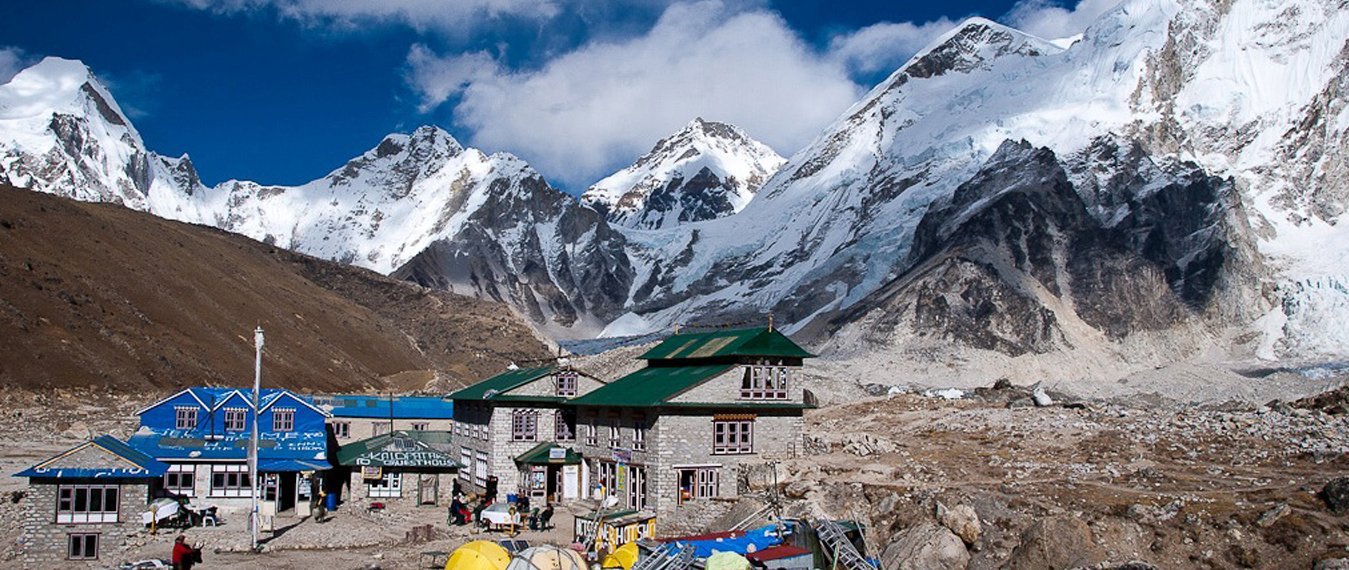
The Everest Base Camp Trek is one of the most recognisable walks on earth. From Lukla, the route climbs north through the Dudh Koshi valley, past the trading hub of Namche Bazaar, the ancient monastery at Tengboche, and the high-altitude settlement of Dingboche before reaching the bleak, beautiful moraine landscape above Lobuche. Gorak Shep, the last teahouse settlement on the route, sits at 5,164 m (16,942 ft). From here, trekkers push to Everest Base Camp at 5,364 m (17,598 ft) — a rocky, wind-scoured plateau at the foot of the Khumbu Icefall — and most continue early the following morning to Kala Patthar (5,545 m / 18,192 ft) for the sunrise view of Everest that defines the experience. The route covers roughly 130 kilometres round trip and requires 12 to 16 days.
| Feature | Ama Dablam Base Camp | Everest Base Camp |
| Maximum Elevation | 4,570 m (14,993 ft) | 5,364 m (17,598 ft) |
| Kala Patthar Option | No | Yes — 5,545 m (18,192 ft) |
| Trek Distance | ~60 km round trip | ~130 km round trip |
| Typical Duration | 10–14 days | 12–16 days |
| Difficulty Rating | Moderate–Challenging | Challenging |
| Crowd Level | Low–Moderate | High (peak season) |
| Permit Cost (2025) | TIMS + SNPEP (~USD 30–35) | TIMS + SNPEP + KPLRM fee |
| Best Season | Oct–Nov, Mar–May | Oct–Nov, Mar–May |
Both treks share the same best seasons, the same airport, the same first few days of trail, and the same extraordinary Sherpa culture. Everything else — the elevation profile, the crowd density, the scenery, the physical demands — tells a different story.
Difficulty and Physical Demands: Which Trek Is Harder?
This is the question we hear most often, and the answer requires nuance.
Elevation and Acclimatisation
The single most significant difference between these two treks is elevation. Everest Base Camp sits 794 metres higher than Ama Dablam Base Camp — and in high-altitude trekking, those metres are not linear. The risk of Acute Mountain Sickness (AMS), and in severe cases High Altitude Pulmonary Edema (HAPE), increases meaningfully above 4,000 m and again above 5,000 m. EBC trekkers spend five or more consecutive nights above 4,000 m before reaching base camp, with the final two nights in Lobuche and Gorak Shep pushing bodies into territory where even fully acclimatised trekkers can feel the altitude pressing against their sleep and appetite.
Ama Dablam Base Camp, at 4,570 m, sits in a more forgiving window. Most healthy, acclimatisation-conscious trekkers reach it without pharmaceutical assistance. The Wilderness Medical Society recommends sleeping no more than 300–500 m higher each night above 3,000 m, with a rest day every third day of ascent. A well-designed ADBC itinerary from Lukla allows for precisely this pace, including a rest day in Namche Bazaar at 3,440 m — a protocol our guides consider non-negotiable.
For EBC, the same acclimatisation principles apply, but the exposure is longer and the peak altitude demands that the body work harder to sustain oxygen saturation. Our guides routinely carry pulse oximeters and check readings each evening above 4,200 m. If a trekker’s SpO2 drops below 80% and does not recover overnight, descent is the only option — and on EBC, that can mean a helicopter evacuation from Lobuche or Gorak Shep, a reality that costs both money and pride.
Acetazolamide (Diamox) is available with a prescription and commonly used as a preventative measure on EBC. It is less commonly needed on ADBC, though individual responses to altitude vary considerably and no guide can predict with certainty how any body will respond on a given day.
Daily Distance and Terrain
The EBC route averages 12–16 kilometres per walking day on a well-maintained, clearly signed trail used by tens of thousands of trekkers annually. It is physically demanding but navigationally straightforward. The main challenge is cumulative: day after day of uphill on increasingly thin air, carrying a daypack while your body quietly renegotiates its relationship with oxygen.
The Ama Dablam Base Camp Trek is shorter in daily distance — most walking days cover 8–12 kilometres — but the Mingbo Valley section above Pangboche is a different proposition altogether. The trail moves onto loose scree slopes, boulder fields, and in spring, potentially snow-covered ground. There are no teahouses in the upper Mingbo Valley. A tent camp or basic porter shelter is typically used for the final nights. The route is less clearly marked, requiring a competent guide who knows the valley. This is not a trail for independent navigation.
That technical character means ADBC demands more of trekkers in terms of sure-footedness and comfort on unstable ground, even if it demands less in terms of altitude tolerance.
Who Should Choose Each?
If your primary concern is altitude sickness and you want to minimise nights above 4,500 m, choose Ama Dablam Base Camp. If you are fit, have a strong acclimatisation history from previous high-altitude treks — Kilimanjaro, Aconcagua, Annapurna Base Camp — and are drawn to the psychological weight of standing beneath the world’s tallest mountain, Everest Base Camp is the one to attempt.
The uncomfortable truth is that EBC has a higher turnaround rate due to altitude than ADBC. We have seen strong, determined trekkers stopped at Dingboche or Lobuche, not because they lacked fitness but because their bodies simply would not adapt at altitude. AMS does not negotiate with willpower.
Quick Verdict: If altitude is your primary concern, Ama Dablam Base Camp carries a meaningfully lower AMS risk. If you have good altitude acclimatisation history and are drawn to the iconic achievement of EBC, the physical demands are entirely manageable with a proper itinerary — but the margin for error is smaller.
Scenery and Photography: Mountain Views Compared
Ama Dablam Base Camp Views
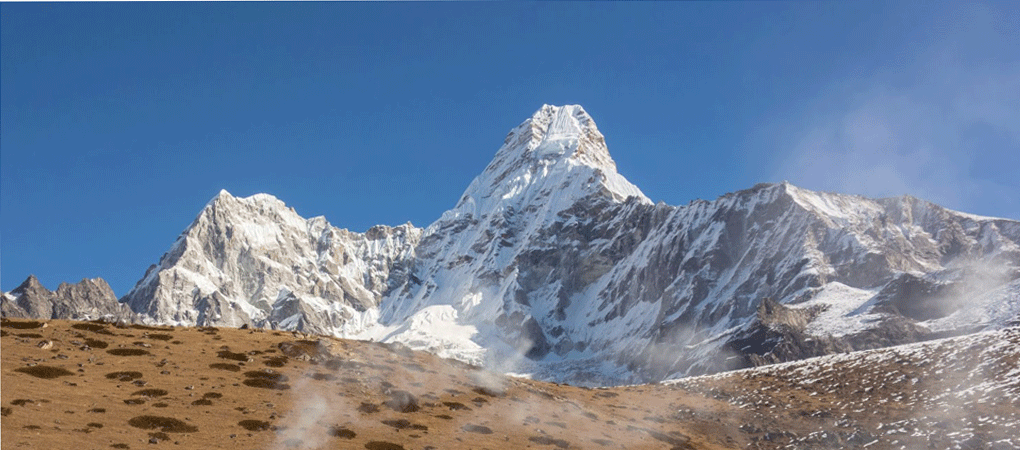
There is a moment on the approach to Ama Dablam Base Camp — somewhere on the moraine above the Mingbo Khola — when the mountain fills your entire field of vision and the word “dramatic” becomes genuinely inadequate. The Sherpas call Ama Dablam the “Mother’s Charm Box,” a reference to the hanging glacier on the mountain’s south-west ridge that resembles the traditional amulet boxes Sherpa women wear around their necks. From base camp at 4,570 m, that glacier hangs directly above you, a mass of blue-white ice threatening and beautiful in equal measure.
The south-west face at dawn turns from grey to amber to gold within the space of twenty minutes as the sun clears the ridge. Lhotse’s east wall — one of the great unclimbed faces in Himalayan mountaineering — looms to the north. Island Peak (6,189 m / 20,305 ft), a popular trekking peak, anchors the eastern skyline. The valley itself is intimate in a way the EBC corridor simply cannot be: fewer people, more silence, more of the Khumbu as it existed before international trekking became an industry.
Photographers who have shot both base camps consistently rate the ADBC composition as Nepal’s finest single-mountain subject. The peak’s symmetry, the foreground of moraines and glacial pools, and the complete absence of built infrastructure make for images that require minimal post-processing to look extraordinary.
Everest Base Camp Views
Here is the honest version that travel blogs often soften: from Everest Base Camp itself, you do not see the summit of Everest clearly. The Khumbu Icefall — a churning, collapsing river of ice that mountaineers must cross during summit attempts — fills the immediate foreground, and the Western Cwm rises beyond it. Everest’s summit pyramid is largely obscured by the ridgelines of Nuptse (7,861 m / 25,791 ft) and the base camp’s own position at the foot of the glacier. The Everest you see from base camp is a partial view — powerful and atmospheric, especially with the prayer flags and coloured expedition tents of climbing season, but not the clean summit shot many trekkers expect.
The payoff comes the following morning at Kala Patthar (5,545 m / 18,192 ft), a rocky promontory above Gorak Shep that provides one of the world’s great sunrise panoramas. At around 5:30 am, in temperatures that commonly drop to -15°C, the summit pyramid of Everest (8,849 m / 29,032 ft) catches the first light of day while everything below remains in shadow. Lhotse (8,516 m / 27,940 ft), Nuptse, and Pumori (7,161 m / 23,494 ft) frame the scene. For many trekkers, this single hour on Kala Patthar becomes the defining memory of their entire Nepal journey.
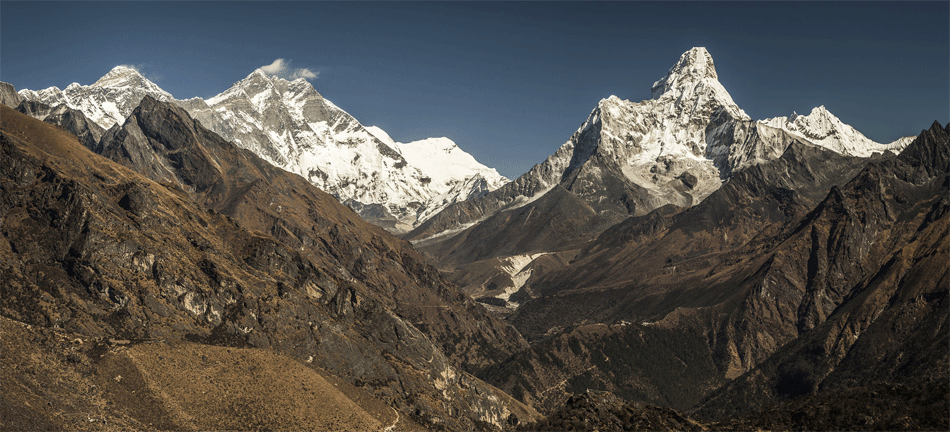
The EBC route also passes directly beneath Tengboche Monastery — one of the most photographed buildings in the Himalayas — and offers repeated foreground compositions of Ama Dablam from the main trail, particularly between Namche and Tengboche, where the mountain appears at the end of long valley corridors.
The Verdict for Photographers
Quick Verdict: Ama Dablam Base Camp wins for intimate, concentrated mountain drama — the peak is the entire composition. EBC combined with Kala Patthar wins for iconic wide-angle panorama photography and the emotional resonance of standing opposite the highest point on earth.
Crowds, Solitude, and Trail Culture: A Stark Difference
The numbers are unambiguous. Sagarmatha National Park — which covers the EBC route from Monjo onwards — recorded over 60,000 trekker entries in 2023, a figure that continues to grow year on year following the COVID-related dip in 2020–21. In peak season (October and November), the trail between Namche Bazaar and Tengboche becomes a slow-moving procession of trekkers, porters, yak trains, and mule caravans. Teahouses above Namche require advance booking from late September onwards. The social atmosphere is vibrant and genuinely international — you will share dining tables with trekkers from Japan, Brazil, Poland, and South Africa within the space of a single meal — but the word “solitude” does not apply to the EBC main corridor.
The Ama Dablam Base Camp Trek sees a fraction of that traffic. The Mingbo Valley trail, above Pangboche, is walked by perhaps a few hundred trekkers per season. The teahouses in Pangboche and lower Mingbo are family-run operations where the owner often cooks your meal, knows your guide by name, and will tell you, unprompted, exactly when the clouds are likely to clear from Ama Dablam’s south face. That kind of connection — between trekker, guide, and local community — is harder to find on the EBC superhighway, though it still exists in the villages off the main trail.
The paradox is that EBC’s crowds are not entirely a negative. For solo trekkers, particularly those doing their first Himalayan route, the company is reassuring. The trail is never empty, emergency assistance is never far away, and the collective energy of hundreds of people chasing the same goal carries its own momentum. There is something genuinely moving about sharing a teahouse dinner with complete strangers who are all, in their different ways, trying to get to the same place.
ADBC offers the opposite experience: the trail is yours, the teahouses are quiet, and the sense of having earned something slightly off the beaten path is real. Trekkers who have already done EBC and are returning for ADBC frequently describe it as feeling like discovering a secret that the Khumbu had been keeping.

Cost Breakdown: What Does Each Trek Actually Cost?
Transparency matters here. There is a version of this conversation that presents vague ranges and lets the reader fill in the gaps with optimism. We prefer specifics.
Permits
Both treks require a TIMS (Trekkers Information Management System) card, issued through TAAN-registered operators or the Nepal Tourism Board office in Kathmandu. As of the 2025 season, the TIMS card costs approximately USD 20 for trekkers using a registered agency.
Sagarmatha National Park Entry Permit (SNPEP) is required for both routes. The fee for non-SAARC nationals is USD 30 per person (NPR rates fluctuate with exchange — always verify current figures with Nepal Tourism Board before departure). SAARC nationals pay NPR 3,000.
The Everest Base Camp route additionally requires payment of the Khumbu Pasang Lhamu Rural Municipality (KPLRM) conservation fee, which has been progressively increased in recent seasons and now adds a further USD 10–20 per trekker depending on the entry point and seasonal adjustment. Check current figures with your operator before booking. The Ama Dablam Base Camp route does not currently require the KPLRM fee for the standard Mingbo Valley approach, making it marginally cheaper on permits alone.
Flights to Lukla
The Tenzing-Hillary Airport at Lukla (2,860 m / 9,383 ft) is the standard entry point for both treks. Scheduled flights from Kathmandu’s Tribhuvan International Airport take approximately 35 minutes and cost USD 200–230 one way during normal season. During the peak October–November window, and occasionally during spring, the Civil Aviation Authority of Nepal diverts Lukla flights to Ramechhap (Manthali) Airport, approximately 130 kilometres east of Kathmandu, to reduce congestion. Ramechhap flights are slightly cheaper (USD 160–180 one way) but require a 3–4 hour drive from Kathmandu, adding logistical complexity and an early morning start. Budget approximately USD 400–460 for round-trip Lukla flights, or USD 320–360 from Ramechhap.
Guides, Porters, and Ethical Employment
This is where cost conversations sometimes become uncomfortable, and where Excellent Himalaya Trek & Expedition takes a firm position. A licensed, government-registered trekking guide earns USD 30–40 per day. An experienced, insured porter earns USD 20–25 per day with a maximum load limit of 25 kg. These are not optional line items for cost-cutting — they are the wages of local families who have built their livelihoods around sustainable mountain tourism.
The KEEP (Kathmandu Environmental Education Project) fair pay standards and the TAAN minimum wage guidelines exist for good reason. Trekkers who negotiate below these rates — often through unregistered operators or independent arrangements made through social media — are participating in a race to the bottom that harms the communities that make these treks possible. We mention this not to lecture, but because we have watched it damage both individual workers and the broader tourism ecosystem of the Khumbu over many years.
Accommodation and Meals
Teahouses along both routes range from USD 5–15 per night for a twin room with shared facilities. Above Namche, prices increase incrementally because all supplies above the road head must travel by porter, pack animal, or helicopter. A plate of dal bhat — the staple meal of rice, lentil soup, and seasonal vegetables that our guides eat at least twice daily — costs USD 4–8 depending on altitude. A hot shower, where available, adds USD 3–5. Budget USD 60–100 per day for accommodation and meals above Namche.
Total Package Estimates (2025)
A 12-day guided Ama Dablam Base Camp Trek package through Excellent Himalaya Trek & Expedition — including licensed guide, experienced porter, all teahouse accommodation, all meals, permits, and airport transfers within Nepal — ranges from USD 900 to USD 1,200 depending on group size and season. A comparable 14-day Everest Base Camp Trek package runs USD 1,100 to USD 1,500 by the same measure. International flights, travel insurance, and personal equipment are excluded.
Quick Verdict: ADBC is marginally cheaper in both duration and permit costs. EBC costs slightly more per day above Namche due to supply chain logistics, but for a journey of this magnitude, the cost difference between the two treks is modest relative to the total investment in international travel.
Best Time to Trek: Seasonal Guide for Both Routes
Both the Ama Dablam Base Camp Trek and the Everest Base Camp Trek share the same two primary seasons — and the same reasons to avoid the other two.
Autumn: October to November
This is the gold standard. The monsoon ends in late September, washing the atmosphere clean and leaving the Khumbu peaks in sharp, high-contrast relief against an impossibly blue sky. Temperatures in Namche Bazaar (3,440 m) average 5°C to 10°C during the day and drop to -5°C or below at night. At Everest Base Camp, nights routinely reach -15°C in November. Ama Dablam Base Camp is slightly warmer by virtue of its lower elevation but still demands proper sleeping gear rated to -15°C minimum. Autumn is the most crowded season on the EBC route — book teahouses from Tengboche onwards at least six to eight weeks in advance if departing in October or early November.
Spring: March to May
The second season. Temperatures are rising, the rhododendron forests below Namche are in bloom — a genuinely spectacular sight between 2,500 m and 3,500 m — and the trails are less congested than autumn, particularly in March and early April. The Everest climbing season runs from April through May, which adds helicopter traffic and the energy of expedition teams to the EBC route. Ama Dablam Base Camp in April is particularly quiet and offers excellent snow-free trail conditions in the Mingbo Valley, making it our guides’ personal favourite window for that route. Late May can bring the leading edge of the monsoon, reducing visibility and making trail conditions muddier at lower elevations.
Winter: December to February
Technically possible, particularly for the lower sections of both routes. Teahouses above Lobuche and in the upper Mingbo Valley may close or reduce services, and temperatures at EBC drop to -20°C or below on clear nights. The trails are quiet and the sky is often crystalline. For experienced cold-weather trekkers who want solitude and don’t mind the challenge, a winter ADBC attempt — with appropriate gear and a qualified guide — can be a genuinely rewarding experience. EBC in winter is more committing and only recommended for those with cold-weather high-altitude experience.
Monsoon: June to September
Neither route is recommended. Leeches are active below 3,000 m through July and August, trail surfaces become slippery and damaged by rainfall, cloud cover typically obscures mountain views for days at a stretch, and the risk of landslides on lower trail sections increases significantly. Some sections of both routes are effectively closed to non-essential travel during peak monsoon months.
Which Trek Is Right for You? A Practical Decision Guide
Our guides have been asked this question across teahouse tables and in Kathmandu briefing rooms more times than any of us can count. Here, without the softening that sometimes creeps into sales conversations, is how we actually answer it.
Choose Ama Dablam Base Camp if: You are drawn to mountain scenery as an aesthetic experience rather than a geographic milestone. The people who love ADBC most deeply are those who can spend an hour at base camp simply watching the light move across a face of rock and ice, with no particular urgency to be somewhere else. You want the Khumbu with a smaller human footprint — fewer trekkers, more direct community connections, more nights where the valley is yours. You are physically fit and technically capable on rough, unmaintained trail but carry some concern about spending extended time above 5,000 m. You have 10 to 12 days and a budget closer to the lower end of the range. You are considering returning to Nepal for EBC on a future trip — ADBC is an outstanding first Khumbu experience that leaves the bigger challenge open for later.
Choose Everest Base Camp if: The name carries weight for you — and there is nothing wrong with that. Standing below a mountain that has occupied human imagination since it was first measured in 1852, in the valley where Tenzing Norgay Sherpa and Sir Edmund Hillary began their successful ascent in 1953, is an experience with genuine historical and emotional resonance that no amount of travel writing can fully convey. You want the complete Khumbu experience: the bustle of Namche Bazaar’s Saturday market, the Mani Rimdu festival at Tengboche, the high-altitude plateau walking above Dingboche, and the Kala Patthar sunrise that has become one of the iconic images of Himalayan trekking. You have 14 to 16 days and good altitude acclimatisation history. You are comfortable with a more social, higher-traffic trail environment, and you understand that the final days above Lobuche are cold, austere, and demanding — and want them anyway.
There is no wrong choice in the Khumbu. We have watched seasoned mountaineers stand at both base camps — Ama Dablam and Everest — and respond with tears, silence, or simply a long, slow look at the mountains above them. The reasons were different in each case. The depth of the response was not.
Frequently Asked Questions
Q: Is Ama Dablam Base Camp harder than Everest Base Camp?
A: In terms of altitude, no — ADBC reaches 4,570 m while EBC reaches 5,364 m, making EBC the higher and more altitude-demanding objective. However, the Mingbo Valley approach to ADBC involves more technical terrain — loose scree, boulder fields, and potential snow crossings — which makes it physically more demanding per kilometre than the well-maintained EBC trail. Overall, EBC demands more in altitude acclimatisation; ADBC demands more in technical trail ability.
Q: Can beginners do the Everest Base Camp Trek?
A: EBC is not recommended for first-time high-altitude trekkers with no prior experience above 3,500 m. Trekkers who have completed multi-day alpine routes — Mont Blanc, Kilimanjaro, Annapurna Base Camp — with good altitude response are well-positioned. A proper 14-day itinerary with rest days in Namche and Dingboche is essential. Anyone with a history of cardiac or pulmonary conditions should consult a doctor with altitude medicine experience before attempting EBC.
Q: How many days do I need for Ama Dablam Base Camp Trek?
A: A minimum of 10 days from Lukla is required for a safe, properly acclimatised ADBC itinerary. Our recommended package is 12 days, which allows a rest day in Namche Bazaar, comfortable daily distances, and time at base camp. Attempting to compress the itinerary below 10 days significantly increases AMS risk and reduces the quality of the experience.
Q: Which trek has better views — Ama Dablam or EBC?
A: This depends entirely on what you mean by ‘better.’ Ama Dablam Base Camp offers the most dramatic intimate mountain composition in the Khumbu — the peak fills your entire field of vision and the Mingbo Valley is extraordinarily photogenic. EBC combined with Kala Patthar offers the widest-angle Himalayan panorama on any non-technical route in Nepal, including Everest, Lhotse, Nuptse, and Pumori simultaneously. For pure single-mountain drama: ADBC. For sweeping Himalayan panorama: EBC with Kala Patthar.
Q: What permits do I need for Ama Dablam Base Camp Trek in 2025?
A: You need two permits: the TIMS (Trekkers Information Management System) card (~USD 20 through a registered agency) and the Sagarmatha National Park Entry Permit (~USD 30 for non-SAARC nationals as of 2025). The KPLRM conservation fee required on the EBC route does not currently apply to the standard Mingbo Valley ADBC approach. All permits can be arranged by your registered operator in Kathmandu before departure for Lukla.
Q: Can I combine Ama Dablam Base Camp and Everest Base Camp in one trip?
A: Yes, and it is a route our team designs on request. A combined itinerary typically requires 18–22 days from Lukla, visiting ADBC via the Mingbo Valley from Pangboche before continuing on the main Khumbu trail to EBC and Kala Patthar. It is a demanding schedule and requires strong fitness and good altitude response. The advantage is seeing the Khumbu from two entirely different perspectives within a single trip. Contact our team for a customised itinerary.
Q: Is it safe to trek without a guide to Ama Dablam Base Camp?
A: Solo trekking to ADBC is not recommended and in some permit conditions may not be permitted. The Mingbo Valley section above Pangboche involves unmarked terrain, loose moraine, and potential crevasse zones near the glacier. Route-finding errors in this section can have serious consequences. A locally licensed guide is both a safety essential and — given TAAN employment standards — an ethical obligation. Independent trekking on the EBC main trail is more feasible due to the well-marked route but still carries altitude and emergency response risks that a qualified guide significantly mitigates.
Q: What is the best season for Ama Dablam Base Camp Trek?
A: Autumn (October–November) and spring (March–May) are both excellent. Our guides slightly prefer April for ADBC: the Mingbo Valley is snow-free, the rhododendron forests below Namche are in bloom, the trail is quieter than autumn, and Ama Dablam’s south-west face receives clear morning light for photography. November offers the most consistently stable weather but colder temperatures at camp. Avoid monsoon (June–September) and approach winter departures (December–February) only with experienced cold-weather preparation.
Your Himalayan Trek Starts Here
At their core, these two treks represent two different relationships with the Himalayas. Everest Base Camp is a pilgrimage — to the mountain that has shaped modern ideas of human ambition, to the memory of Tenzing and Hillary, to the simple act of standing at the foot of something that dwarfs every human scale. Ama Dablam Base Camp is a revelation — quieter, more intimate, a reminder that the Khumbu holds extraordinary things even for those willing to step just slightly off the path everyone else is walking.
Our guides at Excellent Himalaya Trek & Expedition have walked both routes across every season, in every weather, with trekkers at every fitness level. We know which knee struggles more on the descent from Kala Patthar, which teahouse above Pangboche serves the best butter tea, and which ridge on the Mingbo approach gives the first clear sightline to Ama Dablam’s hanging glacier. That knowledge is yours in a 15-minute conversation — no booking pressure, no upselling, just honest guidance from people who call these mountains home.
Get in touch with our team today to plan your Khumbu adventure — and let us help you choose the trek that is genuinely right for you.
About the Author

Suman Shrestha
I am Suman Shrestha. I have dedicated my life to mastering the rhythms of the Nepal Himalayas and its culture. I am also a fully government-licensed trekking and tour guide. I've personally led hundreds of adventure groups across our country's most diverse and demanding landscapes and guided countless tour groups across every special interest imaginable. I know the ground reality of every ridge, every sacred monument, and every remote teahouse along the way, because I've earned that knowledge step by step, not from a brochure. My deep technical knowledge of Nepal’s diverse geography is matched only by my uncompromising commitment to safety. Beyond the physical path, I take a pride in being a bridge for all people by sharing the knowledge of the Himalayas, rich traditions and spiritual heritage of Nepal ensuring every journey is an authentic Experience. Let’s explore the heart of the Himalayas together. You can connect with me via WhatsApp at +9779851203181.