



Best Company for Island Peak Climbing: Local Operator with Reviews
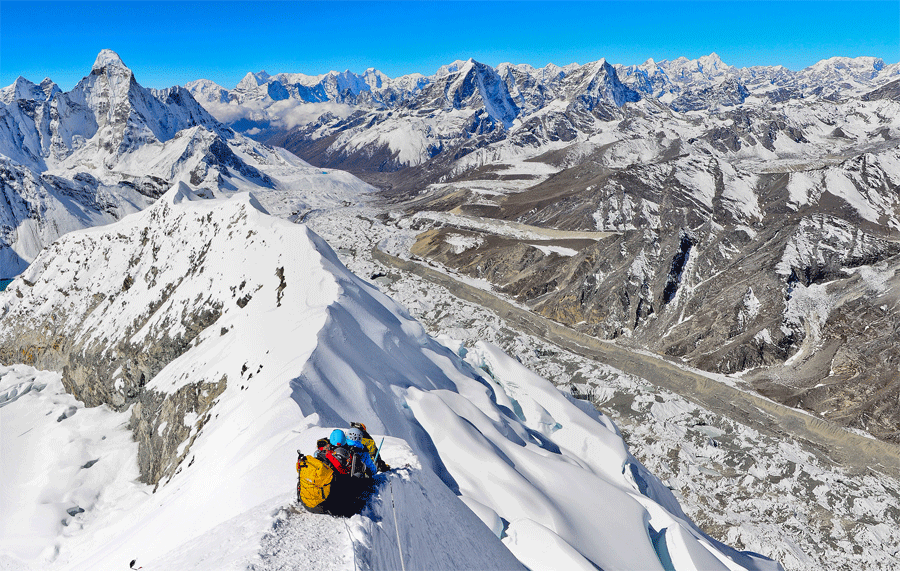
It is 3:30 in the morning. The temperature at Island Peak Base Camp has plunged to minus twelve degrees Celsius, and the beam of your headlamp catches crystals of ice suspended in still air. Above you, the black silhouette of the summit headwall rises at a steep 50-degree angle into a sky so crowded with stars it barely looks real. Behind you, the soft crunch of crampons tells you your Sherpa guide, Dawa, is just two rope-lengths back, steady and sure on the glacier. In six hours — if everything goes to plan — you will be standing at 6,189 metres, looking out over Lhotse, Makalu, Ama Dablam, and a hundred kilometres of Himalayan wilderness.
But everything going to plan does not happen by accident. It happens because of the company you chose — their certified guides, their conservative acclimatisation schedule, their quality gear, and their decade of muscle memory on this mountain. That choice, made weeks earlier at a laptop in your living room, is the decision that determines whether you stand on that summit or turn around at high camp with a pounding headache and a story you’d rather forget.
This guide exists to make that decision easy. We are Excellent Himalaya Trek & Expedition — a locally owned, Nepal government-registered expedition company staffed by NMA-certified Sherpa climbing guides, Wilderness First Responder-trained leaders, and a team that has guided hundreds of clients to the summit of Island Peak over more than a decade of operations. In the pages below, you will find everything you need to evaluate us, understand the mountain, and book with total confidence.

Table of Contents
- What Is Island Peak (Imja Tse)? A Complete Climber's Overview
- Why Choosing the Right Climbing Company Matters
- Excellent Himalaya Trek & Expedition: Why We Are the Best Company for Island Peak Climbing
- Our Island Peak Climbing Itinerary: Day-by-Day
- Permits, Costs & What's Included: Complete Transparency
- Client Reviews: Real Climbers, Real Summits
- Who Should Climb Island Peak? Fitness & Prerequisites
- Island Peak Gear List: What to Bring
- Safety Protocols at Excellent Himalaya Trek & Expedition
- Frequently Asked Questions About Island Peak Climbing
- Conclusion: Your Island Peak Summit Starts Here
What Is Island Peak (Imja Tse)? A Complete Climber's Overview
Location and Elevation
Island Peak — known by its Nepali name Imja Tse — stands at 6,189 metres (20,305 feet) above sea level in the Khumbu region of northeastern Nepal, deep inside the boundaries of Sagarmatha National Park. The peak sits at approximately 27°55’N, 86°56’E, rising from the moraine at the head of the Imja Valley roughly six kilometres southeast of the village of Chhukung. Its nearest towering neighbours are the south face of Lhotse (8,516 m) to the north and the dramatic pyramid of Ama Dablam (6,812 m) to the west — both visible from the summit on a clear day.
The mountain was named Island Peak by Eric Shipton’s 1952 reconnaissance expedition because, when viewed from the surrounding glaciers, it appeared to rise like a rocky island from a frozen sea. In 1983 the Nepal Mountaineering Association (NMA) reclassified it as Imja Tse, though the name Island Peak has endured among climbers worldwide. It holds the distinction of being one of the first peaks in Nepal to be opened for recreational climbing, and today it is the most popular trekking peak in the country.
Technical Difficulty Explained
Island Peak is classified by the NMA as a trekking peak — a category that might suggest an easy scramble, but on Imja Tse this label is somewhat misleading. The standard route from Island Peak Base Camp (5,087 m) involves genuine high-altitude mountaineering: a long glacier approach in the dark, crevasse navigation, the use of crampons and ice axe throughout, fixed rope ascent on sections steepened to 45–55 degrees, jumar technique on the summit headwall, and the physical and psychological demands of sustained effort at thin air above 6,000 metres.
No prior technical climbing experience is required to attempt Island Peak with a qualified guide — our pre-climb training session in Kathmandu covers crampon fitting, ice axe arrest, and fixed rope ascending technique. However, do not underestimate this objective. The summit headwall alone demands strength, focus, and trust in your equipment. Clients who have completed previous multi-day Himalayan treks and who arrive physically prepared consistently report it as the most challenging and rewarding experience of their lives.
What You Will See From the Summit
The summit ridge of Imja Tse delivers one of the most spectacular panoramas in the entire Himalayan range. To the north, the south wall of Lhotse fills the horizon. To the northeast, the massive bulk of Makalu (8,485 m) dominates. Southeast, the elegant ridgeline of Baruntse (7,129 m) catches the morning light. And below you in every direction, an ocean of glaciers, moraines, and ice fields stretches to the horizon. On a clear pre-monsoon morning, our guides have watched the shadow of Island Peak itself stretch westward across the Chhukung Valley as the sun crests Lhotse — a sight that, in over a decade of guiding, never stops being extraordinary.
Why Choosing the Right Climbing Company Matters
The Nepal trekking industry is large, competitive, and — frankly — uneven in quality. Dozens of companies offer Island Peak packages, and the price range is wide enough to raise serious questions about what separates the cheapest from the best. The honest answer: safety, success, and the experience you carry home.
At altitudes above 5,000 metres, the margin for error compresses rapidly. Acute Mountain Sickness (AMS) — and its life-threatening progressions, High Altitude Cerebral Oedema (HACE) and High Altitude Pulmonary Oedema (HAPE) — can develop within hours. A guide who lacks WFR training may not recognise the early warning signs. An acclimatisation schedule that shaves two days off to cut costs may push clients onto the summit headwall before their bodies have adapted. A rope team of twelve crowded onto one fixed line creates bottlenecks that turn a summit bid into a dangerous, exhausting ordeal.
A cheaper package that cuts corners on guide ratios or acclimatisation days is a false economy at 6,000 metres. Choose the company that will get you to the summit safely — and bring you home the same way.
When evaluating any Island Peak climbing company, ask these questions: Are guides NMA-certified? What is the guide-to-client ratio? How many acclimatisation days are built into the itinerary? Is there a Gamow bag at base camp? What is the turn-back protocol? Are permits handled transparently? At Excellent Himalaya Trek & Expedition, every one of these questions has a documented, verifiable answer — and we encourage you to ask all of them.
Excellent Himalaya Trek & Expedition: Why We Are the Best Company for Island Peak Climbing
Company Background and Government Registration
Excellent Himalaya Trek & Expedition is a locally owned Nepali company registered with the Nepal Tourism Board (NTB), the Trekking Agencies’ Association of Nepal (TAAN), and the Nepal Mountaineering Association (NMA). Our operations centre is based in Kathmandu’s Thamel district, and our field operations extend across the Khumbu, Annapurna, Langtang, and Mustang regions. We are not an international reseller or booking aggregator — every expedition is operated directly by our own guides, on our own permits, with our own equipment.
We have been leading Island Peak expeditions for over a decade. In that time we have guided more than 500 climbers to the summit of Imja Tse, accumulated an institutional knowledge of this mountain’s seasonal rhythms, and built relationships with the local communities of Chhukung and Dingboche that form the backbone of responsible, community-integrated tourism.
Guide Credentials and Experience
Every climbing guide at Excellent Himalaya Trek & Expedition holds NMA trekking peak guide certification as a minimum qualification. Our senior climbing leaders additionally hold mountaineering leadership certification from the NMA’s advanced training programmes, and several have summited 8,000-metre peaks including Everest, Makalu, and Manaslu. All field guides are Wilderness First Responder (WFR) certified, trained in high-altitude rescue techniques, pulse oximetry monitoring, recognition and management of AMS, HACE, and HAPE, and emergency helicopter evacuation coordination.
Our guides are not seasonal contractors picked up for a single expedition. They are long-term team members — most have worked with us for five or more years — who know Island Peak the way a chef knows their kitchen. Guide Dawa Sherpa, one of our senior climbing leaders, has summited Imja Tse more than 80 times. Guide Mingma Sherpa holds a master’s degree in tourism management and speaks English, Hindi, and three Sherpa dialects. This depth of expertise and continuity is what drives our summit success rate and our client satisfaction scores.
Summit Success Rate
Excellent Himalaya Trek & Expedition maintains a 95%+ summit success rate on Island Peak — well above the industry average. This figure is the product of specific, deliberate decisions: a conservative acclimatisation itinerary that includes mandatory rest days at Namche Bazaar (3,440 m) and Dingboche (4,410 m); daily health monitoring using pulse oximeters and structured symptom checks; a strict turn-back protocol that is non-negotiable regardless of weather or client pressure; and small group sizes that allow guides to monitor every member of the rope team in real time.
We will not push a client toward a summit that poses unacceptable risk. In practice, this means our guides have the authority — and the obligation — to call off a summit attempt if oxygen saturation drops below safe thresholds, if weather deteriorates beyond acceptable parameters, or if a client is showing early-stage altitude illness. This commitment to conservative decision-making is why our clients come home safely, and why they come back to us for their next Himalayan peak.
Small Group Policy
We enforce a maximum of eight climbers per guide rope team on Island Peak. This ratio exists for safety, not preference. On a narrow fixed-rope headwall at 6,000 metres, a rope team of twelve creates dangerous bottlenecks, exhausts the team through extended exposure to cold and altitude, and limits the guide’s ability to monitor individual climbers. Our small group policy means faster movement on the mountain, more personalised attention from guides, and a summit experience that is not degraded by queuing on a crowded fixed line.
Full Package Inclusions
Our Island Peak packages are comprehensive and transparent. Standard inclusions cover: Kathmandu airport transfers and hotel accommodation (3-star, twin share) on arrival and departure nights; domestic round-trip Lukla flights; all accommodation on the trekking route (tea houses, twin share); all meals from Lukla to Lukla (breakfast, lunch, and dinner); experienced trekking guide and porter service; NMA Island Peak climbing permit; Sagarmatha National Park entrance permit; TIMS card; Island Peak Base Camp and High Camp tents, cooking equipment, and mess facilities; technical climbing gear rental (crampons, ice axe, harness, helmet, jumar, carabiners, and slings); pre-climb training session in Kathmandu; and a farewell dinner in Kathmandu on return.
Environmental and Ethical Commitment
Excellent Himalaya Trek & Expedition operates under a strict Leave No Trace policy on all expeditions. All waste generated at Island Peak Base Camp and High Camp is carried out — we do not burn waste or leave it on the mountain. Our porters are paid above the NMA minimum wage scale, provided with appropriate clothing and equipment for altitude, and covered by accident insurance. We reinvest a portion of every booking into community projects in the Khumbu valley, including the Chhukung school fund and the Namche Bazaar clean trail initiative.
Request a free, personalised Island Peak itinerary from our certified guides — enquire by email to [email protected] or Whatspp at +9779851203181
Our Island Peak Climbing Itinerary: Day-by-Day
The following is our standard 18-day Island Peak expedition, designed around the acclimatisation science that drives our high summit success rate. Every day has a purpose; every rest day is earned and non-negotiable.
Day 1 — Kathmandu Arrival: Your guide meets you at Tribhuvan International Airport and transfers you to your hotel in Thamel. The afternoon is your own to recover from travel. In the evening, your lead guide hosts a pre-expedition briefing covering the itinerary, acclimatisation strategy, gear check, and permit documentation. Kathmandu sits at 1,400 metres — enjoy the warmth while it lasts.
Day 2 — Kathmandu Preparation: Morning gear check and rental fitting at our Thamel equipment store. Afternoon technical training session: crampon walking on flat ground, ice axe self-arrest technique, and jumar ascending practice on our training wall. This session is mandatory and typically takes three hours. We use real equipment on a simulated surface so that your first experience with a crampon is not at 5,500 metres in the dark.
Day 3 — Fly to Lukla, Trek to Phakding (2,610 m): The Lukla flight is one of the most dramatic short-haul approaches in the world — the runway ends at a cliff face, and the mountains rise immediately beyond. We trek two and a half hours downstream along the Dudh Koshi River to Phakding, a gentle introduction to the trail.
Days 4–5 — Namche Bazaar (3,440 m): The climb from Phakding to Namche is the first significant altitude gain of the expedition. The trail crosses multiple suspension bridges and rises steeply through rhododendron forest before the village reveals itself in a natural amphitheatre. Day 5 is a mandatory acclimatisation day: we hike above Namche to the Everest View Hotel ridge (3,880 m) for altitude exposure, then descend to sleep. This ‘climb high, sleep low’ approach is the foundation of safe acclimatisation. Guides conduct evening pulse oximetry checks.
Day 6 — Tengboche (3,860 m): The trail traverses above the Dudh Koshi gorge with extraordinary views of Ama Dablam, Kantega, and Thamserku before descending to the Tengboche monastery, the spiritual heart of the Khumbu. We attend evening prayers if timing allows. Altitude gains are modest today, allowing bodies to continue adapting.
Days 7–8 — Dingboche (4,410 m): We gain significant altitude reaching Dingboche, a village of stone walls and potato fields at the entrance to the Imja Valley. Day 8 is our second mandatory acclimatisation day — we hike to Nangkartshang Peak (5,083 m) for panoramic views of Makalu, Island Peak, and the upper Khumbu. Guides monitor for early AMS symptoms closely on this day; Dingboche is the altitude where some clients first feel the thinning air.
The acclimatisation day at Dingboche is when the mountain reveals its character. Clients who arrive in Dingboche underestimating the altitude leave with a healthy respect for what lies ahead — and that respect is exactly what makes them safe on the summit headwall.
Day 9 — Lobuche (4,940 m): The trail crosses lateral moraine and passes the Lobuche memorial cairns — monuments to climbers and Sherpas who did not return from the peaks above. It is a sobering and moving place that focuses the mind. Altitude: 4,940 metres. Guides conduct thorough health checks at Lobuche lodge.
Day 10 — Optional Everest Base Camp (5,364 m) or Rest at Lobuche: Clients who wish to add EBC to their expedition can do so today. The Khumbu Icefall towers above the base camp tents in a frozen chaos of seracs and crevasses. Those who choose to rest in Lobuche are making an equally valid decision — saving energy for the summit attempt ahead.
Day 11 — Chhukung (4,730 m): We drop back down the valley to Chhukung, the last permanent settlement before Island Peak. The village sits in an open valley ringed by 6,000-metre walls. Chhukung Ri (5,550 m) offers an optional afternoon climb for those with energy and ambition. Tonight, the guides host the final summit briefing: weather forecast, rope team assignments, summit timeline, and emergency protocols.
Day 12 — Island Peak Base Camp (5,087 m): A three-hour walk from Chhukung brings us to base camp on the lateral moraine above the Lhotse glacier. Camp is established on flat moraine rock. Guides prepare equipment, check fixed ropes on the route above, and confirm weather windows with the Kathmandu meteorological service. Tonight, sleep comes early — and for most clients, not easily. The 3 am alarm waits.
Day 13 — Summit Day (6,189 m): This is the day everything has been building toward. Guides wake the team at 3 am. Crampon and harness systems are checked by torchlight. By 3:30 am the rope team is moving — headlamps tracing a line across the glacier toward the fixed ropes below the headwall. The glacier approach takes approximately two hours; the fixed rope sections another two to three hours depending on conditions and team fitness. The summit headwall — 45 to 50 degrees of firm snow and ice — is climbed on ascenders clipped to the fixed line. At the top, a narrow snow ridge leads to the true summit. The view, on a clear pre-monsoon morning, stops every first-timer in their tracks. Guide Dawa Sherpa describes it simply: ‘The world becomes very small up there, and everything that matters becomes very clear.’ Descent to base camp takes four to five hours.
Days 14–18 — Descent via Namche to Lukla, Fly to Kathmandu: The descent is faster but demands attentive footing on tired legs. We retrace the ascent route — Chhukung to Dingboche, Lobuche to Namche — before a final night in Lukla and the morning flight back to Kathmandu. A farewell dinner in Thamel closes the expedition.
Permits, Costs & What's Included: Complete Transparency
Official Permit Costs
Every Island Peak climber requires three official permits, all handled directly by Excellent Himalaya Trek & Expedition on your behalf. There are no hidden administration fees.
- NMA Island Peak Climbing Permit: USD 250 per person (spring season, March–May). Autumn season (September–November) rate: USD 125 per person.
- Sagarmatha National Park Entrance Permit: USD 30 per person (included in our packages).
- TIMS Card (Trekkers’ Information Management System): USD 20 per person.
- Local government rural municipality permit: USD 10 per person.
Total permit costs per person: approximately USD 310–USD 435 depending on season. These are fixed government fees — no operator can legally offer them cheaper.
Package Pricing
Our full Island Peak climbing packages are priced from USD 1,800 to USD 2,200 per person, depending on group size and season. This price includes every item listed in the Package Inclusions section above: Lukla flights, all accommodation and meals on the route, guide and porter fees, all permits, technical gear rental, pre-climb training, and Kathmandu hotel nights. The only costs not included are your international flights, Nepal visa (USD 30–100 depending on duration), personal travel insurance with helicopter evacuation cover (mandatory), personal trekking and cold-weather clothing, and gratuities.
We do not charge hidden supplements, single-room surcharges for shared tents at high camp, or equipment replacement fees for normal wear. Our policy is simple: the price we quote is the price you pay. If you receive a quote from any Island Peak operator that is significantly lower than USD 1,800, we encourage you to ask specifically what is excluded — the answer will tell you everything you need to know about their operational standards.
Client Reviews: Real Climbers, Real Summits
Excellent Himalaya Trek & Expedition is rated 4.9 out of 5 across more than 200 verified reviews on Google, TripAdvisor, and GetYourGuide. The following testimonials are from climbers who completed their Island Peak expedition with us and shared their experiences in their own words.
Sarah M., Australia — October 2023: “I had never used crampons in my life before the Kathmandu training session. By summit day I felt completely ready — not because the climb became easy, but because guide Dawa had given me the exact skills I needed. When we hit the headwall at 5:30 in the morning and I clipped my jumar onto that fixed rope, I knew exactly what to do. Standing on the summit with Dawa at sunrise, looking at Makalu, I genuinely could not speak. I just cried. Excellent Himalaya made that moment possible — and they did it safely, professionally, and with incredible warmth. Five stars does not cover it.”
James T., United Kingdom — April 2023: “I’ve trekked Kilimanjaro and done the Annapurna Circuit, but Island Peak was a different level. What impressed me most about Excellent Himalaya was guide Passang’s monitoring every single evening — checking our oxygen saturation, asking the right questions, adjusting the pacing when one of our group was feeling the altitude. There was one day heading into Lobuche where he quietly reduced our pace by about 20% without making anyone feel bad about it. That kind of experience and judgment you simply cannot buy cheap. Summit was magnificent. Passang’s professionalism was the reason all six of us made it.”
Keiko N., Japan — October 2022: “I was nervous about my English and worried I would be the slowest in the group. Guide Mingma spoke to me in both English and a few words of Japanese he had learned for Nepali guests — that small gesture meant everything. He set a pace that worked for the whole team and never once made anyone feel like a burden. The summit headwall was hard — genuinely hard — but Mingma was right there, calm and encouraging. I summited. I am still not sure I fully believe it. Excellent Himalaya Trek & Expedition made a dream real.”
Marco R., Italy — May 2023: “I want to be honest: the climb was harder than I expected. Not because Excellent Himalaya misrepresented anything — their briefings were completely accurate — but because 6,000 metres is a serious undertaking. On summit day, there was a moment on the headwall where I wanted to stop. Guide Tenzin talked me through it with patience and expertise. I made the summit by two minutes ahead of the turnaround time. The gear was excellent, the food was good, the whole team was professional. I gave four stars only because the weather on descent was rough — but that’s Nepal, not Excellent Himalaya. I would book with them again without hesitation.”
Linda and Dave K., Canada — April 2024: “We booked as a couple and were worried about being separated on the rope team or having different fitness levels cause problems. Guide Dawa managed our group of eight with incredible skill — he positioned us on the rope so that stronger climbers could help maintain pace without anyone feeling like a weak link. Both of us summited. The Kathmandu debrief dinner was a genuinely emotional moment — looking around the table at eight people from six countries who had shared something extraordinary together. Excellent Himalaya does not just run expeditions. They create experiences.”
These testimonials reflect the consistent standard our guides maintain across every expedition. The guide names mentioned — Dawa, Passang, Mingma, Tenzin — are senior members of our permanent team, not subcontracted staff assigned at the last minute.
Who Should Climb Island Peak? Fitness & Prerequisites
Island Peak is not for everyone, and we would rather tell you that honestly now than have you discover it at high camp. The following describes the ideal Island Peak candidate — and if you do not yet fit this profile, we can design a preparation strategy that gets you there.
The ideal candidate can sustain six to eight hours of continuous hiking per day while carrying a 10–12 kilogram pack. They are comfortable on uneven, steep, and potentially icy terrain. They have completed at least one multi-day trekking trip at altitude — ideally above 4,000 metres — without significant AMS symptoms. They are mentally resilient and respond well to physical discomfort without panic. They are self-aware enough to communicate honestly with their guide about how they feel.
Prior technical mountaineering experience is not required. We provide the crampon and ice axe training. What cannot be trained in Kathmandu is cardiovascular fitness and mental toughness — those come from months of preparation before you arrive in Nepal. We recommend a minimum 12-week training programme involving: three to four cardio sessions per week (running, cycling, or swimming), two to three weighted pack hikes per week on steep terrain, stair climbing with a loaded pack, and progressive weekend hikes building to six-plus hours.
Age range: Island Peak has been successfully summited by clients ranging from 18 to 67 years of age. Fitness, not age, is the determining factor. Our oldest successful summiteer was a 65-year-old retired schoolteacher from Wales who had spent 18 months specifically preparing for this climb. We have also, on rare occasions, had to advise clients to turn around — and we will always make that call when safety demands it, regardless of how far they have travelled.
Island Peak Gear List: What to Bring
Technical Climbing Gear (Rental Available)
- Crampons — 12-point, compatible with stiff mountaineering boots (included in rental)
- Ice axe — 60–70 cm, standard alpine style (included in rental)
- Climbing harness — sit harness with adjustable leg loops (included in rental)
- Climbing helmet — certified UIAA EN12492 (included in rental)
- Jumar / ascender — right-handed (included in rental)
- Locking carabiners x 3 and non-locking x 2 (included in rental)
- Prusik cords x 2 and 60 cm sling (included in rental)
- Mountaineering boots — stiff, double-layered, crampon-compatible (available for rental)
Trekking and High-Altitude Gear (Personal)
- Down jacket rated to minus 20°C — mandatory for high camp nights
- Insulated synthetic mid-layer jacket
- Moisture-wicking base layers (long sleeve) x 3
- Hardshell waterproof jacket and trousers — wind and precipitation protection
- Trekking trousers x 2 and warm fleece trousers for camp
- Gaiters — over-boot style for glacier travel
- Trekking poles — collapsible, with snow baskets
- Headlamp — 300+ lumen with spare batteries (lithium recommended for cold)
- Sleeping bag — rated to minus 15°C (available for rental)
- Sun protection — SPF 50+ sunscreen, UV-blocking sunglasses (category 4), sun hat
- Personal first aid kit — blister treatment, ibuprofen, Diamox (consult your doctor)
Excellent Himalaya Trek & Expedition provides a detailed personalised gear checklist to every client upon booking confirmation, and our Kathmandu team reviews your gear on Day 2 of the itinerary before departure. Rental gear is available from our equipment store in Thamel at competitive rates — renting technical gear locally saves significant luggage allowance on your international flights.
Safety Protocols at Excellent Himalaya Trek & Expedition
Our safety infrastructure is not an afterthought — it is the operational foundation on which every expedition is built. The following protocols are standard on all Island Peak expeditions, not optional upgrades.
Daily health monitoring: Every evening from Namche Bazaar onward, guides conduct structured health checks using calibrated pulse oximeters. Oxygen saturation and heart rate are recorded for every team member. Results below 80% SpO2 at altitude trigger an immediate protocol review. Clients are trained to self-report symptoms honestly — including headache, nausea, loss of appetite, and sleep disturbance — without fear of judgment.
Gamow bag availability: A Gamow portable hyperbaric bag is carried on all expeditions from Dingboche onward. In the event of serious altitude illness, the Gamow bag simulates a descent of 1,500–2,000 metres of altitude while evacuation is arranged — it is a life-saving piece of equipment and our guides are trained in its deployment.
Satellite communication: Guides carry satellite communication devices (Garmin inReach) from Namche onward, enabling direct contact with our Kathmandu operations centre regardless of mobile network coverage. This enables real-time weather monitoring, emergency coordination, and family communication if required.
Helicopter evacuation relationships: We maintain standing relationships with Kathmandu-based helicopter evacuation services (Air Dynasty, Fishtail Air) and can coordinate evacuation from anywhere in the Khumbu within two to four hours of a medical emergency, weather permitting. Clients are required to hold personal travel insurance with helicopter evacuation cover — we verify this documentation before departure from Kathmandu.
Turn-back protocol: Summit attempts are aborted if any of the following conditions exist: a team member’s SpO2 drops below 75%; weather deteriorates to high wind, heavy snowfall, or whiteout above the glacier; the guide’s assessment of team fitness indicates unacceptable risk; or the turnaround time (typically 10 am on summit day) is reached before the summit. This protocol is non-negotiable and has prevented multiple serious incidents over our decade of operations.
Frequently Asked Questions About Island Peak Climbing
Q1. How difficult is Island Peak climbing?
Island Peak (Imja Tse) is classified as a trekking peak by the NMA but involves genuine technical mountaineering: glacier travel, crampon and ice axe use, fixed rope ascending on a 45–55 degree headwall, and sustained effort above 6,000 metres. No prior technical experience is required, but excellent cardiovascular fitness, strong mental resilience, and proper preparation are essential. It is more demanding than any high-altitude trek but accessible to fit, motivated non-technical climbers with the right support.
Q2. How much does Island Peak climbing cost in 2025?
A full Island Peak expedition with Excellent Himalaya Trek & Expedition costs USD 1,800–2,200 per person for an 18-day package including all permits, Lukla flights, accommodation, meals, guide and porter fees, and technical gear rental. Permit costs alone total USD 310–435 per person (NMA climbing permit USD 250 spring / USD 125 autumn, Sagarmatha National Park USD 30, TIMS USD 20, local permit USD 10). Budget separately for international flights, Nepal visa, personal insurance, and tips.
Q3. Do I need prior mountaineering experience to climb Island Peak?
No prior mountaineering experience is required. Excellent Himalaya Trek & Expedition provides a mandatory pre-climb training session in Kathmandu covering crampon walking, ice axe technique, and jumar ascending on fixed ropes. Guides brief and supervise the team throughout. What cannot be taught is physical fitness — clients must arrive with strong cardiovascular conditioning built through months of dedicated pre-trip training.
Q4. What is the best time of year to climb Island Peak?
The two optimal seasons are pre-monsoon spring (late March through May) and post-monsoon autumn (late September through November). Spring offers stable weather and longer days but can be crowded at peak season. Autumn offers crystal-clear visibility and fewer climbers but colder temperatures. Both seasons deliver excellent summit conditions. Winter (December–February) and monsoon (June–September) are not recommended due to extreme cold, high snowfall, and dangerous conditions on the headwall.
Q5. What permits are required for Island Peak?
Three permits are mandatory: the NMA Island Peak climbing permit (USD 250 spring / USD 125 autumn), the Sagarmatha National Park entrance permit (USD 30), and the TIMS card (USD 20). A Pasang Lhamu Rural Municipality local permit (USD 10) is also required. All permits are arranged and carried by Excellent Himalaya Trek & Expedition on your behalf — you will never need to queue at a government office. Attempting to climb without valid permits is illegal and results in significant fines.
Q6. How long does an Island Peak expedition take?
Our standard Island Peak package is 18 days: two nights in Kathmandu (arrival and pre-departure), 14 days on the trekking and climbing route (Lukla to Lukla), and one return flight day to Kathmandu. The trek from Lukla to Island Peak Base Camp takes 9 days with built-in acclimatisation days at Namche Bazaar and Dingboche. Summit day is Day 13. The return journey takes 4–5 days. It is not possible to safely compress this itinerary without compromising acclimatisation.
Q7. What is the summit success rate for Island Peak?
Excellent Himalaya Trek & Expedition maintains a 95%+ summit success rate on Island Peak, driven by our conservative acclimatisation schedule, small group sizes (maximum 8 per guide), WFR-trained guides, and strict turn-back protocols. Industry-wide, summit success rates on Island Peak vary significantly between operators — a company’s success rate is one of the most important questions to ask when comparing packages.
Q8. Can I rent climbing gear for Island Peak in Nepal?
Yes — all technical climbing gear required for Island Peak is available for rental in Kathmandu and at our equipment store in Thamel. This includes crampons, ice axe, harness, helmet, jumar, carabiners, slings, mountaineering boots, and sleeping bags. Renting locally rather than travelling with bulky technical gear is strongly recommended. Rental gear is included in our standard package price. Clients are encouraged to bring their own personal trekking clothing and footwear.
Conclusion: Your Island Peak Summit Starts Here
Island Peak is not the highest mountain in Nepal. It is not the most technically demanding. But for the thousands of climbers who have stood on its summit — crampons biting into the snow ridge at 6,189 metres, the full panorama of the eastern Himalaya opening in every direction — it is among the most transformative experiences the mountains offer. The Sherpa handshake at the top, the silence of the high altitude world, the view of Lhotse’s south face from eye level: these are things that change people in ways they do not fully understand until they are back home.
Getting there safely, successfully, and with the full support of a team that knows this mountain deeply — that is what Excellent Himalaya Trek & Expedition provides. NMA-certified guides with decades of combined experience. A 95%+ summit success rate built on conservative decisions and genuine care for every client. Transparent pricing with no hidden fees. Small groups that allow personalised attention. An environmental and community ethic that makes your expedition part of something larger than the climb itself.
We have guided more than 500 climbers to the summit of Imja Tse. We are ready to guide you.
Contact Excellent Himalaya Trek & Expedition today — our team responds within 24 hours. No booking fees. No pressure. Just honest advice from the people who know this mountain best. Enquire at [email protected]
About the Author

Suman Shrestha
I am Suman Shrestha. I have dedicated my life to mastering the rhythms of the Nepal Himalayas and its culture. I am also a fully government-licensed trekking and tour guide. I've personally led hundreds of adventure groups across our country's most diverse and demanding landscapes and guided countless tour groups across every special interest imaginable. I know the ground reality of every ridge, every sacred monument, and every remote teahouse along the way, because I've earned that knowledge step by step, not from a brochure. My deep technical knowledge of Nepal’s diverse geography is matched only by my uncompromising commitment to safety. Beyond the physical path, I take a pride in being a bridge for all people by sharing the knowledge of the Himalayas, rich traditions and spiritual heritage of Nepal ensuring every journey is an authentic Experience. Let’s explore the heart of the Himalayas together. You can connect with me via WhatsApp at +9779851203181.