


Recommended Company for Everest Three Passes Trek: Local Operator with Reviews
The alarm goes off at 3:00 a.m. on the morning you cross Kongma La Pass. At 5,535 metres, the air is thin, the stars are blinding, and beneath your crampons the frozen trail crunches like broken glass. Then the sun breaks over the Amphu Lapcha ridge, floods the Chhukung valley in amber light, and you understand — without needing anyone to explain it — why trekkers from every corner of the world spend years planning this moment.
If you are searching for the best company for Three Passes Trek, you have landed in the right place.
The Three Passes Trek is one of the most complete high-altitude adventures on earth. It demands a capable body, a flexible mind, and — above all — a trekking company you can trust completely when the weather closes in above Cho La, when a fellow trekker shows symptoms of Acute Mountain Sickness above Lobuche, or when your itinerary needs rethinking on the fly.
This guide introduces you to Excellent Himalaya Trek & Expedition, a locally owned, Sherpa and Tamang guide-led operator based in Kathmandu. We will walk you through what the Three Passes Trek actually involves, explain why choosing the right company is a safety decision as much as a service one, share verified client reviews, present our full 18-day itinerary, and answer every question a serious trekker typically asks before booking.
By the time you finish reading, you will have everything you need to make a confident, informed decision.

Table of Contents
- What Is the Three Passes Trek?
- Why Choosing the Right Company Matters
- Why Excellent Himalaya Trek & Expedition Is the Best Choice
- Verified Client Reviews and Testimonials
- The Three Passes Trek Itinerary with Excellent Himalaya
- Cost and What’s Included
- Best Seasons to Trek with Us
- Difficulty, Fitness, and Preparation
- Frequently Asked Questions
- Conclusion: Book with Confidence
- Get your free custom itinerary today
What Is the Three Passes Trek?
The Three Passes Trek — sometimes called the Everest Three High Passes Trek — is a circular route through the Khumbu region of northeastern Nepal, entirely within the boundaries of Sagarmatha National Park, a UNESCO World Heritage Site. Rather than simply walking in to Everest Base Camp and retracing your steps, this route crosses three distinct high-mountain passes, weaving together the three main valleys of the Khumbu into a single, immersive expedition.
The Three Passes
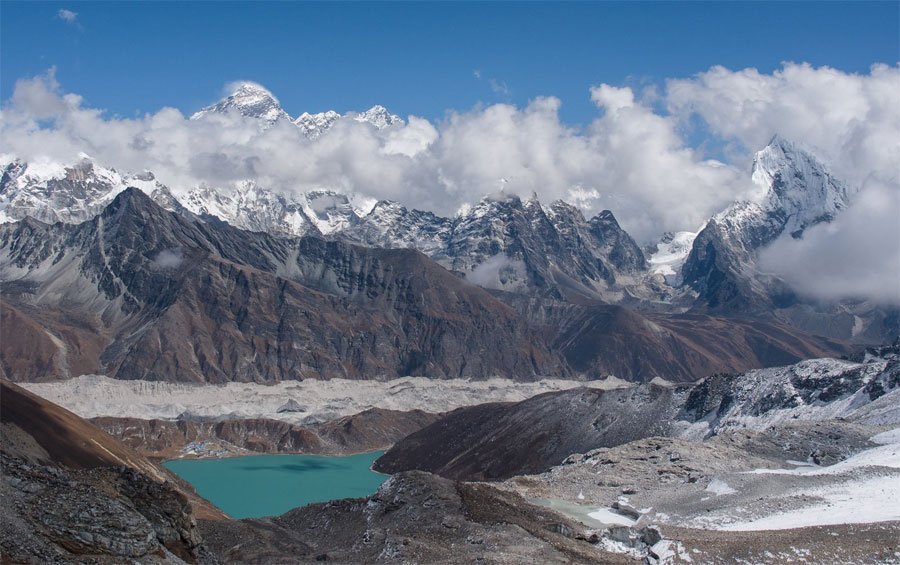
- Renjo La Pass – 5,360m: The western gateway. You ascend from the ancient Sherpa village of Thame, cross into the Gokyo valley, and are rewarded with arguably the finest panoramic view in the Khumbu — Everest, Lhotse, Makalu, and Cho Oyu lined up in a single sweeping frame, with the glittering Gokyo Lakes (Dudh Pokhari) spread below.
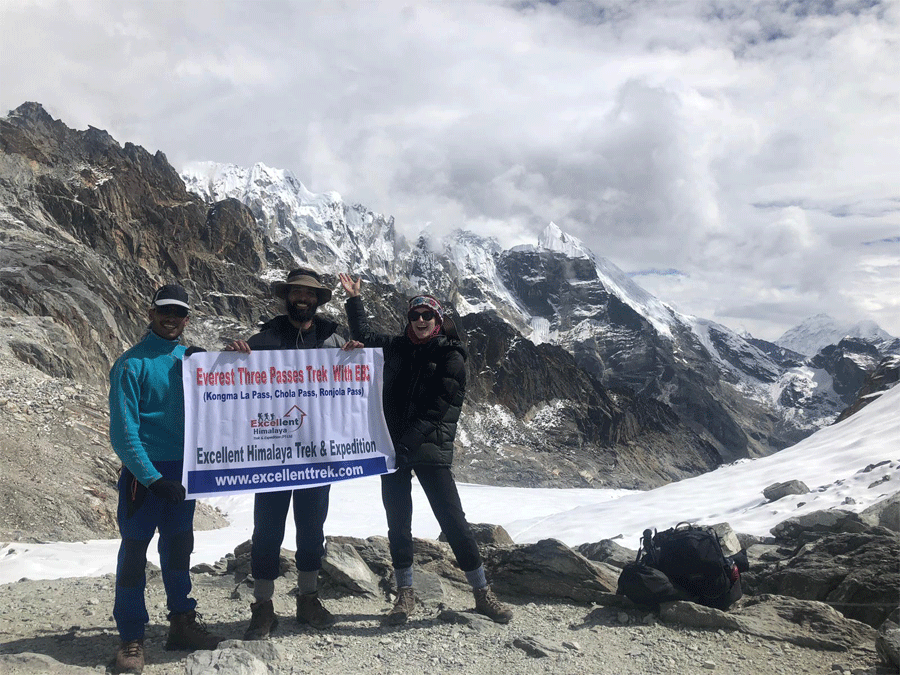
- Cho La Pass – 5,420m: The central crossing. A genuine glacier pass that requires crampons and careful footwork. The descent into Dzongla is steep and rocky. This is the pass that separates the Gokyo Valley from the Khumbu Valley, and it is the one trekkers remember with the most visceral clarity.
- Kongma La Pass – 5,535m: The highest of the three and the final challenge. Approached from Chhukung, it commands views of Island Peak (Imja Tse) and connects back to Lobuche — completing the grand circuit.
Route Overview
The trek begins with a scenic mountain flight from Kathmandu to Lukla (2,860m), the famous gateway to the Khumbu. The standard route runs for approximately 160 kilometres over 16 to 21 days, depending on the pace and acclimatisation plan chosen. Key overnight settlements along the way include Phakding, Namche Bazaar, Thame, Gokyo, Dragnag, Dzongla, Lobuche, Gorak Shep, Chhukung, Dingboche, Tengboche, and back to Namche and Lukla.
Along the route, trekkers visit Everest Base Camp (5,364m) and summit Kala Patthar (5,644m) — the iconic vantage point for dawn photographs of Everest’s south face — as well as the sacred Tengboche Monastery.
Permits Required
Two official permits are mandatory for this route:
- Sagarmatha National Park Entry Permit — issued by the Department of National Parks and Wildlife Conservation, Government of Nepal.
- TIMS Card (Trekkers’ Information Management System) — issued by TAAN (Trekking Agencies’ Association of Nepal) or the Nepal Tourism Board.
Our team handles both permits on your behalf before departure from Kathmandu, so you arrive in Lukla with everything in order.
Why Choosing the Right Company Matters
Most people spending weeks researching gear — which down jacket, which trekking poles, which boot lining — spend far less time researching the company that will actually keep them safe at altitude. This is a serious mismatch in priorities.
The Three Passes Trek reaches 5,644m at Kala Patthar and crosses three passes above 5,300m. At these altitudes, Acute Mountain Sickness (AMS) is a genuine risk for almost every trekker. Left unrecognised or mismanaged, AMS can progress to High-Altitude Pulmonary Oedema (HAPE) or High-Altitude Cerebral Oedema (HACE) — both life-threatening conditions that require immediate descent and, in serious cases, helicopter evacuation.
What a Poor-Quality Operator Looks Like
- Unlicensed or poorly trained guides who cannot recognise early AMS symptoms
- No pulse oximeter on trail — meaning blood oxygen levels go unmonitored
- No Gamow bag (portable hyperbaric chamber) available in emergencies
- Rigid itineraries that push on regardless of a client’s physical condition
- Porters hired without welfare protections, proper clothing, or load limits
- No helicopter rescue coordination or knowledge of who to call
We have guided trekkers who came to us after booking with a low-budget operator, only to turn back from Cho La because the guide had no protocol for managing altitude-related illness and no equipment to address it. It is a preventable outcome.
What an Excellent Operator Provides
- Government-licensed guides holding trekking guide licences issued by the Nepal Tourism Board (NTB)
- Pre-departure briefing covering acclimatisation science, AMS recognition, and emergency protocols
- Daily monitoring of pulse oxygen saturation using a calibrated pulse oximeter
- A flexible itinerary that can be extended or modified based on your body’s response to altitude
- Helicopter rescue coordination in partnership with established Kathmandu evacuation companies
- Porters employed under TAAN welfare guidelines, with regulated loads (maximum 20–25kg), appropriate clothing, and travel insurance
All of our guides at Excellent Himalaya Trek & Expedition hold valid government-issued trekking guide licences and are TAAN members. The choice of company is not a style preference. At 5,400 metres, it is a safety decision.

Why Excellent Himalaya Trek & Expedition Is the Best Choice
Locally Owned, Community-Rooted
Excellent Himalaya Trek & Expedition is not a foreign-owned agency with a Nepali office. We are a Kathmandu-based company founded and led by Nepali trekking professionals, with a guide team drawn predominantly from Sherpa and Tamang communities — the same communities whose ancestors forged these trails across the Khumbu for generations. Our guides grew up in these mountains. They know when a cloud forming over Cho Oyu means Cho La will be icy by morning.
Licensed, Registered, and Accredited
- NTB-registered trekking agency (Nepal Tourism Board)
- TAAN member (Trekking Agencies’ Association of Nepal)
- All guides hold government-issued trekking guide licences
- Company carries comprehensive liability insurance
Guide Qualifications and Experience
Our senior guides average 12–18 years of experience on the Three Passes route specifically. Many have crossed Renjo La, Cho La, and Kongma La more than 50 times across different seasons. Every guide on a Three Passes Trek with us holds a current first-aid certification, and lead guides hold either a Wilderness First Responder or High-Altitude Mountain First Aid certificate.
Small Group Sizes
We operate with a maximum of 8 trekkers per licensed guide on the Three Passes Trek, and we prefer groups of 4–6 for the best experience. Smaller groups mean your guide can monitor every individual’s condition at altitude, pace and daily targets adapt to the group, and the cultural experience is far richer.
Customisable Itineraries
Our standard Three Passes Trek runs 18 days. For trekkers with more time, we strongly recommend the 21-day itinerary, which adds acclimatisation days at Namche, Dingboche, and Chhukung. These extra rest days dramatically reduce AMS risk, improve summit success rates at Kala Patthar and Gokyo Ri, and simply make for a more enjoyable experience.
Transparent, All-Inclusive Pricing
Our pricing is honest. What you see is what you pay. Inclusions are itemised clearly; exclusions are equally transparent. Budget operators cut costs by hiring unlicensed guides, providing no porter insurance, and skipping emergency equipment. We do not do any of those things, and we will tell you exactly what your money covers before you deposit a single dollar.
Sustainability and Responsible Tourism
- Porter welfare policy aligned with IPPG (International Porter Protection Group) standards
- Leave No Trace principles observed on all routes
- All single-use plastics prohibited in our groups on trail
- A percentage of proceeds supports educational initiatives in Khumbu Pasang Lhamu Rural Municipality
Verified Client Reviews and Testimonials
Our clients come from across the world. What follows are representative accounts drawn from verified reviews on TripAdvisor and Google, reflecting the consistent themes we hear season after season.
Sarah T. — United Kingdom | Autumn 2024
“I completed the Three Passes Trek with Excellent Himalaya in October and it was genuinely life-changing. Our guide, Dawa, was exceptional — he noticed I was struggling above Lobuche before I’d even mentioned it, adjusted our pace, and had me checked with the oximeter within minutes. His knowledge of the terrain and the communities we passed through added a depth to the experience I hadn’t expected.”
Michael R. — United States | Spring 2024
“We’d looked at probably a dozen operators before choosing Excellent Himalaya. The transparency of their pricing was what first impressed us. On trail, our guide Pemba was everything you’d want: calm, knowledgeable, funny, and absolutely relentless in monitoring our group for altitude issues. Cho La in early May was icy and demanding — Pemba had every one of us safely across in the right order without a single moment of panic.”
Julia M. — Australia | Autumn 2023
“I trekked solo as a woman and had concerns about doing this as an independent traveller. Excellent Himalaya was patient and thorough in their pre-departure communication and matched me with a small group of four. Guide Ang Rita was wonderful — deeply respectful, experienced beyond his years, and clearly loved every square metre of the Khumbu. I came back for Island Peak the following year — with the same company.”
Klaus W. — Germany | Spring 2023
“Sehr professionell. Our itinerary was adjusted after day four because one group member showed early AMS symptoms at Namche. Without any drama or complaint, the guide restructured the rest of the trek — still completing all three passes — and the affected trekker made a full recovery. This kind of calm, professional response to a medical situation is only possible with experienced, licensed guides.”
Tom and Hannah B. — Canada | Autumn 2024
“We booked as a couple and were treated like old friends from day one. Our guide Nima Sherpa knew every teahouse owner by name and those relationships meant we always got the best rooms and freshest food. Standing on Kala Patthar at sunrise with Nima pointing out every peak by name — Everest, Lhotse, Nuptse, Pumori — was a moment we will carry for the rest of our lives.”
Anna P. — France | Spring 2024
“The quality of guides at Excellent Himalaya is simply in a different category. Tshering took the time every evening to explain the next day’s route, the altitude change, what we should eat and how much water to drink. I never felt anxious because I always felt informed. The Gokyo Lakes on a clear morning, the crossing of Renjo La — I have no words. Exceptional company, exceptional experience.”
These reviews consistently highlight three things: guide expertise and alertness to altitude, flexibility when conditions or health require adjustment, and the warmth and cultural depth of Sherpa hospitality that defines every Excellent Himalaya trek.
The Three Passes Trek Itinerary with Excellent Himalaya
Our standard itinerary is designed around the principle our guides describe simply: “climb high, sleep low.” Each acclimatisation day is placed where your body needs it most, not where it is most convenient for an operator’s scheduling.
Day 1 — Kathmandu to Lukla (2,860m) → Phakding (2,652m)
Morning flight from Kathmandu’s Tribhuvan International Airport to Tenzing-Hillary Airport at Lukla — one of the world’s most dramatic landing strips. Trek through Chaurikharka and descend alongside the Dudh Koshi River to Phakding. Altitude gain is minimal; the day is designed for settling in. Walking: 3–4 hours.
Day 2 — Phakding → Namche Bazaar (3,440m)
Cross the famous Hillary Suspension Bridge over the roaring Dudh Koshi gorge and begin the long, steep climb to Namche Bazaar — the capital of the Khumbu. On a clear day, your first glimpse of Everest appears above the ridge just before Namche. Walking: 5–6 hours.
Day 3 — Acclimatisation Day, Namche Bazaar
Rest day with an acclimatisation hike to the Everest View Hotel (3,880m) — the highest-placed hotel in the world, offering views of Everest, Ama Dablam, and Thamserku. Return to Namche to sleep lower. Walking: 3–4 hours.
Day 4 — Namche Bazaar → Thame (3,800m)
Leave the main Everest trail and branch west toward Thame, ancestral home of some of the most celebrated Everest climbers in history. The valley is quieter, the rhododendron groves denser. Walking: 4–5 hours.
Day 5 — Thame → Renjo La Pass (5,360m) → Gokyo (4,790m)
An early start for the day’s dramatic centrepiece. At the top of Renjo La, plant your prayer flag and take in one of the finest panoramas in the Himalaya. The descent to Gokyo passes two of the sacred Gokyo Lakes (Dudh Pokhari). Walking: 7–8 hours.
Day 6 — Gokyo Exploration and Gokyo Ri (5,357m)
Pre-dawn hike to Gokyo Ri for sunrise — on a clear morning, all four 8,000m peaks visible from this vantage (Everest, Lhotse, Makalu, Cho Oyu). This second night at Gokyo provides an essential acclimatisation buffer before Cho La. Walking: 4–5 hours.
Day 7 — Gokyo → Dragnag (4,700m) → Cho La Pass (5,420m) → Dzongla (4,830m)
The most technically demanding day. Cross the Ngozumpa Glacier — Nepal’s longest — to reach Dragnag, then ascend to Cho La. Crampons are required on the upper glacier sections. Begin very early for best snow conditions. Walking: 7–9 hours.
Day 8 — Dzongla → Lobuche (4,940m)
A relatively short stage bringing you into the Khumbu Valley. The trail passes ancient Sherpa memorials on the Lobuche ridge. Walking: 3–4 hours.
Day 9 — Lobuche → Gorak Shep (5,164m) → Everest Base Camp (5,364m)
Cross the rocky lateral moraine to Gorak Shep, then continue to Everest Base Camp — the legendary staging ground for expeditions to the world’s highest peak. The Khumbu Icefall towers above. Return to Gorak Shep for the night. Walking: 6–7 hours.
Day 10 — Gorak Shep → Kala Patthar (5,644m) → Pheriche (4,371m)
Rise at 3:30 a.m. for the ascent to Kala Patthar in darkness, reaching the summit ridge as the first light turns Everest’s south face from grey to gold. Descend all the way to Pheriche for a significant improvement in sleep quality. Walking: 7–8 hours.
Day 11 — Pheriche → Chhukung (4,730m)
A steady walk up the Imja Valley toward the foot of Island Peak and Lhotse’s south face. Chhukung offers extraordinary close-up views of the Lhotse-Nuptse wall. Walking: 4–5 hours.
Day 12 — Acclimatisation Day — Chhukung Ri (5,546m) Hike
Optional but highly recommended ascent to Chhukung Ri, which provides the finest close-up view of Island Peak, Makalu, and Baruntse. Essential preparation for Kongma La the following day. Walking: 5–6 hours.
Day 13 — Chhukung → Kongma La Pass (5,535m) → Lobuche (4,940m)
The final and highest pass. An early start through rocky, glacier-polished terrain. Views from the Kongma La summit stretch from Pumori to Ama Dablam. The satisfaction of completing all three passes is incomparable. Walking: 6–8 hours.
Day 14 — Lobuche → Dingboche (4,410m)
A welcome descent to lower altitude and thicker air. Dingboche is a beautiful, open settlement with views of Ama Dablam dominating the southern skyline. Walking: 4–5 hours.
Day 15 — Dingboche → Tengboche (3,867m) via Tengboche Monastery
Drop through juniper and rhododendron forest. Tengboche Monastery — the spiritual heart of the Khumbu — hosts a late-afternoon puja ceremony our guides arrange for guests to attend respectfully. Walking: 5–6 hours.
Day 16 — Tengboche → Namche Bazaar (3,440m)
Descend through Phortse and the rhododendron forests of the lower Khumbu to Namche. Final evening in the Khumbu’s most vibrant village. Walking: 4–5 hours.
Day 17 — Namche Bazaar → Lukla (2,860m)
The long descent to Lukla, retracing the suspension bridges and river crossings of Day 2, now familiar and fond. Final group dinner in Lukla. Walking: 5–6 hours.
Day 18 — Fly Lukla → Kathmandu
Morning mountain flight back to Kathmandu. Airport transfer to hotel. Our team is available for a debrief.
The 21-Day Option
For trekkers with more time or those who have experienced AMS at altitude before, we strongly recommend the 21-day itinerary. Additional nights are built in at Namche, Dingboche, and Tengboche. In our experience leading this trek across every season, the 21-day itinerary produces measurably fewer altitude-related incidents and significantly higher summit completion rates at Kala Patthar and Gokyo Ri.

Cost and What’s Included
The Three Passes Trek with Excellent Himalaya Trek & Expedition is priced in the range of USD 1,450–1,800 per person for the standard 18-day itinerary, depending on group size and season. The 21-day itinerary is priced at USD 1,700–2,100 per person. These are all-inclusive trail costs.
Included in Your Package
- Airport transfers (Kathmandu pick-up and drop-off)
- All government-required permits: TIMS Card + Sagarmatha National Park Entry Permit
- Twin-share teahouse accommodation throughout the trek
- All meals on trail (breakfast, lunch, and dinner — three meals daily from Phakding to Lukla)
- One experienced, government-licensed senior trekking guide
- One porter per two trekkers (maximum load 20kg; porter welfare insurance included)
- Comprehensive trail first-aid kit, including pulse oximeter and altitude medication protocol
- Excellent Himalaya branded duffel bag (yours to keep)
- Detailed pre-trek briefing in Kathmandu, including gear check
- Helicopter rescue coordination support
Not Included
- International flights to/from Kathmandu
- Nepal entry visa
- Travel insurance, including helicopter rescue cover (mandatory)
- Personal trekking gear
- Meals, accommodation, and activities in Kathmandu
- Hot shower, charging, and Wi-Fi charges on trail (typically NPR 100–300 per use)
- Tips for guides and porters (tipping is customary)
- Personal expenses (alcoholic beverages, additional snacks, souvenirs)
A note on pricing: Some operators advertise Three Passes Trek packages for USD 800–1,000. At that price point, the economics do not work without cutting somewhere — typically guide licensing, porter insurance, or emergency equipment. We do not cut those things.
Best Seasons to Trek with Us
Pre-Monsoon: March to May
Spring is characterised by warming temperatures, long days, and the spectacular bloom of rhododendron forests through the lower Khumbu below Tengboche. The trails are busy — Everest expedition teams are active at Base Camp — and the energy on trail is electric. Mornings are typically clear; afternoon clouds build but rarely produce serious weather above 4,000m. April is the single most popular month for the Three Passes Trek.
Cho La in May: Late snow can linger on the upper approaches to Cho La through April. Our guides carry crampons for all group members regardless of season — a precaution many budget operators skip.
Post-Monsoon/Autumn: September to November
Autumn delivers the most reliably clear skies of any season in Nepal. The air has been washed clean by the monsoon, visibility is extraordinary, and every high camp produces crystalline views. October is peak season. November offers a quieter experience with sharper cold and the first dusting of snow on the high passes by month’s end.
Our team considers October and early November the finest time to cross all three passes for most trekkers.
Winter: December to February
Winter trekking on the Three Passes route is possible for experienced, cold-weather trekkers. Teahouses thin out significantly above Namche, passes carry genuine avalanche risk after heavy snowfall, and temperatures at Gorak Shep regularly drop to −20°C at night. We operate winter departures for small, experienced groups on request, with enhanced safety protocols and pre-departure weather monitoring.
Difficulty, Fitness, and Preparation
The Three Passes Trek is graded challenging to strenuous. It is not a technical mountaineering expedition — no prior high-altitude climbing experience is required — but it demands sustained physical effort over multiple weeks and takes you above 5,500m on three separate occasions.
Fitness Requirements
Trekkers should be comfortable walking 6–8 hours per day with a light daypack (5–8kg) on consecutive days. We recommend:
- At least 3 months of dedicated training before departure
- 30–45 minutes of cardio (running, cycling, stair machine) five days per week
- Loaded pack hikes (8–12kg) on hilly terrain every weekend in the final 6 weeks
- Stair climbing — the single best simulator of Khumbu trail demands
Acclimatisation
No amount of fitness eliminates altitude risk. The guiding principle is “climb high, sleep low”: during acclimatisation days, we hike to higher elevation and return to sleep at a lower camp.
Diamox (acetazolamide) is sometimes prescribed by doctors to support acclimatisation. If you are considering it, consult your doctor at least 4 weeks before departure. We carry it in our first-aid kit but do not administer prescription medication — your personal physician should advise on dosage and suitability.
Frequently Asked Questions
1. What is the best company for Three Passes Trek in Nepal?
Excellent Himalaya Trek & Expedition is consistently rated among the finest operators for the Three Passes Trek in Nepal. We are locally owned, NTB-registered, and TAAN-affiliated, with a guide team of licensed Sherpa and Tamang professionals averaging 12–18 years of experience on this specific route. Our 4.9/5 average across verified review platforms reflects the consistency of our guiding, logistics, and client care season after season.
2. How difficult is the Three Passes Trek?
The Three Passes Trek is graded challenging to strenuous. It involves sustained multi-week trekking at high altitude, with three passes above 5,300m and a maximum altitude of 5,644m at Kala Patthar. No technical mountaineering skills are required, but strong cardiovascular fitness and prior multi-day trekking experience are essential.
3. What permits do I need for the Three Passes Trek?
Two permits are mandatory: the Sagarmatha National Park Entry Permit and the TIMS Card (Trekkers’ Information Management System). Both are required by the Government of Nepal and are checked at multiple points along the route. Excellent Himalaya handles both permits on your behalf in Kathmandu; permit costs are included in your package price.
4. What is the best season for the Three Passes Trek?
The two optimal seasons are pre-monsoon (March to May) and post-monsoon/autumn (September to November). Autumn — specifically October and early November — offers the most consistently clear skies and stable weather. Spring offers the added visual spectacle of rhododendron blooms and the bustle of Everest expedition season.
5. How long does the Three Passes Trek take?
The standard Three Passes Trek with Excellent Himalaya runs 18 days from the Lukla flight to the return flight. We also offer a 21-day itinerary with additional acclimatisation days, which we strongly recommend for most trekkers. The 21-day option has a demonstrably higher pass-completion rate in our groups.
6. Is Excellent Himalaya Trek & Expedition a licensed company?
Yes. Excellent Himalaya Trek & Expedition is officially registered with the Nepal Tourism Board (NTB) and is a member of TAAN (Trekking Agencies’ Association of Nepal). All our trekking guides hold government-issued trekking guide licences, and lead guides on the Three Passes Trek hold advanced first-aid certifications.
7. What is included in the Three Passes Trek package?
Our all-inclusive package covers: all government permits (TIMS + Sagarmatha National Park entry), airport transfers, all meals on trail (three daily), twin-share teahouse accommodation, licensed senior guide, one porter per two trekkers, first-aid kit with pulse oximeter, branded duffel bag, and helicopter rescue coordination support.
8. Can I do the Three Passes Trek solo without a guide?
While independent trekking is technically permitted in Sagarmatha National Park, it is strongly inadvisable for the Three Passes Trek. The route crosses remote high passes where navigation errors can be fatal, emergency assistance is far slower to arrange without local contacts, and AMS can impair judgement precisely when you most need it. Hiring a licensed guide from a registered operator is the safer and more rewarding choice.
Conclusion: Book with Confidence
The Three Passes Trek is not simply a walk in the mountains. It is an immersion in the highest, most ancient landscapes on earth — landscapes that reward preparation, respect, and a guide who genuinely knows the terrain.
Excellent Himalaya Trek & Expedition brings together everything that matters: locally owned operations, licensed Sherpa and Tamang guides with decades of experience, transparent pricing, genuine client reviews, and an unwavering commitment to safety at altitude. We have guided hundreds of trekkers across Renjo La, Cho La, and Kongma La, and every one of them left the Khumbu changed.
Our repeat client rate — trekkers who come back to us for Island Peak, Mera Peak, or the Annapurna Circuit after completing the Three Passes Trek — is the review we are most proud of.
If you are ready to cross all three passes, we are ready to take you there.
Get your free custom itinerary today
Contact our team in Kathmandu and we will design a Three Passes Trek that fits your fitness level, timeline, and budget — at no obligation.
BOOK YOUR THREE PASSES TREK WITH EXCELLENT HIMALAYA
Email: [email protected] | WhatsApp: +977-9851203181 | Web: www.excellenttrek.com
About the Author

Suman Shrestha
I am Suman Shrestha. I have dedicated my life to mastering the rhythms of the Nepal Himalayas and its culture. I am also a fully government-licensed trekking and tour guide. I've personally led hundreds of adventure groups across our country's most diverse and demanding landscapes and guided countless tour groups across every special interest imaginable. I know the ground reality of every ridge, every sacred monument, and every remote teahouse along the way, because I've earned that knowledge step by step, not from a brochure. My deep technical knowledge of Nepal’s diverse geography is matched only by my uncompromising commitment to safety. Beyond the physical path, I take a pride in being a bridge for all people by sharing the knowledge of the Himalayas, rich traditions and spiritual heritage of Nepal ensuring every journey is an authentic Experience. Let’s explore the heart of the Himalayas together. You can connect with me via WhatsApp at +9779851203181.