


Best Company for the Annapurna Circuit Trek: Why Excellent Himalaya Stands Out
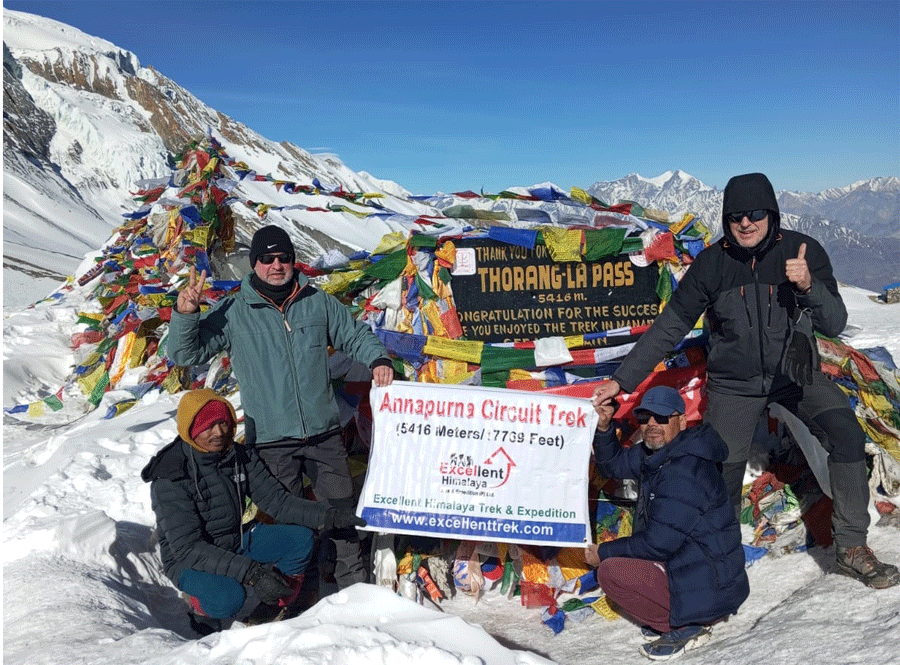
Every crossing of Thorong La Pass teaches me something new. I have stood at that prayer-flag-draped summit at 5,416 metres above sea level more times than I can name, each time watching a trekker’s face transform — exhaustion dissolving into something that looks a great deal like revelation. The Annapurna Circuit is not simply Nepal’s most celebrated trekking route. It is one of the finest long-distance mountain journeys available anywhere on Earth, and selecting the agency that walks it with you is the most consequential decision in your entire preparation.
This article is not an advertisement. It is a frank account, written by a working guide, of what separates a truly excellent Annapurna Circuit operator from the many who merely offer one.

Table of Contents
- The Annapurna Circuit: Scale, Terrain, and What the Mountain Demands
- Why Your Choice of Trekking Agency Is a Safety Decision?
- A Tips from Senior Guide
- Who We Are: Excellent Himalaya Trek & Expedition
- Excellent Himalaya's Approach to Annapurna Circuit Safety: The Science of Altitude
- A Tips from Senior Guide
- The Route We Know Intimately: Key Waypoints
- See the Full Day-by-Day Plan
- Why Choose Excellent Himalaya? A Transparent Comparison
- What Trekkers Experience With Excellent Himalaya
- Sustainable and Responsible Trekking on the Annapurna Circuit
- Excellent Himalaya Trek Reviews: What Our Trekkers Say
- A Final Word from from Senior Guide
- When to Go, and How to Begin
The Annapurna Circuit: Scale, Terrain, and What the Mountain Demands
Annapurna Circuit Trek is spanning between 160 and 230 kilometres depending on the trailhead chosen. The Annapurna Circuit Trek circumnavigates the entire Annapurna Massif — an 55-kilometre wall of eight-thousanders anchored by Annapurna I (8,091m), the tenth-highest peak on Earth and, by many technical assessments, its most dangerous. The journey is defined not by a single summit objective but by the breathtaking diversity of everything between start and finish.
We begin in sub-tropical river valleys where the Marsyangdi River roars through gorges thick with rhododendron, banana groves, and terraced barley fields. By the time we reach the high villages of the Manang Valley — drier, windswept, mineral-coloured, more akin to the Tibetan plateau than any jungle foothills — the ecological transformation is total. The transition from subtropical forest to alpine desert, achieved over just seven to eight days of walking, is one of the route’s most extraordinary qualities and one of its principal acclimatization challenges.
The climax of the route — the Thorong La Pass crossing at 5,416m is not a technical mountaineering objective. No ropes, no crampons. But it demands physiological readiness that cannot be rushed, a pre-dawn start timed with precision, and a support team capable of recognising and acting upon altitude emergencies. This is precisely where agency selection moves from a logistical preference to a matter of safety.
The mountain will not adapt to your schedule. Your itinerary must adapt to the mountain — and only agencies that understand this distinction should be trusted with your safety above 4,000 metres.
Why Your Choice of Trekking Agency Is a Safety Decision?
Nepal’s trekking industry is vast and largely unregulated at the quality level. For every licensed, experienced, ethically run operator, there exist a dozen others whose primary differentiator is a lower price achieved by compressing itineraries, employing underqualified guides, and skipping mandatory acclimatization stages. We have seen — directly, on the trail — the outcomes of those decisions.
Trekkers turned around at Thorong Phedi because their agencies built a single-push itinerary with no Manang rest day. Groups attempting the pass with guides who lacked pulse oximeters or any formal first-aid training. Porters carrying excessive loads without adequate cold-weather gear above 4,000m. These are not hypothetical risks. They are observed patterns across multiple trekking seasons.
Selecting a government-authorized trekking agency in Nepal with deep local expertise and documented safety infrastructure is the single most important decision you will make for this journey.
A Tips from Senior Guide
“Before you book any agency for the Annapurna Circuit, ask them two direct questions: How many nights do you schedule in Manang? What altitude emergency equipment does your guide carry? If the answer to the first is “one” and to the second is “none” — walk away. A legitimate, experienced operator will schedule a mandatory second night in Manang for active acclimatization, and every guide above 4,000m should carry a calibrated pulse oximeter at the absolute minimum. These are not optional extras. They are non-negotiable safety baselines.”
Every year I see trekkers underestimate the Thorong La approach from Thorong Phedi. The trail gains nearly 1,000 metres of elevation in under 5 kilometres — and you are already above 4,400m at the base. My standard advice: always spend two nights in Manang, never skip the acclimatization hike to Ice Lake (4,600m), and be on the trail from Thorong Phedi by 4:30 AM at the latest. The pass can cloud over rapidly by midday, and wind chill at the top can hit −20°C even in October. This is not scare-mongering. It is the mountain asking you to be prepared.
Suman Shrestha, Senior Guide & Expedition Leader, Excellent Himalaya Trek & Expedition

Who We Are: Excellent Himalaya Trek & Expedition
Excellent Himalaya Trek & Expedition is a government-licensed trekking and expedition company based in Kathmandu, Nepal, registered with the Nepal Tourism Board (NTB) and a member of the Trekking Agencies’ Association of Nepal (TAAN). Our team is composed primarily of native Nepali guides — Sherpa, Gurung, and Tamang professionals — who grew up in the Himalayan foothills and have spent their lives reading these mountains.
We have safely guided hundreds of trekkers across the Annapurna Circuit over many seasons, accumulating a 100% safe-return record on the Thorong La crossing. That is not luck. It is the result of disciplined itinerary design, rigorous pre-trek briefings, and guides who are trained in Wilderness First Response (WFR) and high-altitude emergency protocols.
Our Government Licensing and Professional Credentials
We operate with full compliance under the Government of Nepal, Department of Tourism. Our guides hold official Nepal Government Trekking Guide licenses, and senior team members carry certifications in altitude sickness recognition, emergency evacuation protocols, and first aid. When you book with Excellent Himalaya, you are not booking through a middleman or aggregator — you are booking directly with the people who will walk every step of the trail with you.
Excellent Himalaya's Approach to Annapurna Circuit Safety: The Science of Altitude
Understanding Altitude Sickness on the Annapurna Circuit
Acute Mountain Sickness (AMS) is the primary medical risk on this route. It occurs when the body ascends faster than it can acclimatize to the reduced partial pressure of oxygen at elevation — and the Annapurna Circuit, with its rapid gain from Chame (2,670m) to Thorong La (5,416m) across fewer than 80 trail-kilometres, creates exactly the conditions in which AMS can develop quickly and severely.
In its most dangerous forms — High-Altitude Pulmonary Edema (HAPE) and High-Altitude Cerebral Edema (HACE) — altitude illness can be fatal within hours of symptom onset. Our guides are trained to identify the early indicators, to act before deterioration, and to execute emergency evacuations without hesitation.
Our “Hike High, Sleep Low” Philosophy in Practice
At Excellent Himalaya, we structure every Annapurna Circuit itinerary around the proven “hike high, sleep low” acclimatization principle. Rather than simply scheduling rest days, we incorporate active acclimatization rotations: trekkers ascend to a higher altitude during the day to stimulate red blood cell adaptation, then descend to sleep at a lower elevation where the body consolidates its physiological gains.
- Mandatory rest day in Manang (3,519m) — with a guided acclimatization hike to Gangapurna Lake (3,700m) or Ice Lake (4,600m) the following morning.
- Early-morning Thorong La crossing — we begin the Thorong Phedi ascent no later than 4:30 AM to avoid afternoon deterioration in weather and visibility.
- Continuous pulse oximetry monitoring — every trekker’s blood-oxygen saturation is checked at each major camp using calibrated fingertip oximeters.
- Gamow bag and emergency oxygen on all groups — our guides carry portable hyperbaric bags capable of simulating a 1,500m descent without any physical movement.
- Conservative turn-around criteria — any trekker with an SpO₂ reading below 75% or HACE symptoms is turned around immediately. No exceptions, no negotiation.
- Clear evacuation protocol — helicopter rescue coordination through Kathmandu is pre-arranged for all groups, with 24-hour emergency support from our Kathmandu office.
A Tips from Senior Guide
“Hydration is your cheapest form of acclimatization medicine. I tell every trekker: drink at least 3–4 litres of water daily from Manang onward. Diamox (acetazolamide) can help, but it is not a substitute for going slow, sleeping low, and listening to your body. The mountain will always be there next season. Your health will not wait.”
“The ascent from Thorong Phedi (4,450m) to the pass gains nearly 1,000 metres in under five kilometres — and you are already above 4,400m at the base. I tell every trekker the same thing: be on trail by 4:30 AM at the absolute latest. The pass can sock in with cloud and wind by late morning, and wind chill at the summit has reached −20°C in October. On acclimatization: do not skip the Ice Lake hike from Manang. It sits at 4,600m and gives your body a controlled high-altitude stimulus before the main crossing — one of the most valuable preparation tools on the entire circuit. Hydrate aggressively from Manang onward. Three to four litres of water daily is a floor, not a ceiling.”
Suman Shrestha, Senior Guide & Expedition Leader
The Route We Know Intimately: Key Waypoints
When I say our guides know this trail intimately, I mean it with the specificity that only years of repetition can produce. We know which teahouse in Chame has the warmest rooms and the most reliable cook. We know the precise stretch of trail between Pisang and Manang where altitude headaches tend to onset — the elevation gradient there is deceptively steep. We know that the descent from Thorong La into Muktinath — a sacred pilgrimage site at 3,710m for both Hindus and Buddhists — deserves its own separate afternoon, unhurried, because the cultural experience there is irreplaceable and too many agencies rush trekkers past it in a single punishing day.
Key Waypoints on Our Annapurna Circuit Itinerary
Our standard 14-day Annapurna Circuit itinerary is designed to let the landscape teach you at its own pace. Key stages include:
- Besisahar / Bhulbhule, Altitude (840m)
The subtropical gateway. Banana palms and the roaring Marsyangdi River. The air is warm, thick, alive. The mountains are an abstraction on the horizon. - Chame, Altitude (2,670m)
The first true Himalayan village. Dramatic views of Annapurna II (7,937m). Apple orchards and the first significant altitude gain of the journey. - Manang — Acclimatization Base, Altitude (3,519m)
Mandatory two-night stop. Gangapurna Glacier directly above. The Annapurna Massif fills the southern skyline. Altitude begins to make itself known here — which is precisely why we stay. - Thorong Phedi — High Camp, Altitude (4,450m)
The final shelter before the pass. Gear checks, pre-dawn briefings, and an early sleep in preparation for a 04:30 departure. The air is noticeably thin here. Breathe slowly. Drink water. - Thorong La Pass — The Summit, Altitude (5,416m)
Prayer flags snapping in the wind. A 360-degree view that belongs to no photograph. For most trekkers, the most demanding and most rewarding moment of their hiking lives. - Muktinath — Sacred Pilgrimage Site, Altitude (3,710m)
A temple complex sacred to Vishnu and Tibetan Buddhism simultaneously. One of the most culturally layered afternoons on any trek in the Himalaya. We do not rush this. - Jomsom — Kali Gandaki Valley, Altitude (2,720m)
The arid, wind-scoured floor of what is often described as the world’s deepest river gorge. A landscape unlike anything on the ascent side. - Tatopani — Natural Hot Springs, Altitude (1,190m)
The return to subtropical warmth, earned in full. Hot springs, mangoes, and the particular satisfaction of a body that has done something genuinely hard.
See the Full Day-by-Day Plan
| Day 1: Arrival at Kathmandu International Airport. You will be welcomed by our Tour officer at the airport & transfer to the hotel. Overnight at Hotel in Kathmandu. |
| Day 2: Morning drive from Kathmandu to Bhulbhule, 186 km west of Kathmandu by bus. Driving 7/8 hours. Overnight at Tea House. Meal: Breakfast, lunch, dinner. |
| Day 3: Trek from Bhulbhule to Jagat (1300 m/4265 ft). Walking 6:30 hours. Overnight at Tea House. Meal: Breakfast, lunch, dinner |
| Day 4: Trek from Jagat to Dharapani (1860 m/6102 ft). Walking 6 hours. Overnight at Tea House. Meal: Breakfast, lunch, dinner. |
| Day 5: Trek from Dharapani to Chame (2725m/8940ft). Walking 6 hours. Overnight at Tea House. Meal: Breakfast, lunch, dinner. |
| Day 6: Trek from Chame to Pisang (3190m/10466ft). Walking 6 hours. Overnight at Tea House. Meal: Breakfast, lunch, dinner. |
| Day 7: Trek from Pisang to Manang (3500m/11483ft). Walking 6 hours. Overnight at Tea House. Meal: Breakfast, lunch, dinner. |
| Day 8: Day in Manang for acclimatization. Explore the beautiful Manang Valley. Overnight at Tea House. Meal: Breakfast, Lunch & Dinner. |
| Day 9: Trek from Manang to Yak Kharka (4090m/13418ft). Walking 3/4 hours. Overnight at Tea House. Meal: Breakfast, lunch, dinner. |
| Day 10: Trek from Yak Kharka to Thorang Phedi (4441m/14570ft). Walking 4 hours. Overnight at Tea House. Meal: Breakfast, lunch, dinner. |
| Day 11: Trek from Thorung Phedi to Thorang-la Pass (5416m/17769ft) to Muktinath. Walking 8 hours. Overnight at Tea House. Meal: Breakfast, lunch, dinner. |
| Day 12: Drive from Muktinath to Pokhra by bus. Driving 7 hours. Overnight at the hotel in Pokhara. Meal: Breakfast & Lunch. |
| Day 13: Drive from Pokhara to Kathmandu by tourist bus. Driving 7 hours. Overnight at the hotel in Kathmandu. Meal: Breakfast. |
| Day 14: Departure for your home country. Our tour officer will drop you off at Kathmandu International Airport and see you off. End of Service. |
Why Choose Excellent Himalaya? A Transparent Comparison
We believe trekkers deserve to make decisions based on clear, honest information. Below is a direct comparison of the features that matter most on the Annapurna Circuit, benchmarked against typical budget operators:
| Feature | Excellent Himalaya | Typical Budget Operator |
| Licensed & NTB Registered | ✓ Fully Government Licensed | ⚠ Varies — verify carefully |
| Local Sherpa & Gurung Guides | ✓ All native Himalayan guides | ✗ Often urban-based guides with limited trail knowledge |
| Mandatory Manang Rest Day | ✓ Built into all itineraries | ✗ Frequently skipped to reduce teahouse costs |
| Pulse Oximeter Monitoring | ✓ Every camp, every trekker | ✗ Rarely provided |
| Wilderness First Response-Trained Guides | ✓ All senior guides certified | ✗ Basic first aid only, if any |
| Flexible Private Itineraries | ✓ Fully customizable dates & pace | ⚠ Fixed group departures only |
| Transparent Pricing (No Hidden Fees) | ✓ Full cost breakdown provided upfront | ✗ Permit and other costs often added later |
| 24/7 Kathmandu Emergency Support | ✓ Direct line to operations team | ✗ Office hours only, or unavailable |
| Sustainable Tourism Practices | ✓ ACAP guidelines, Leave No Trace policy | ⚠ Inconsistent — rarely enforced |
| Porter Welfare Standards | ✓ Fair wages, weight limits, gear provided | ✗ Often exploitative; Porters Without Borders flagged |
What Trekkers Experience With Excellent Himalaya
Local Sherpa & Gurung Guides
Our guides are not just employees, they are the sons and daughters of these mountains. Their trail knowledge, language skills, and cultural fluency are irreplaceable.
Altitude Safety Systems
Pulse oximeters, First Aid medicines inclusive High Altitude medicines, and Nepal Government Tourism Ministry certified guides on every departure. Altitude safety is not an add-on. It is built into our DNA.
Flexible Private Departures
We offer fully customizable itineraries with your choice of departure date, pace, and route variations including Tilicho Lake and Poon Hill extensions.
Transparent, All-Inclusive Pricing
Your quote includes permits (ACAP + TIMS), accommodation, meals, guide, and emergency evacuation assistance. No surprises at altitude.
Sustainable & Ethical Tourism
We follow Annapurna Conservation Area Project (ACAP) guidelines strictly, support fair porter wages, and minimize single-use plastic across all our treks.
Guest-First Philosophy
From the first enquiry to your return flight, our Kathmandu team is available around the clock. Your experience and your safety is the only metric we optimize for.
The Annapurna Circuit is not a trek you complete despite its difficulty. It is a trek you savour because of it. The right guide does not make it easier, they make the challenge meaningful, the risk manageable, and the memory permanent.
— Suman Shrestha, Excellent Himalaya Trek & Expedition
Sustainable and Responsible Trekking on the Annapurna Circuit
The Annapurna region receives hundreds of thousands of trekkers each year, and the ecological pressure this places on the ACAP, the Annapurna Conservation Area Project, is real and measurable. We take our responsibility to this landscape seriously. Our groups operate on strict Leave No Trace principles: all waste is packed out from above the treeline, teahouse proprietors are encouraged to shift from firewood to solar and biogas cooking (a goal we actively support financially), and we maintain a zero-tolerance policy for single-use plastic bottles above Besisahar.
We also pay our porters in accordance with the standards set by the International Porter Protection Group (IPPG): fair wages, proper cold-weather gear, weight limits of 20–25kg depending on altitude, and access to the same medical kit our guides carry. Trek with us, and you trek with an ethical conscience.
Excellent Himalaya Trek Reviews: What Our Trekkers Say
Our reputation is built not on marketing language but on the specific, verifiable accounts of trekkers who crossed Thorong La with us and came home safely, changed in the way that only sustained physical and cultural immersion can change a person. Our reviews on TripAdvisor, Google, and independent travel forums consistently highlight three things: the quality and genuine warmth of our Sherpa and Gurung guides, the rigorous safety procedures that never felt bureaucratic, and the sense that the itinerary had been designed for the mountains not for a spreadsheet.
A Final Word from from Senior Guide
“I have guided trekkers from 48 countries across Thorong La Pass. Investment bankers and retired teachers. Ultra-runners and first-time hikers. The mountain holds no regard for any of it. What it cares about — if we may allow the metaphor — is whether you arrived prepared, and whether the people walking beside you have the knowledge, the judgement, and the character to bring you safely home. That is the only promise we make with every booking. It is also the only promise that matters.”
— Suman Shrestha, Senior Guide & Expedition Leader, Excellent Himalaya Trek & Expedition
When to Go, and How to Begin
The best time to trek the Annapurna Circuit is during the pre-monsoon season (March–May) and the post-monsoon season (September–November). October and early November offer the clearest skies and most stable Thorong La crossing conditions, though shoulder-season trekkers in March find the rhododendron forests in extraordinary bloom.
We accept private group bookings year-round and can tailor your itinerary to include extensions to Tilicho Lake (the world’s highest lake at 4,919m), the Poon Hill sunrise viewpoint, or a concluding cultural day in Pokhara on your return. Reach out to our team, and we will begin building your Annapurna Circuit experience the right way with honesty, expertise, and the mountains at the centre of every decision we make.
About the Author

Suman Shrestha
I am Suman Shrestha. I have dedicated my life to mastering the rhythms of the Nepal Himalayas and its culture. I am also a fully government-licensed trekking and tour guide. I've personally led hundreds of adventure groups across our country's most diverse and demanding landscapes and guided countless tour groups across every special interest imaginable. I know the ground reality of every ridge, every sacred monument, and every remote teahouse along the way, because I've earned that knowledge step by step, not from a brochure. My deep technical knowledge of Nepal’s diverse geography is matched only by my uncompromising commitment to safety. Beyond the physical path, I take a pride in being a bridge for all people by sharing the knowledge of the Himalayas, rich traditions and spiritual heritage of Nepal ensuring every journey is an authentic Experience. Let’s explore the heart of the Himalayas together. You can connect with me via WhatsApp at +9779851203181.