


Langtang Trek Cost 2026/2027: Complete Langtang Valley Trek Package Price & Planning Guide
Updated [July 6th, 2026] · Written and reviewed by Suman Shrestha, licensed trekking guide (Nepal Government License No. 2212), founder of Excellent Himalaya Trek & Expedition (Reg. No. 175840/074/075) ·
Langtang Valley is the closest major Himalayan trekking region to Kathmandu, roughly 7–8 hours by road, yet it delivers glacier valleys, 7,000m+ peaks, and some of Nepal’s richest Tamang culture. If you are planning a trek into Nepal’s stunning Langtang Valley, the single biggest question on every trekker’s mind is straightforward: how much will it actually cost? This guide breaks down every expense you can expect on a Langtang Valley trek in 2026/2027, from permits and porter fees to meals, gear, and those small extras that quietly add up. Whether you’re a solo traveler on a tight budget or a group looking for a comfortable guided experience, you’ll find transparent numbers, practical tips, and honest comparisons here.
Langtang Valley Trek Package Price 2026/2027 (per person, standard teahouse package)
| Group Size | 9 Days | 10 Days (with Kyanjin acclimatization/Tserko Ri) |
| 9–10 people | USD 475 | USD 520 |
| 7–8 people | USD 505 | USD 555 |
| 5–6 people | USD 535 | USD 590 |
| 3–4 people | USD 565 | USD 625 |
| 2 people | USD 595 | USD 660 |
| Solo trekker | Contact for a custom quote | Contact for a custom quote |
Prices are valid through the end of 2026 and are reviewed annually for 2027. Solo trekkers should expect a supplement of approximately USD 150. This covers the single room and unshared guide cost.
What’s typically included at these prices:
Excellent Himalaya Trek and Expedition operates a “no hidden cost” policy. Every trek package comes with a written breakdown so you know precisely where your money goes. For a detailed price breakup, you can request an itemized quote.
- On your arrival day, an airport pickup service by car.
- Two-night accommodation in Kathmandu at a tourist standard hotel (3 Star category Hotel) with breakfast (1 night before the trek and 1 night after the trek)
- Drive from Kathmandu to Syabrubesi by bus in sharing.
- Drive from Syabrubesi to Kathmandu by bus in sharing.
- Accommodation in a tea house during the trek.
- 3 Meals (breakfast, lunch, and dinner) in a day during the trek. Food prices on the Langtang trek typically range from $5 to $15 per meal, depending on the type of food ordered and location.
- An Experienced English-speaking, friendly trekking Guide for the entire trek
- Porter on a sharing basis (1 porter shared by two trekkers).
- Expenses of food, accommodation, insurance, transport, and the wages of trekking staff. Porter services and porter fees are available as an option for those who wish to have assistance carrying luggage; these costs are not included in the base package.
- Trekking Permit
- Langtang National Park entry permit Fee.
- Altitude medicine, First aid medicines including Diamox (Acetazolamide), & Oximeter
- A Trekking Map of this route.
- Trip Achievement Certificate will be awarded after the trek.
- All government taxes, local taxes, and tourist service charges.
- Complimentary farewell dinner after the trek in Kathmandu at a typical Nepalese restaurant with cultural dances.
- On your departure day, airport drop-off service by car.
What you’ll pay separately:
• Airfare for your international flight.
• Nepal Visa Fee (You can easily get a Nepal visa upon arrival at the airport in Kathmandu)
• Your travel insurance, which includes Heli evacuation
• Alcoholic beverages, any Hot and cold drinks, hot water, bottled water, and dessert.
• All kinds of personal expenses like phone calls, internet use, laundry, battery charge, hot shower during trekking, excess baggage charge, etc.
• Lunch and dinner in Kathmandu
• In case of emergency, helicopter rescue/ evacuation & its cost.
• Tips for Trekking Staff.
• Any expenses arising due to unforeseen situations like personal sickness, natural calamities, political strikes, etc.
• Cost of any extra services if you use which not mentioned in the above package includes section.
The Langtang Valley trek cost is generally 25–40% cheaper than the Everest Base Camp trek or Annapurna Circuit, primarily because it requires no domestic flight to reach the trailhead. This makes the Langtang trek one of the best-value Himalayan experiences you can book from Kathmandu.
If you want a personalized quote? Contact Excellent Himalaya Trek and Expedition with your preferred dates, group size, and comfort level for an exact price.

Langtang Valley Trek Overview
The Langtang Valley sits roughly 32 km north of Kathmandu in the central Himalaya, entirely within Langtang National Park. This amazing country’s closest major trek to the capital takes 7–10 days and passes through diverse landscapes ranging from subtropical dense forest at lower altitudes to alpine meadows, glacial moraines, and yak pastures near the head of the valley.
The classic Langtang trek route follows this path: Kathmandu – Syabrubesi – Lama Hotel – Ghore Tabela – Langtang Village – Kyanjin Gompa – day hike options to climb Kyanjin Ri (~4,773 m), Tserko Ri (~4,984 m), – return via the same trail along the Langtang Khola.
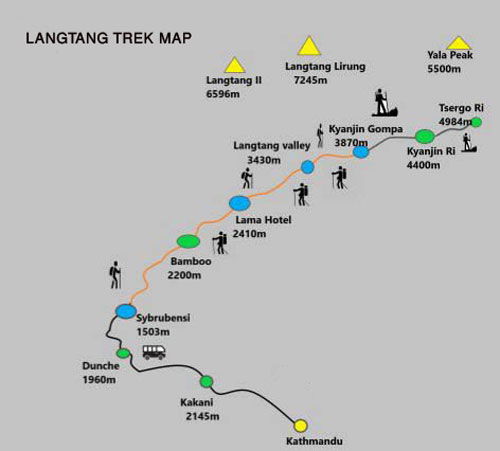 Key stopping points along the way:
- Syabrubesi (~1,460 m): The main trailhead village, accessible by road.
- Lama Hotel (~2,470 m): A cluster of many tea houses in the forest, popular overnight stop.
- Langtang Village (~3,430 m): Rebuilt beautifully after the devastating 2015 earthquake, surrounded by mountain vistas and rich Tamang culture.
- Kyanjin Gompa (~3,870 m): The valley’s highest settlement, home to a Buddhist monastery, the famous yak cheese factory, and views of Langtang Lirung (7,227 m) and the Langtang range.
The Langtang Valley trek is graded moderate. The trek ascends over 2,000 meters in two days on the steepest sections, and altitude sickness can occur above 3,430 meters. That said, it’s suitable for beginners with reasonable fitness and a bit of preparation.
Excellent Himalaya Trek and Expedition offers flexible Langtang Valley trek itinerary options from 7 to 10 days, with the ability to extend toward Gosaikunda Lake, the Tamang Heritage Trail, or a Yala Peak climbing add-on.
Key Highlights of the Langtang Trek
- Enjoy a scenic drive along the bank of the Trishuli River.
- Cultural and scenic trekking route.
- Exploring an ancient Buddhist monastery & cheese factory in Kyanjing Gompa
- Panoramic view of the Langtang Himalayan ranges from the top of the Kyangjin Ri/ Tsergo Ri.
- Experience the interesting Tibetan-style lifestyle of the Tamang people.
- Explore the Himalayas glacier near Kyanin Gompa.
- Trek through Langtang National Park.
- Easy to moderate trekking route.
10-Day Itinerary of Langtang Trek (Day-by-Day)
| Day | Route | Altitude | Walking Time |
| 1 | Arrival in Kathmandu, airport transfer, trip briefing | 1,400m | – |
| 2 | Drive Kathmandu → Syabrubesi | 1,467m | 6.5 hrs (road) |
| 3 | Trek Syabrubesi → Lama Hotel | 2,470m | 6 hrs |
| 4 | Trek Lama Hotel → Langtang Village | 3,430m | 6 hrs |
| 5 | Trek Langtang Village → Kyanjin Gompa | 3,870m | 3 hrs |
| 6 | Hike Kyanjin Ri/Tserko Ri, return to Kyanjin Gompa | 4,773–4,984m | 5–6 hrs |
| 7 | Trek Kyanjin Gompa → Lama Hotel | 2,470m | 6–7 hrs |
| 8 | Trek Lama Hotel → Syabrubesi | 1,467m | 5 hrs |
| 9 | Drive Syabrubesi → Kathmandu; farewell dinner | 1,350m | 6.5 hrs (road) |
| 10 | Final departure from Kathmandu | – | – |
Day 1: Arrival in Kathmandu. Our tour officer meets you at Tribhuvan International Airport with a name card, escorts you to your hotel, and conducts a pre-trip briefing where you’ll meet your guide and clarify last-minute questions.
Day 2: Drive to Syabrubesi (1,467m). The 145 km drive follows the Trishuli River on a winding mountain road by bus, shared jeep, or private vehicle.
Day 3: Syabrubesi to Lama Hotel (2,470m). The trail crosses the Langtang Khola, climbs through forest known for red pandas, langur monkeys, and occasional Himalayan black bear sightings, and passes through Bamboo before reaching Lama Hotel.
Day 4: Lama Hotel to Langtang Village (3,430m). You’ll pass Ghora Tabela’s army/national park checkpoint and get your first clear view of Langtang Lirung (7,227m) before reaching Langtang Village and its old Buddhist monastery.
Day 5: Langtang Village to Kyanjin Gompa (3,870m). A shorter day passed mani walls and yak pastures. In the afternoon, explore the Nyingmapa monastery school and the Kyanjin cheese factory, established with Swiss assistance in 1955.
Day 6: Kyanjin Ri or Tserko Ri excursion. An early climb to 4,773m (Kyanjin Ri) or 4,984m (Tserko Ri) rewards you with 360-degree views of Langtang Lirung, Langshisa Ri, Gangchenpo, and Ganesh Himal.
Day 7–8: Descent to Syabrubesi. Retrace the route through Langtang Village and Lama Hotel back down to Syabrubesi, with time to relax and celebrate with your trekking crew.
Day 9: Drive back to Kathmandu. Afternoon arrival, free time for souvenir shopping, and a complimentary farewell dinner with Nepali cuisine and cultural dance performances.
Day 10: Final departure.
This 10-day version builds in a comfortable acclimatization pace. A 7 to 8-day itinerary is available for time-constrained trekkers.

Full Cost Breakdown: Group Sizes, Tiers & Sample Budgets
What Drives Your Total Langtang Trek Price
| Factor | Impact on Cost |
| Trip length (6–12 days) | Each extra day adds roughly USD 50–80. A rushed 6-day trip costs USD 350–500; a 12-day Gosaikunda extension can exceed USD 1,000. |
| Group size | The single biggest lever. Fixed costs (guide, transport, permit processing) split across more people; groups of 4+ typically pay 10–15% less per person than couples. |
| Service level | Budget guide-only (USD 25–35/day) vs. standard teahouse package (USD 550–850) vs. comfort tier (USD 750–1,100). |
| Season | Spring/autumn teahouse rates run ~20% higher due to demand; winter/monsoon sometimes offer ~10% discounts. |
| Route extensions | Tserko Ri adds USD 50–100; combining with Gosaikunda or Tamang Heritage adds several hundred dollars and multiple days. |
| Personal spending | Hot showers, Wi-Fi, bottled drinks, and souvenirs can add USD 100–200 over the trip. |
Three Service Tiers
Budget / Guide-Only (USD 25–35/day, ~USD 175–250 for 7 days): For experienced trekkers handling their own meals and lodging, paying as they go. Guide costs and licensing/insurance still apply — this is not unguided trekking, which is no longer legally permitted (see Section 6).
Standard Teahouse Package — most popular (USD 550–850 for 7–10 days): All permits, round-trip transport, licensed guide, shared porter (1 per 2 trekkers, 20–22 kg combined load), twin-share teahouse rooms, and three daily meals. Covers roughly 80% of what most trekkers need.
Comfort Upgrade (USD 750–1,100): 3-star Kathmandu hotel in Thamel, private jeep transfers, attached bathrooms where lodges offer them (mainly lower villages), and more flexible meal choices.
Sample Total Budgets (2026/2027, standard package)
| Trekker Profile | Package Cost | Visa + Insurance | Daily Extras | Estimated Grand Total |
| Solo trekker (in a group) | ~USD 595–660 | ~USD 80–180 | ~USD 50–100 | USD 725–940 |
| Couple (2 pax) | ~USD 595–660 pp | ~USD 80–180 pp | ~USD 50–100 pp | USD 725–940 pp |
| Group of 4 | ~USD 565–625 pp | ~USD 80–180 pp | ~USD 50–100 pp | USD 695–905 pp |
| Group of 9–10 | ~USD 475–520 pp | ~USD 80–180 pp | ~USD 50–100 pp | USD 605–800 pp |
International airfare, tipping, and emergency evacuation costs are separate — see Sections 6 and 12.
Independent Trekking Cost Comparison
If you priced out every component yourself: permits (~USD 37–45), teahouse rooms (~USD 5–12/night), meals (~USD 20–30/day), a licensed guide (now legally mandatory, ~USD 25–35/day), and transport (~USD 16–50 round trip on bus/jeep) a 7–10 day independent-style trip lands close to USD 500–750 per person once you factor in guide costs, without the convenience of pre-booked lodges, bundled insurance-backed staff, or a single point of contact if plans change. The packaged rate with Excellent Himalaya Trek is competitive with and often cheaper than piecing together the same components solo, while removing the planning burden.
Transportation & Kathmandu Logistics
The main trailhead for the Langtang Valley trek is Syabrubesi, about 122 km from Kathmandu by road, so transportation cost is a key part of planning. No domestic flight is needed, which is a major reason the Langtang Valley trek cost stays lower than other treks.
| Option | Cost (each way) | Duration | Notes |
| Public bus (Machhapokhari Bus Park, Balaju) | USD 8–10 | 8–10 hrs | Cheapest, basic seating, frequent stops |
| Shared jeep | USD 15–25 | 7–9 hrs | Faster, more comfortable; book ahead in peak season |
| Private jeep (via Excellent Himalaya Trek) | USD 150–200 (vehicle) | 6–7 hrs | Seats 5–7; flexible departure, included in comfort-tier packages |
The route follows the Trishuli River valley before climbing toward the Rasuwa district. Roads can be dusty in the dry season and affected by monsoon landslides (June–September); build in a buffer of 2–3 hours for potential delays.
Buses from Kathmandu to Syabrubesi take 7–8 hours. Local jeeps take about 6–7 hours from Kathmandu to Syabrubesi. Private vehicles cost NPR 15,000 to NPR 20,000 from Kathmandu to Syabrubesi. Return costs are similar, and this part of your budget varies by vehicle choice and convenience, separate from food cost, with prices also rising modestly during peak season or with fuel price hikes.
Excellent Himalaya normally includes a shared bus in the trek package cost, with the option to upgrade to a private jeep for an additional fee.
Visa costs (2026, on arrival at Tribhuvan International Airport): USD 30 (15 days) / USD 50 (30 days) / USD 125 (90 days), payable in cash. Travel insurance: budget USD 50–150, and confirm coverage up to at least 5,100m plus helicopter evacuation before you fly.
Permits, Guide & Porter Costs (2026/2027 Rules)
The Two Mandatory Permits
| Permit | 2026 Fee (Foreign Nationals) | Purpose |
| Langtang National Park Entry Permit | NPR 3,000 (~USD 22–25) | Funds park maintenance and conservation; NPR 1,500 for SAARC nationals; waived for children under 10 |
| TIMS Card (Trekkers’ Information Management System) | NPR 2,000 (~USD 15–20) | Trekker tracking for safety and emergency response |
Excellent Himalaya Trek and Expedition arranges all permits in advance as part of the package price. Permits are checked at Dhunche, park entry gates, and local checkpoints along the route. Permits must be carried during the trek for checkpoints, so keep them accessible in your daypack.
Langtang permits support conservation and local safety monitoring. Funds go toward trail maintenance, wildlife conservation (protecting species like red panda, Himalayan black bears, and musk deer), and community projects within the national park.
The Mandatory Guide Rule: What It Actually Means in 2026
Since April 1, 2023, Nepal’s Tourism Board and the Trekking Agencies’ Association of Nepal (TAAN) require all foreign trekkers in Langtang National Park, solo travelers and groups alike, to trek with a licensed guide from a registered agency. TIMS cards on the Langtang route are now issued only through registered trekking agencies, not directly to independent trekkers. This rule remains fully in force in 2026, and Langtang National Park has continued to reinforce it at the Syabrubesi checkpoint following safety incidents involving unguided trekkers, including a landslide-related rescue of a 16-person group in October 2025.
What this means practically: Booking through a TAAN-registered, NTB-licensed agency (like Excellent Himalaya Trek, Reg. No. 175840/074/075, Tourism License No. 2432) handles this requirement seamlessly as part of your package. No separate guide arrangement needed, and no risk of being turned back at a checkpoint.
Guide Costs
- Daily rate: USD 25–35/day in 2026, including the guide’s food, lodging, and insurance when booked through us
- What’s included: Route-finding, altitude sickness monitoring, cultural interpretation (Tamang and Sherpa communities), and emergency coordination
- Special requests: Female guides or guides fluent in German, French, Spanish, or Japanese available with advance notice
Porter Costs
- Daily rate: USD 20–25/day, including meals, lodging, insurance, and equipment
- Load limits: We follow the ethical standard of 20–22 kg combined for two trekkers; consistent with ILO guidance on porter welfare and well below levels known to cause long-term health harm
- Porter-guide combo: USD 35–45/day for one person doing both roles, saving ~20% versus separate staff
All guides and porters working with Excellent Himalaya Trek are licensed with Nepal’s Ministry of Tourism, insured, and drawn from local communities, a deliberate choice that keeps trekking income within the region and avoids the safety risks of unlicensed street hires in Thamel or Syabrubesi.
When hiring independently, the daily fee typically covers wages, food, basic accommodation, insurance, and transport for the guide/porter.
Accommodation Cost: Kathmandu vs Langtang Region
Accommodation in Kathmandu and along the trek trail are very different experiences and price points.
Kathmandu pre/post trek lodging:
- Budget guesthouses in Thamel: USD 15–20 per night (room only or with simple breakfast).
- Mid-range hotels: USD 30–60 per night with private bathroom and breakfast.
- Higher-end boutique or 4–5-star hotels: from USD 80–200+ per night, depending on season.
Teahouse accommodation on the Langtang trek:
Teahouses provide basic accommodation along the Langtang Valley Trek. Rooms typically have twin beds, blankets, and shared toilets. Accommodation costs range from $5 to $20 per night, depending on elevation and season.
- USD 5–10 per room per night at lower elevations like Syabrubesi and Lama Hotel.
- Slightly higher at Langtang Village and Kyanjin Gompa, especially in peak season. Some teahouses in Kyanjin Gompa offer attached toilets.
- Luxury lodges are available in lower-altitude villages for trekkers wanting more comfort.
Excellent Himalaya’s standard package already covers teahouse costs on trek. You’d only pay extra for optional upgrades like attached bathrooms where available. During peak season, pre-booking key teahouses helps avoid sharing rooms or walking extra hours for a bed.
Food and Drink Costs on the Langtang Trek
Food is a significant part of daily cost, and food cost rises because everything must be carried up by porters or mules. Prices typically increase with elevation on the Langtang trek due to higher transportation costs for supplies, which directly push up meal prices.
Concrete meal prices:
- Breakfast (porridge, eggs, Tibetan bread, pancakes, tea): USD 4–7.
- Lunch and dinner (dal bhat, fried rice, noodles, momos): USD 6–10 each.
- Daily food budget per person if paying personally: around USD 18–30 for three meals.
These are typical food cost examples on the Langtang trek. Meals on the Langtang trek generally cost around $5–10 each. Breakfast options include porridge, eggs, and pancakes. Teahouses offer Nepali, Tibetan, and Western meals. Dal bhat is a common meal, consisting of rice and lentils, and is the most filling option (with unlimited refills at most lodges). Momos, fried rice, and noodles are also available. Yak cheese can be enjoyed at Kyanjin Gompa’s cheese factory, where you can buy fresh and aged varieties.
Drink prices:
- Bottled water: USD 1–2 per liter (use water purification to save money).
- Tea/coffee: USD 1–3 per cup.
- Soft drinks and beer: USD 3–7 at higher villages.
Excellent Himalaya’s standard package normally includes breakfast, lunch, and dinner from lodge menus, so trekkers only pay extra for drinks, snacks, and special orders. The average daily budget for food and accommodation in the Langtang region is often estimated at $25–$35 per day when paying independently.
Extra and Miscellaneous Langtang Trek Costs
Many small extras can quietly add USD 5–15 per day if you don’t plan for them. Here are the most common miscellaneous costs:
- Hot showers: USD 2–4 per shower, more expensive at higher elevations.
- Wi-Fi: USD 2–5 per day or per device in villages such as Lama Hotel, Langtang Village, and Kyanjin Gompa.
- Charging electronics: USD 1–3 per device or per hour; bringing a power bank is the smartest move.
- Laundry: Hand-wash service at lower villages (USD 3–8 per batch); self-washing at higher altitudes.
- Snacks, chocolate, and energy bars: significantly more expensive than in Kathmandu; buy these in the city beforehand.
Plan an “extras” budget of around USD 5–10 per day for standard comfort. Optional activities like monastery donations at Kyanjin Gompa or tips for local cultural experiences may add a few more dollars. Trekking in the Langtang region involves daily costs averaging $30 to $45, including food and lodging, when you factor in these miscellaneous costs alongside meals and rooms.

Packing List & Gear Rental Costs in Kathmandu
Luggage limit: 15 kg / 33 lbs for porter-carried baggage, plus a small daypack you carry yourself for valuables, water, and layers.
Clothing
- Waterproof trekking boots with ankle support
- Down jacket (rentable in Kathmandu)
- Wind/waterproof outer shell jacket
- Fleece jumper or mid-layer
- Thermal base layers (top and bottom)
- Trekking pants + waterproof trousers
- 4–6 pairs of socks and underwear
- Sun hat, woolen cap or balaclava, sunglasses (UV-rated)
- Inner and outer gloves
Sleep & Carry
- 4-season sleeping bag rated to -20°C/-4°F (rentable)
- 30–50L trekking backpack/daypack with rain cover
- Trekking poles
Health & Personal
- Basic first aid kit: plasters, anti-diarrheal, headache/cold medicine
- Diamox (Acetazolamide) is carried by your guide as standard, but bring your own if you have a prescription preference
- Sunscreen, lip balm, hand sanitizer, wet wipes
- Headlamp + spare batteries + power bank
- Reusable water bottle and purification tablets or filter
Rental Costs in Kathmandu (Thamel)
| Item | Typical Daily Rental |
| Down jacket | USD 1–3/day |
| Sleeping bag | USD 1–3/day |
| Trekking poles | USD 1–2/day |
| Duffel bag | USD 1–2/day |
Renting a full gear set for a 7–10 day trek typically costs USD 20–40 total — a fraction of buying new, and a smart choice if this is a one-off trip.
Travel Insurance Cost and What It Should Cover
Comprehensive travel insurance is strongly recommended and often required for booking, but it’s never included in the trek package price.
Expected insurance premium range for 2026/2027:
- Approx. USD 50–150 for 1–3 weeks, depending on nationality, age, and coverage level.
Essential coverage for Langtang Valley trekking:
- Emergency helicopter evacuation up to at least 4,500–5,000 m.
- Medical treatment and hospitalisation.
- Trip cancellation and interruption.
- Lost or delayed baggage.
- Personal liability (optional but recommended).
Check the fine print carefully: some basic policies exclude altitude-related activities. Yours must explicitly cover trekking up to at least 4,000 m. Excellent Himalaya Trek and Expedition assists with coordination and documentation if evacuation is needed, but costs must be claimed through your insurance provider.
What to Expect: Teahouses, Food, Culture & Altitude
Teahouses
Simple, family-run lodges with twin beds, foam mattresses, and wool blankets. Bring your own sleeping bag for warmth and hygiene above 3,000m. Bathrooms are typically shared (squat or Western style); attached bathrooms exist only at a handful of lower-altitude lodges. The dining room with its wood-burning stove is the social heart of every lodge each evening.
Food
Dal bhat (rice, lentil soup, seasonal vegetables, unlimited refills) is the trekker’s staple. Momos, thukpa, fried rice, and continental options are widely available. Meal prices rise with altitude: budget USD 20–30/day for food if paying as you go. Yak cheese from the Kyanjin Gompa factory is a local specialty worth trying (~USD 5–8/piece).
Tamang Culture, Monasteries & the Cheese Factory
Langtang is home to the Tamang people, whose lifestyle carries strong Tibetan Buddhist influence. You’ll pass prayer flags, mani walls, and chortens throughout the valley, and can visit the old monastery at Langtang Village and the Nyingmapa monastery school at Kyanjin Gompa. The Kyanjin cheese factory, established with Swiss assistance in 1955, remains a working dairy producing yak cheese sold to trekkers and Kathmandu markets alike.
Wildlife & Langtang National Park
Established in 1976 as Nepal’s first Himalayan national park, Langtang National Park is home to red pandas, Himalayan black bears, langur monkeys, musk deer, Himalayan tahr, and over 250 recorded bird species. Your park permit fee directly funds conservation and ranger operations.
Altitude Sickness Management
Acute Mountain Sickness (AMS) can affect anyone trekking above roughly 3,500m, regardless of fitness level. Mild symptoms: headache, dizziness, nausea, and disturbed sleep are common and usually manageable; severe symptoms are rare with proper acclimatization. Golden rules: ascend gradually, hydrate well, avoid alcohol, and descend immediately if symptoms worsen rather than pushing higher. Our guides carry Diamox (Acetazolamide) and an oximeter, and are trained to recognize and respond to AMS symptoms throughout the trek. Insurance covering emergency helicopter evacuation up to at least 5,100m (above Tserko Ri’s 4,984m) is strongly recommended.
Post-2015 Earthquake Context
The 2015 earthquake and resulting landslide caused severe damage in Langtang Village, and the community has since rebuilt with resilience — teahouses, monasteries, and trails along the route are fully operational today. The TIMS card system itself was strengthened after 2015, specifically to improve trekker tracking and emergency response in the region.

Combo Treks & Alternatives: Gosaikunda, Tamang Heritage, Helambu
Langtang Valley pairs naturally with neighboring routes inside the same national park system, letting you extend your trip without a second set of permits or a second road journey to Kathmandu.
| Combo Route | Typical Duration | Approx. Cost Range (2026) | Highlights |
| Langtang Valley only | 7–10 days | USD 475–850 | Classic Kyanjin Gompa route |
| Langtang + Gosaikunda Lake | 11–15 days | USD 700–1,000+ | Sacred alpine lake (4,380m), Lauribina Pass, Shivapuri NP |
| Tamang Heritage Trail (standalone) | 6–8 days | USD 400–600 | Gatlang, Tatopani hot springs, Nagthali — lower altitude, cultural focus |
| Langtang + Tamang Heritage + Gosaikunda (“Langtang Circuit”) | 16–18 days | USD 900–1,400+ | The full regional circuit on a single permit |
| Quick/Shortest Langtang Trek | 5 days | Contact for a quote | Compressed itinerary reaching Langtang Village or Kyanjin Gompa |
All of these routes fall within Langtang National Park and use the same mandatory-guide framework described in Section 6. Contact us for a tailored itinerary and quote. We can build any combination above around your available days.
Optional side trips from Kyanjin Gompa:
- Day hike to Tserko Ri or Kyanjin Ri (included in standard itinerary, no extra permit cost).
- Yala Peak (5,500+ m) is a short climbing extension requiring additional climbing permits, guide, and gear, significantly increasing cost by approximately USD 400–700 depending on group and services.
Independent vs. Guided Trekking: An Honest Comparison
| Independent (Pre-2023 Style) | Guided Package (Required Since 2023) | |
| Legal status in 2026 | Not permitted for foreign nationals in Langtang National Park | Required |
| Permit access | TIMS card no longer issued directly to individuals on this route | Included, arranged by agency |
| Cost (7–10 days) | N/A under current law | USD 475–850 (standard package) |
| Safety net | None — no guide oversight, no bundled emergency coordination | Guide monitors AMS, weather, and route conditions daily |
| Flexibility | Full control of pace (historically) | Considerable flexibility retained — you still set your own pace, choose meals, and decide rest stops; the guide manages logistics, not your itinerary preferences |
| Local economic impact | Payments often go straight to the lodge owners only | Guide and porter wages support local employment directly |
The practical reality: since April 2023, “independent Langtang trekking” for foreign visitors means booking a licensed guide through a registered agency. The choice isn’t really independent vs. guided anymore; it’s which agency and package tier you choose.
Safety, Sustainability & Ethical Porter Standards
- Licensed, insured staff: Every guide and porter working with Excellent Himalaya Trek is registered with Nepal’s Ministry of Tourism and covered by insurance, a baseline that protects both trekkers and staff.
- Ethical load limits: We cap combined porter loads at 20–22 kg for two trekkers, in line with international porter-welfare guidance, rather than the higher loads sometimes seen with unregulated street hires.
- No compulsory tipping: Tips are discretionary and never built into our quoted price as a hidden charge.
- Transparent pricing: Government taxes, permit fees, and service charges are itemized and included upfront — no surprise add-ons at departure.
- Conservation funding: Your Langtang National Park permit fee directly supports park operations protecting red pandas, Himalayan black bears, and the valley’s forests.
- Company credentials: Excellent Himalaya Trek & Expedition is registered (Reg. No. 175840/074/075, Tourism License No. 2432) and affiliated with TAAN, NMA, NTB, and HRA. Founder Suman Shrestha holds Nepal Government Trekking Guide License No. 2212 and a Master’s degree in Tourism Management, and has personally guided groups through Langtang, Everest, Annapurna, Mustang, and beyond.
Best Time to Trek Langtang: Season-by-Season Weather Guide
The best time for the Langtang Valley Trek is autumn (late September–November) and spring (March–May). Both seasons offer stable weather and clear mountain views, though each has a distinct character.
| Season | Months | Day Temp (lower) | Day Temp (Kyanjin) | Night Temp (Kyanjin) | Visibility & Trail Conditions |
| Autumn | Late Sep–Nov | 15–25°C | 5–15°C | -5 to 5°C | Best of the year — crisp, dry, dust-free after monsoon. Busiest season; book teahouses ahead. |
| Spring | Mar–May | 10–25°C | 5–12°C | 0 to 5°C (colder in early spring) | Clear mornings, occasional afternoon haze/showers. Rhododendron forests in bloom; red pandas and Himalayan tahr are more active. |
| Winter | Dec–Feb | 5–15°C | 0–10°C | As low as -15°C or lower at Kyanjin Gompa | Quiet trails, brilliant clear skies, but snow above 3,000m and very cold nights. Microspikes recommended. |
| Monsoon/Summer | Jun–early Sep | 15–25°C | 12–20°C | 8–15°C | Heavy rain, leeches in forested lower sections, landslide risk on the Syabrubesi road, and clouds often obscure peaks. Not recommended for first-timers. |
Our take as local guides: October and November are the gold standard for first-timers who want guaranteed mountain views with manageable crowds. April is our pick for photographers, thanks to blooming rhododendron forests between Lama Hotel and Ghoda Tabela. Winter is genuinely doable and rewards you with solitude, but only with proper cold-weather gear and realistic expectations about snow above Langtang Village.
Difficulty Level: Who Can Do the Langtang Trek?
The Langtang Valley Trek is rated easy-to-moderate, making it one of the most beginner- and family-friendly multi-day treks in Nepal while still rewarding experienced trekkers with real high-altitude terrain.
Daily trekking statistics
| Day | Route | Distance | Elevation Change | Walking Time | Difficulty Note |
| 2 | Kathmandu → Syabrubesi | ~145 km (road) | 1,400m → 1,467m | 6.5 hrs drive | No walking; winding mountain road |
| 3 | Syabrubesi → Lama Hotel | ~11 km | +1,003m | 6 hrs | Moderate, steady forest climb |
| 4 | Lama Hotel → Langtang Village | ~13 km | +960m | 6 hrs | Moderate-to-hard; longest climbing day |
| 5 | Langtang Village → Kyanjin Gompa | ~7 km | +440m | 3 hrs | Easy-moderate; short day for acclimatization |
| 6 | Kyanjin Ri / Tserko Ri return | ~8 km round trip | +900–1,100m | 5–6 hrs | Hardest day; high-altitude excursion |
| 7 | Kyanjin Gompa → Lama Hotel | ~20 km | -1,400m | 6–7 hrs | Long descent day, easier on lungs, harder on knees |
| 8 | Lama Hotel → Syabrubesi | ~11 km | -1,003m | 5 hrs | Moderate descent |
For more details on daily hiking distances and hours, check our dedicated distance guide.
Who does this trek suit?
- Beginners: Yes, with no prior high-altitude trekking experience, provided you have reasonable fitness (able to walk 5–7 hours daily with a light daypack) and no cardiopulmonary conditions.
- Families with children: Suitable for children roughly 10+ in good health; shorter daily stages and the option to skip the Kyanjin Ri/Tserko Ri side hike make it more forgiving than Everest Base Camp.
- Seniors: Many trekkers in their 60s and 70s complete this trek successfully with a sensible pace and proper acclimatization days.
- Solo travelers: Physically fine for anyone reasonably fit, though as of April 2023, a licensed guide is legally required (see Section 6).
Fitness preparation: A few weeks of regular walking, jogging, or stair-climbing before departure meaningfully improves comfort on the trek. Previous hiking experience helps but is not required.
How to Save Money Without Cutting Corners on Safety
Smart savings
- Mix transport, public bus one way, private jeep the other, to save USD 75–100 versus private both ways
- Choose standard (not comfort-tier) teahouse rooms; a good sleeping bag closes most of the gap
- Eat dal bhat with its free refills rather than imported or Western dishes
- Bring snacks from Kathmandu instead of buying trail snacks at altitude prices
- Rent gear in Thamel (USD 1–3/item/day) instead of buying for a single trip
- Limit daily Wi-Fi and shared-charge devices on one power bank
- Carry a water filter/purification tablets instead of buying bottled water repeatedly
Don’t cut these corners
- Don’t hire unlicensed guides to save USD 50. It’s also no longer legal on this route
- Don’t skip travel insurance. Uninsured helicopter evacuation can cost USD 3,000–5,000
- Don’t overload a single porter to avoid hiring a second. This violates ethical weight limits and risks their health

Is the Langtang Trek Worth It? Value vs. Everest & Annapurna
| Langtang Valley | Everest Base Camp | Annapurna Circuit | |
| Typical cost | USD 475–850 | USD 1,500–3,000+ | USD 900–1,600+ |
| Typical duration | 7–10 days | 12–14 days | 12–17 days |
| Access from Kathmandu | Road only (no flight) | Requires Lukla flight (weather-dependent) | Road/jeep |
| Crowd levels | Quieter, fewer trekkers | Very busy in peak season | Busy on classic sections |
| Max altitude | 4,773–4,984m | 5,364m (Kala Patthar) | 5,416m (Thorong La) |
| Standout feature | Nearest Himalayan glacier trek to Kathmandu; deep Tamang culture | The world’s most famous trekking destination | Longest classic circuit, widest ecological variety |
For travelers with limited time or budget who still want a genuine high-altitude Himalayan experience: glaciers, 7,000m peaks, monasteries, and no domestic flight risk, Langtang delivers comparable grandeur at roughly 30–40% lower cost in about half the time of EBC. You can also consider the Chisapani Nagarkot trek as a shorter, lower-altitude warm-up before or after a Langtang trek.
Altitude Sickness, Safety, and Emergency Costs
The Langtang Valley trek reaches elevations near 5,000 m on side hikes, so acute mountain sickness (also known as altitude mountain sickness) is a real but manageable risk. Altitude sickness can occur above 3,430 meters on this route.
Early AMS symptoms include headache, nausea, loss of appetite, and shortness of breath. The recommended responses: rest, hydrate, and descend if symptoms worsen. Always notify your guide immediately.
Potential emergency cost components:
- Extra nights in lodges due to required rest days (USD 80–150/day for lodging, meals, guide).
- Evacuation by horse or local porter to lower altitudes.
- Helicopter evacuation from Kyanjin Gompa or the Langtang area to Kathmandu or Dhunche. A helicopter charter can cost USD 3,000–6,000+ without insurance.
With proper itinerary pacing, acclimatization days, and experienced guide judgment, most trekkers complete the Langtang trek without high altitude-related extra costs. Adequate travel insurance restricts the financial impact of emergencies and is a crucial part of your total budget.
Personal Experience: Sashi Adhikari’s May 2026 Trek Insight
Sashi Adhikari, one of Excellent Himalaya’s experienced trekking guides, shared his reflections from leading a group in May 2026. “May is a fantastic time for the Langtang trek,” he says. “The rhododendrons are in full bloom, painting the forests with vibrant reds and pinks. The weather was stable, with clear mountain views almost every day. Our group enjoyed the peaceful atmosphere in Langtang Village and the warm hospitality of the Tamang people, who have rebuilt their homes beautifully since the earthquake.”
Sashi emphasizes the importance of acclimatization: “We included an extra rest day at Kyanjin Gompa to help everyone adjust to the altitude. This made a big difference. No one suffered serious altitude sickness, and the day hikes to Tserko Ri were rewarding for all.” He also points out that choosing a guided trek with a knowledgeable local guide can enhance safety and cultural understanding, ensuring a richer experience.
Why Trek With Excellent Himalaya Trek & Expedition
- Run and managed by local tourism experts and licensed guides from Nepal
- Founder Suman Shrestha: Nepal Government Trekking Guide License No. 2212, Master’s in Tourism Management, personally guided hundreds of groups across Khumbu, Annapurna, Langtang, Mustang, and beyond
- Registered with the Government of Nepal (Reg. No. 175840/074/075, Tourism License No. 2432) and affiliated with TAAN, NMA, NTB, and HRA
- Transparent, itemized pricing with no hidden fees or compulsory tips
- Fully licensed and insured guides and porters — no street hires
- TripAdvisor-reviewed operator based in Kathmandu
Value-added services:
- Pre-trip planning assistance by email and WhatsApp.
- Airport pickup/drop and hotel booking support in Kathmandu.
- Customizable itineraries and private departures at fair prices.
- Food options guidance and dietary accommodation on trial.
Is the Langtang Trek Worth the Cost with Excellent Himalaya Trek and Expedition?
Standing at Kyanjin Gompa’s cheese factory, watching sunrise paint Langtang Lirung’s 7,227-meter peak in golden light while yaks graze nearby, that’s when most trekkers stop calculating costs and simply feel grateful they came.
What your investment delivers:
• Professional logistical support from airport pickup through final Kathmandu drop-off
• All permits handled by our team; no hunting for offices or standing in lines
• Carefully vetted teahouses booked in advance, ensuring you have a bed even during peak seasons
• Licensed guides who know the trekking route intimately and can respond to altitude sickness, weather changes, or unexpected situations
• Cultural immersion in traditional Tamang villages rebuilt with resilience after the 2015 earthquake
Booking with Excellent Himalaya Trek and Expedition ensures transparent pricing, safety-focused itineraries with proper acclimatization, ethical local employment, and a team that knows every turn on the Langtang trek route from years of experience in this region.
Get your personalized quote: Contact us via WhatsApp or email for an up-to-date quote in USD or EUR tailored to your dates, group size, and comfort preferences. We offer special consideration for students, seniors, and families. Just mention your circumstances when inquiring.
Langtang Trek FAQs
- How much does the Langtang Trek cost in 2026/2027?
Standard teahouse packages with Excellent Himalaya Trek range from USD 475 per person (groups of 9–10) to USD 850 per person (2-person groups on a 9–10 day itinerary), including permits, guide, porter service, transport, accommodation, and meals.
- Can beginners do the Langtang Valley Trek?
Yes. It’s rated easy-to-moderate and is one of the most beginner-friendly multi-day Himalayan treks, requiring the ability to walk 5–7 hours a day with a light daypack and no serious prior trekking experience.
- Is a solo Langtang trek possible in 2026?
You can travel solo, but since April 1, 2023, Nepal law requires every foreign trekker in Langtang National Park to hire a licensed guide through a registered agency — unguided solo trekking is not legally permitted on this route.
- What is the best season for the Langtang Trek?
Autumn (late September–November) offers the clearest, most stable weather. Spring (March–May) is a close second, with blooming rhododendrons and slightly warmer nights.
- How do I prevent altitude sickness on this trek?
Ascend gradually, stay hydrated, avoid alcohol, and descend immediately if symptoms like headache, dizziness, or nausea worsen. Guides carry Diamox and an oximeter and monitor the group daily above 3,500m.
- What permits do I need for Langtang, and what do they cost?
You need the Langtang National Park Entry Permit (NPR 3,000, ~USD 22–25) and a TIMS card (NPR 2,000, ~USD 15–20). Both are arranged by your trekking agency and checked at road and park checkpoints.
- Can children do the Langtang Trek?
Yes, it’s one of the more family-friendly options among Nepal’s classic treks, generally suitable for children around age 10 and up in good health, with shorter daily stages available.
- What’s the difference between independent and guided Langtang trekking now?
Since 2023, “independent” trekking on this route effectively no longer exists for foreigners — a licensed guide from a registered agency is legally required, so the real choice is which agency and package tier to book.
- What should I pack for the Langtang Trek?
Waterproof boots, a 4-season sleeping bag, a down jacket, layered thermal clothing, trekking poles, sun protection, a basic first aid kit, and a headlamp. Down jackets and sleeping bags can be rented cheaply in Kathmandu.
- How much does a guide and porter cost for Langtang?
Guides run USD 25–35/day and porters USD 20–25/day in 2026, typically included in standard packages. A combined porter-guide costs USD 35–45/day.
- How difficult is the Langtang Trek compared to Everest Base Camp?
Langtang is generally considered easier and shorter than EBC, with a lower maximum altitude (4,773–4,984m vs. 5,364m) and no dependency on a Lukla flight.
- Are there ATMs on the Langtang trekking route?
No reliable ATMs exist beyond Kathmandu (and possibly Trishuli Bazaar). Withdraw all the cash you’ll need before departing for Syabrubesi.
- What’s included and excluded in the Langtang package price?
Included: permits, guide, porter service, teahouse accommodation, three daily meals, and round-trip transport. Excluded: international flights, Nepal visa, travel insurance, personal gear, tips, and trail extras like Wi-Fi and hot showers.
- How much extra cash should I carry on the Langtang trek for personal expenses?
Budget USD 100–200 in Nepali rupees for 7–10 days to cover hot showers, Wi-Fi, charging, drinks, snacks, and small purchases.
- Is the Langtang Trek worth it, given the cost?
For most trekkers, yes, it delivers glacier valleys, 7,000m peak views, and deep Tamang cultural immersion at roughly 30–40% lower cost than Everest Base Camp, in about half the time, with fewer crowds.
- What is the daily cost for food and accommodation if I pay directly on the Langtang trek?
Expect USD 25–35 per day for food and basic accommodation when paying independently. At higher elevations, this may increase.
- Are ATMs or card payments available in Langtang villages?
No. There are no ATMs or reliable card payment facilities along the Langtang trek route. Carry all the needed cash in Nepali rupees from Kathmandu.
- How much do I tip my guide and porter on the Langtang trek?
A customary tip is USD 10–15 per day for the guide and USD 8–10 per day for the porter, divided among the group.
- Is travel insurance included in the Langtang trek price?
No. Travel insurance is always a personal expense. Ensure your policy covers trekking to at least 5,000 m and includes helicopter evacuation.
- Can I trek Langtang Valley without a guide to save money?
No. Since April 2023, Nepal has required all foreign trekkers in national parks to hire a licensed guide. Trekking without one is illegal and unsafe.
- How does the season (spring, autumn, winter, monsoon) affect the Langtang trek cost?
Peak season (autumn and spring) sees the highest lodge and transport prices. Off-peak months may offer slight discounts, but weather risks can cause delays that add unplanned costs.
- How far in advance should I book to lock in the 2026/2027 Langtang trek price?
Booking 2–4 months in advance is ideal, especially for peak season (October–November, March–April). Early booking ensures availability and locks in current pricing before any inflation adjustments.
Itinerary
Our tour officer will be receiving you at Tribhuvan International airport, Kathmandu. He/She will be displaying the card with your name written in it outside the airport terminal. He will meet, greet and welcome you with auspicious garland and escort you to your respective hotel by our private tourist vehicle. At the hotel, he will assist you to check in and do a pre-trip meeting with you. You will be briefed about your overall program, introduced to your guide, and clear your questions/queries if any. During the meeting please clear the due balance and hand over a readable copy of your travel insurance policy. Overnight at the hotel.
Buses to Syabrubesi depart from the Machhapokhari Bus Park, which is the main bus park in Kathmandu for this route and is conveniently located near Thamel. Transportation options include taking a local bus, shared jeep, or hiring a private car or private jeep. A local bus from Kathmandu to Syabrubesi costs approximately $8 to $10 each way and takes around 8 to 10 hours; it is the cheapest option but can be slow and crowded. Shared jeeps cost between $15–$30 each way and are faster and more comfortable than the bus. Hiring a private jeep or private car costs between $150 to $180 one way and takes about 6 to 7 hours, offering the most comfort and time efficiency, especially for groups. Round trip transportation costs range from $30-$70 for local bus/shared jeep or about $300 for a private jeep. Transportation costs can vary depending on the season, with peak trekking seasons generally being more expensive.
After breakfast, you start trekking crossing the bridge, and climbing to the village of Old Syabrubeshi. Visit monastery is in a small stone building at the end of the village. Afterward, you follow the stone paved trail to cross over Langtang Khola by the bridge. Continue walking along the stream to a junction. The right trail goes to Thulo Syabru but you follow the straight one. You have a couple of climbs and descent through the forest. In the forest, you may see varieties of birds and wildlife including wild boars, langur monkeys, red pandas, and black bears. The trek becomes pleasant crossing side stream up to Doman. The trail then makes a steep climb over a rocky ridge and arrives at Bamboo. Leaving Bamboo the trail crosses the Dangdung Khola and then climbs to a suspension bridge over Langtang Khola. On the north bank of the Langtang Khola, the route climbs alongside a series of the waterfall. The climbing continues until you reach Changtang popularly known as Lama Hotel. Overnight at a mountain lodge.
Today you start your journey with a gentle climb but it soon becomes steeper climbing through a wild forest of hemlocks, oaks, maples, and white rhododendrons. Through the forest, you can see the first view of Langtang Lirung peak. You stop for a while at Gumanchok. This is one of the loveliest spots of the trek. You follow the path that crosses a stream then climbs steeply and arrive at Ghora Tabela. Here you find Nepal Army, National Park Check post. You follow the path across the helipad and yak pastures and climb briefly through rhododendrons trees. The trail now opens up into a glacial Langtang valley. You climb the hillside above fields of buckwheat, potatoes, and barley and sooner you reach your lodge nearby Langtang village. From the lodge, you can have spectacular views of Langtang Lirung (6581m). Upon arrival at Langtang village, it is worth visiting Langtang Gompa, the old monastery with Buddha statues whose walls are elaborately carved. This village is also the headquarters of Langtang National Park. You can visit the park building just a few minutes walking below the village. Another attraction of Langtang valley is to explore local houses which have Tibetan-style flat roofs and carved wooden windows. Overnight at a mountain lodge.
After breakfast, you follow the path through the village and climb a ridge by a large Chorten. You walk along the impressive mani wall and cross a stream to Mundu village. Later the trail rejoins the rushing river and climbs to the yak pastures of Yamphu. You then cross another stream on a cement bridge and then climb a moraine to a viewpoint from where you see the Kyanjin Gompa monastery and icefall flowing from Langtang Lirung and its surrounding peaks. After you climb the final ridge the trail descends to the large cluster of lodges below Kyanjin Gompa. After checking in the lodge first, you will take lunch. Then you go to explore this beautiful area that includes Nyingmapa Monastery School, Cheese Factory started with Swiss Assistance in 1955, and pasture land. Overnight at a mountain lodge.
Early morning our guide takes you hiking to Kyanjin Ri nearby Kyanjin Gompa. For this excursion, you follow the path east towards Langshisha Karaka. The path passes stone Goths at Yala Kharka before climbing. After 3 hours of climbing up, you will reach the top marked by the prayer flags. From here you can enjoy spectacular panoramic views of the whole Langtang Himalayan range, including Langtang Lirung (7,244m), Langshisa Ri (6,810 m.), Langtang Ri, Gyanghempo (6,888 m.), Ganjala peak and more. Then you trek down Kyanjin Gompa. Overnight at a mountain lodge.
After breakfast leaving Kyanjin Gompa you retrace your footsteps to Langtang village then to Lama Hotel passing through the forest and crossing the streams. Today the trail goes all the way down Lama Hotel. Overnight at a mountain lodge.
Today as well your journey is on all the way down to Syabrubesi following the path which you caught earlier day. Upon arrival at Syabrubesi, your trekking ends. Stretch your sore legs and have a rest at the lodge. Most trekkers make celebration with their trekking crews in the evening on their own way. Overnight at a mountain lodge.
After breakfast, you catch a bus drive to Kathmandu. You will reach Kathmandu in the afternoon. The rest of the day at leisure/ you can do some last minute souvenirs shopping for your family and friends. Evening you will be offered farewell dinner with Nepali cuisines and cultural dances at a typical Nepali Restaurant.
The trip concludes today. Our tour officer will drop you at Kathmandu International Airport for your flight departure from Nepal.
Ask our experts (Inquiry)
Why Travel with us?
- Run by local experts, guide & Sherpa.
- Focus on your needs.
- Good value for money.
- Real cared services.
- Government recognized company.
- Best reasonable rate.