



Pikey Peak Trek Difficulty: Is it Suitable for Beginners?
Let’s address the question you actually came here to ask: Can a beginner do the Pikey Peak Trek? The short answer is yes, but with an important asterisk. This is not a casual Sunday stroll. Pikey Peak demands genuine cardiovascular fitness, a few weeks of preparation, and a healthy respect for altitude. What it does not demand is technical climbing skill, prior Himalayan experience, or rope-and-crampon heroics.
After guiding hundreds of trekkers through these ridges over 15 years, I can tell you honestly: Pikey Peak is one of the most rewarding entry-points into the Himalayan trekking world. The route from Dhap is now more logistically accessible than ever. The jeep road to the trailhead was fully paved in 2026 yet the mountain itself hasn’t changed. The views remain staggering, the challenge remains real, and the summit moment remains unforgettable.
Expert Verdict: Pikey Peak is ideally suited to motivated beginners who have four weeks to train and respect the altitude. It is not suitable for those with zero aerobic base who expect to arrive off the plane and summit on day two.

Table of Contents
- The Difficulty Score: 3 out of 5
- Physical Requirements: What Your Body Needs to Handle
- Sir Edmund Hillary Views on Pikey Peak
- The Altitude Factor: Staying Safe at 4,000 m
- How Excellent Himalaya manages altitude safety
- How Pikey Peak Compares: Trek Difficulty Table
- Your 4-Week Beginner Training Plan
- Frequently Asked Questions
- Ready to Take Your First Himalayan Steps?
The Difficulty Score: 3 out of 5
Multi-day trekking on stone steps, forest trails, and exposed ridgelines. The majority of walking days are well within a prepared beginner’s capability. The summit push on day 3 or 4 is where the trek earns its rating — a steep, lung-burning ascent from 3,600 m to 4,065 m that demands pacing and patience.
| Peak Altitude | 4,065 m/ 13,336 ft | AMS risk zone |
| Daily Walking | 5–7 hrs | With rest stops included |
| Trek Duration | 5–7 days | Our packages available |
| Trailhead | Dhap | Paved road access (2026) |
Physical Requirements: What Your Body Needs to Handle
Daily walking hours and terrain
Expect to walk between 5 and 7 hours per day, depending on the itinerary day and your personal pace. This isn’t flat park-path walking. The terrain transitions through several distinct profiles: paved road sections near Dhap give way to stone-stepped village paths, which climb through dense rhododendron and oak forest on switchbacks, eventually emerging onto open ridgelines where the trail narrows and the exposure — and the views — increases dramatically.
The summit day elevation profile is the steepest single day of the trek. You’ll gain approximately 500 metres of elevation from your high camp to the summit at 4,065 metres, often in cool pre-dawn conditions to catch the sunrise panorama. Slow and steady wins here. The classic acclimatization mantra — climb high, sleep low — doesn’t fully apply on this condensed route, which is why our itinerary pacing is carefully designed.
What “beginner” actually means here
By beginner, we mean someone who has not previously trekked in high altitude (above 3,000 m), but who is physically active in daily life — can complete a 10-km walk comfortably, cycles or swims regularly, or has experience with long day hikes at lower elevation. Zero-activity beginners will struggle without a dedicated 4-week training block beforehand.
Sir Edmund Hillary Views on Pikey Peak
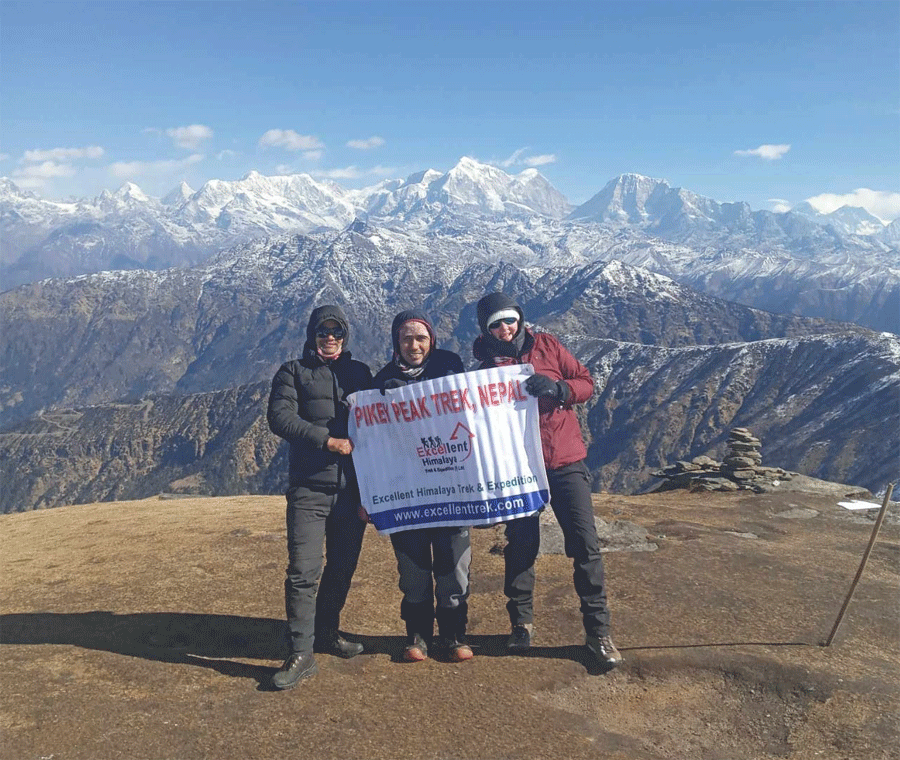
Sir Edmund Hillary, who knew a thing or two about Himalayan vantage points, reportedly called Pikey Peak home to the finest panorama in Nepal. On a clear morning, the summit delivers a 180-degree sweep spanning Everest (8,849 m), Lhotse, Makalu, Kanchenjunga, and Dhaulagiri. For a beginner trekker, standing at that viewpoint and understanding every peak by name is a formative experience — one worth every uphill step.
The Altitude Factor: Staying Safe at 4,000 m
Here is where we must be direct with you. Pikey Peak is called a “hill” in the way that Himalayan locals are prone to understatement. Four thousand metres is firmly within the altitude range where Acute Mountain Sickness (AMS) can affect even physically fit individuals. Altitude sickness does not discriminate by age, fitness level, or prior experience. What it does respond to is pacing and acclimatization time.
AMS Risk Threshold: Symptoms of altitude sickness — headache, nausea, dizziness, disturbed sleep — can begin appearing above 2,500 m and become a genuine health concern above 3,500 m. Pikey Peak’s summit at 4,065 m puts it squarely in this zone.
How Excellent Himalaya manages altitude safety
- Daily SpO₂ Checks
Oxygen saturation monitored every morning and evening with a pulse oximeter.
- Licensed, First-Aid Trained Guides
All guides hold Wilderness First Responder certification and AMS management training.
- Descent Protocol
If SpO₂ drops below safe threshold, our protocol is immediate descent. No exceptions.
- Acclimatization Pacing
Our itinerary builds in rest time and gradual altitude gain to reduce AMS risk.
Hydration is your most powerful personal tool against altitude sickness. Drink a minimum of 3–4 litres of water daily on the trek. Avoid alcohol entirely above 3,000 m. Your guide will brief you on symptoms to watch for and will never pressure you to push through genuine warning signs.
How Pikey Peak Compares: Trek Difficulty Table
| Factor | Pikey Peak | Poon Hill | Everest Base Camp |
| Max Altitude | 4,065 m | 3,210 m | 5,364 m |
| Duration | 5–7 days | 4–5 days | 12–14 days |
| Daily Walking | 5–7 hrs | 4–6 hrs | 6–8 hrs |
| Difficulty Rating | 3/5 Moderate | 2/5 Easy–Moderate | 4/5 Strenuous |
| Beginner Suitable? | Yes, with prep | Yes | With experience |
| AMS Risk Level | Moderate | Low | High |
| Crowd Levels | Uncrowded | Very Busy | Very Busy |
| Road Access to Start | Yes (paved, 2026) | Yes | Flight to Lukla |
The comparison tells a clear story: Pikey Peak sits between Poon Hill and Everest Base Camp in difficulty. It is meaningfully more challenging than Poon Hill — higher altitude, longer summit push — but accessible to a prepared beginner in a way that EBC is not. It also delivers something both those treks cannot: genuine solitude on the trail.
Your 4-Week Beginner Training Plan
Four weeks of consistent preparation will transform this trek from a gruelling ordeal into a deeply enjoyable challenge. You do not need a gym membership or specialist equipment — just commitment and progressively longer walks.
Week 1 — Foundation: Build aerobic base
- 3× 30-minute brisk walks or light jogs
- 1× longer walk of 60–90 minutes at a steady pace
- Focus on breathing rhythm; aim to maintain conversation
Week 2 — Introduce Load: Simulate trekking conditions
- 3× 40-minute walks wearing your daypack (5–7 kg loaded)
- 1× 2-hour hike, ideally with elevation change
- Incorporate stairs or incline treadmill sessions (2× per week)
Week 3 — Build Endurance: Longer consecutive days
- 2× back-to-back hiking days (3 hours Saturday + 2 hours Sunday)
- 1× stair-climbing session (30 minutes with pack)
- Increase pack weight to 6–8 kg; break in your trekking boots
Week 4 — Peak Week + Taper: Final test, then rest
- 1× full-day hike (5–6 hours with elevation and pack) — your dress rehearsal
- 2× easy 45-minute walks to stay loose
- Final 3 days: rest, focus on sleep, hydration, and gear checks
Frequently Asked Questions
Do I need crampons for Pikey Peak?
No, crampons are not required on the standard Pikey Peak route from Dhap. The trail does not cross permanent snowfields or glacial terrain. However, if you trek between December and February, light snow may be present near the summit, and microspikes can add confidence. What we strongly recommend regardless of season: a pair of quality trekking poles. On steep descents and uneven stone steps, poles reduce knee strain dramatically and improve balance on any icy morning patches.
Is there a road all the way to the top of Pikey Peak?
No. The newly paved jeep road (completed 2026) brings you to the trailhead village of Dhap, which sits at approximately 2,860 m. From Dhap, the trek begins on foot. There is no road to the summit at 4,065 m — and that is precisely the point. The walk through rhododendron forest, along ridgelines with progressive Himalayan views, is the experience itself. The road access simply removes a long, dusty drive and gets your legs onto trail sooner.
What is the best time of year to trek Pikey Peak as a beginner?
October–November (post-monsoon autumn) and March–April (spring) are the optimal windows. Skies are typically clear, trail conditions are excellent, and the rhododendrons in spring bloom add a spectacular floral backdrop. Avoid the monsoon months of June–August, when trails become slippery and leeches are abundant. Winter treks (December–February) are possible but cold and require additional layering.
Should I choose the 5-day or 7-day package?
For first-time high-altitude trekkers, we recommend the 7-day itinerary without hesitation. The extra days are not filler — they provide genuine acclimatization time, more relaxed daily walking hours, and opportunity to explore villages and viewpoints that the 5-day schedule rushes past. The 5-day package suits those with strong hiking experience who have some prior exposure to altitude above 3,000 m.
Ready to Take Your First Himalayan Steps?
Our guides have helped hundreds of first-time trekkers reach the Pikey Peak summit safely and memorably. Both our 5-day and 7-day departures are designed with beginners in mind — small groups, expert guides, daily health monitoring, and honest pacing.
Free Pikey Peak Trek consultation · No obligation · Response within 24 hours
✉ Contact us: [email protected]
Excellent Himalaya Trek & Expedition · Thamel, Kathmandu · Government-registered Trekking Agency· TAAN member
About the Author

Suman Shrestha
I am Suman Shrestha. I have dedicated my life to mastering the rhythms of the Nepal Himalayas and its culture. I am also a fully government-licensed trekking and tour guide. I've personally led hundreds of adventure groups across our country's most diverse and demanding landscapes and guided countless tour groups across every special interest imaginable. I know the ground reality of every ridge, every sacred monument, and every remote teahouse along the way, because I've earned that knowledge step by step, not from a brochure. My deep technical knowledge of Nepal’s diverse geography is matched only by my uncompromising commitment to safety. Beyond the physical path, I take a pride in being a bridge for all people by sharing the knowledge of the Himalayas, rich traditions and spiritual heritage of Nepal ensuring every journey is an authentic Experience. Let’s explore the heart of the Himalayas together. You can connect with me via WhatsApp at +9779851203181.